Schemas, assimilation and accommodation
Schema
A package of organised prior knowledge about a person, object or situation, built up from experience, that guides what you expect, notice and remember.
- A schema is a mental framework: an organised package of what you know about one kind of thing.
Assimilation
In Piaget's theory, fitting new information into an existing schema without changing that schema, so the new experience is understood using what you already know.
- Assimilation means fitting a new experience into a schema you already have.
Accommodation
In Piaget's theory, changing an existing schema or creating a new one because new information will not fit what you already know.
- Accommodation means changing a schema, or building a brand new one, because the old one no longer fits.
Equilibrium and the cycle of learning
Equilibration
The process of returning to a comfortable mental balance after new information has caused confusion, achieved by adapting your schemas until they fit the world again.
- Piaget said learning begins when you try to assimilate something new and your existing schemas cannot make sense of it.
- That mismatch creates disequilibrium, an uncomfortable feeling of mental imbalance.
- To escape the discomfort, you adjust the schema through accommodation.
- Once the updated schema fits the new information, balance returns and equilibration is reached.
The four stages of cognitive development
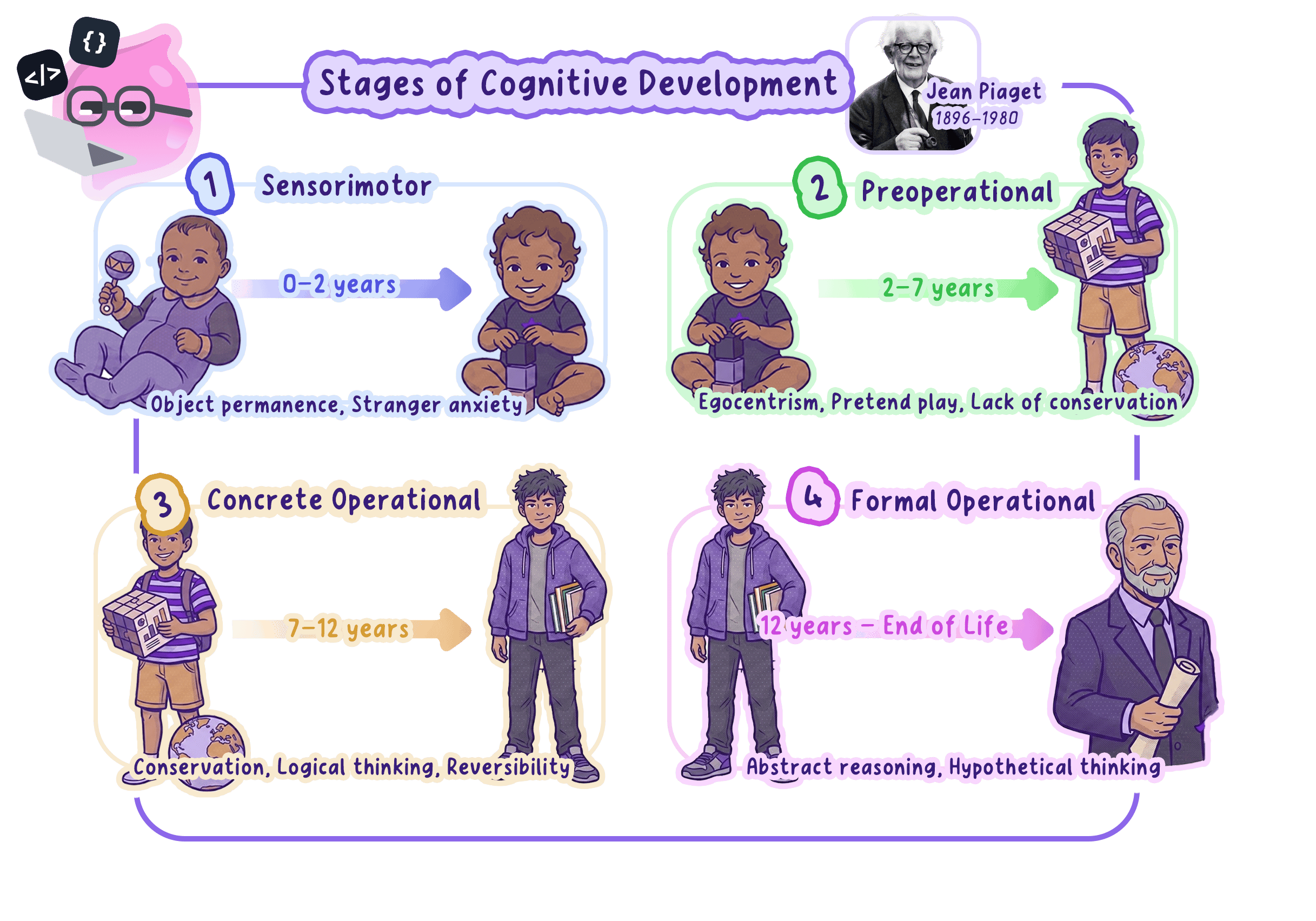
- The stages are invariant, which means each child goes through them in the same fixed order.
- The change between stages is qualitative, meaning the child's thinking changes in kind rather than merely in amount.
Object permanence
The understanding that an object still exists even when you can no longer see, hear or touch it. Piaget argued this develops towards the end of the sensorimotor stage.
- In the sensorimotor stage, from birth to about two, a baby explores the world through the senses and movement.
- The key achievement here is object permanence, knowing that a hidden object still exists.
- In the preoperational stage, from about two to seven, the child can use language and other symbols.
- Their thinking is still egocentric and they cannot yet conserve, so appearances easily fool them.
Conservation
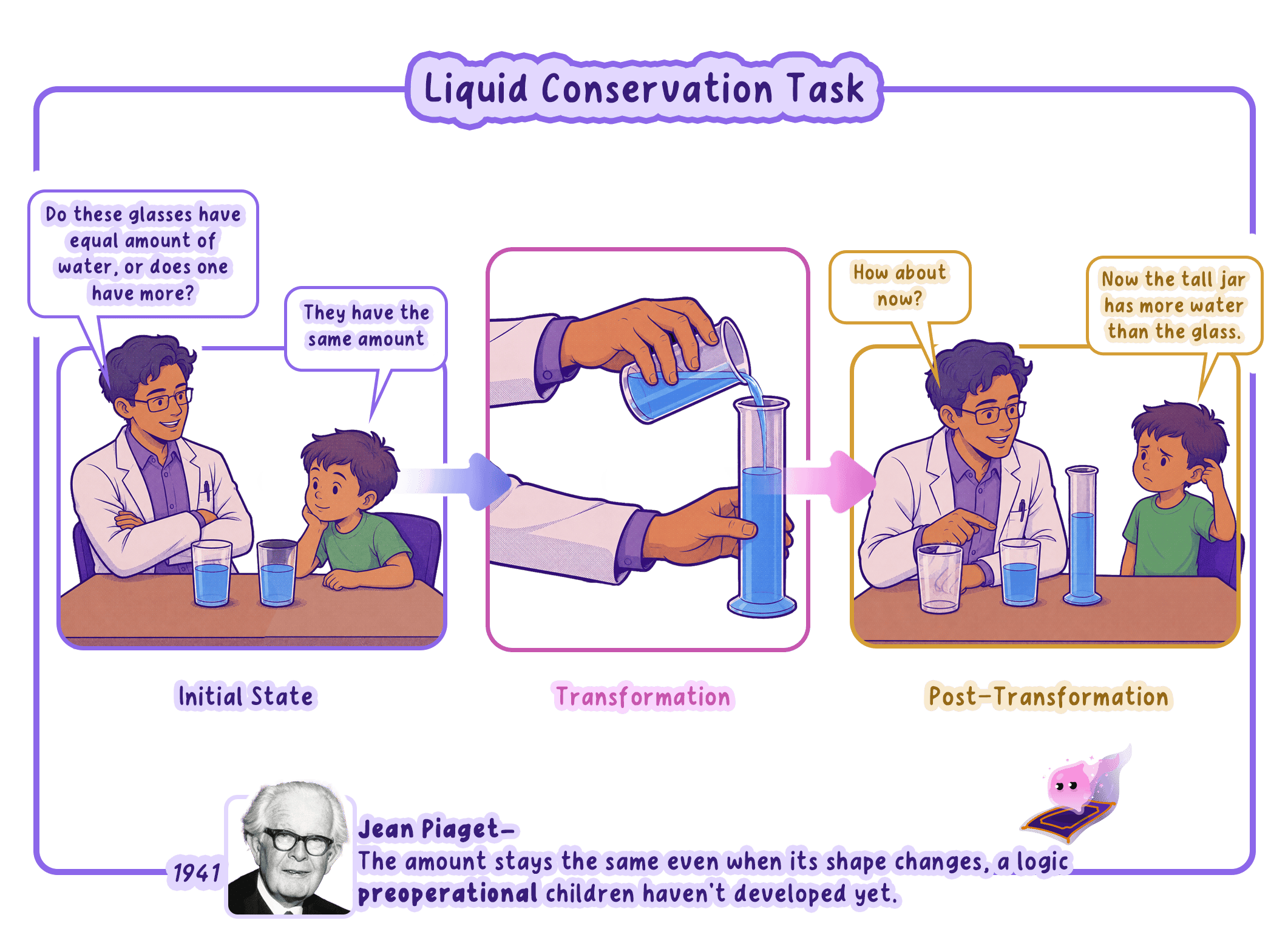
In Piaget's theory, understanding that the quantity of something stays the same even when its appearance changes, such as its shape or the way it is arranged.
- In the concrete operational stage, from about seven to eleven, the child can think logically about real, concrete things.
- They can now conserve, grasping that a quantity stays the same even when its appearance changes.
- In the formal operational stage, from about eleven onwards, thinking becomes abstract.
- The young person can now reason about hypothetical ideas and work problems through in their head.
How younger children think differently
- A preoperational child often treats objects as if they have feelings and intentions.
- This is called animism: believing that lifeless things are alive or can feel.
- A preoperational child assumes that other people share their own viewpoint.
- This is egocentrism: being unable to picture a scene from anyone else's position.
- Conservation is knowing that the amount of something stays the same when only its appearance changes.
- Decentration is the ability to focus on several features of a situation at the same time.
- Reversibility is understanding that an action can be undone in your mind to get back to the start.
Strengths
- Piaget changed how children are taught, because active discovery learning in primary classrooms comes directly from his idea that children build understanding for themselves.
- The order of the stages holds up across very different cultures, so the sequence he described looks genuinely universal rather than a feature of one sample.
Weaknesses
- Piaget underestimated what young children can do, because they conserve earlier when the task is made simpler and the change to the materials is not made deliberately.
- The stages are less fixed than he claimed, because a child can show a skill in one situation but not another, and adult guidance can move them on faster than he allowed for.
Turning this into marks
- Name the four stages with their rough age ranges and give the main feature of thinking at each, because that is what a description question credits.
- Use the words schema, assimilation, accommodation and equilibrium when you explain how a child learns, because the marks sit on those exact terms.
- The mark most often lost is on evaluation, where it is easy to list criticisms without crediting his influence, so weigh both sides and say which one wins.
- What is a schema, and what does each of assimilation and accommodation do to one?
- Why does disequilibrium push a child to learn?
- Name Piaget's four stages in order with their rough age ranges.
- In which stage can a child first conserve, and what does conservation mean?
- Give one criticism of Piaget's theory and one reason it is still valued.
