This article covers 3.1.2 Perception of the AQA GCSE Psychology specification.
Perception as the Brain's Best Guess
Definition
Constructivist theory
Gregory's idea that perception is built by the brain, which uses past experience to make sense of incomplete or ambiguous sensory input.
- Gregory claimed that perception is constructed by the brain rather than handed to it ready-made.
- Because the information reaching the eye is fragmentary, the brain has to go beyond it to make sense of a scene.
- This makes it a top-down theory, because perception is driven by stored knowledge, not by the input alone.
- It sits on the nurture side of the debate, because you learn to perceive through experience.
Key Idea
- The input is too poor to explain the rich, detailed world you actually perceive.
- So the brain fills the gaps with informed guesses drawn from past experience.
Why the Eye Is Not Enough
- The image landing on the retina is flat, incomplete and often blurred or partly hidden.
- A great deal of what you seem to see clearly is not actually present in that raw information.
- Gregory therefore argued that perception cannot simply mirror the input, so the brain must add to it.
Perceptual Hypotheses: Guess, Then Test
Definition
Perceptual hypothesis
An informed guess the brain makes about what is out there, based on past experience, which perception then tests against the incoming sensory input.
- The brain forms a perceptual hypothesis, an informed guess about what is really out there.
- It builds that guess from past experience of similar scenes and objects.
- It then checks the guess against the incoming input and revises it if the two do not match.
- Because the guess is usually right, perception feels instant and effortless even though work is going on underneath.
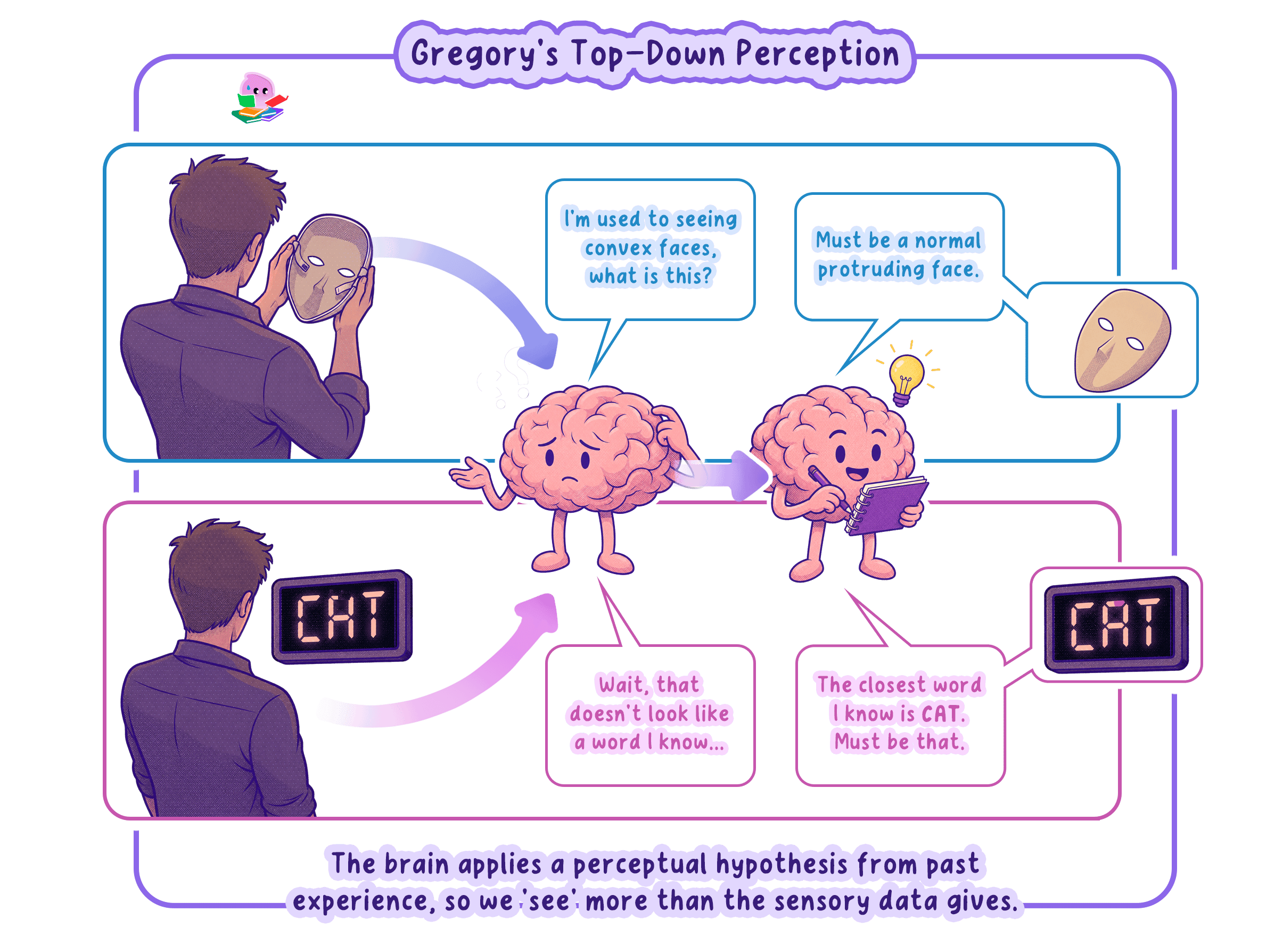
Example
- Glancing at a blurry departures board at Euston, you read your usual platform in a split second because you expect it, even before the letters are sharp.
- Your brain has tested a hypothesis built from past journeys against the fuzzy input and settled on the best fit.
Past Experience and Expectation
Definition
Top-down processing
Processing that starts with your prior knowledge, context and expectations, using them to interpret incomplete sensory input.
- Top-down processing means perception starts from your stored knowledge and expectations.
- The more experience you have of a type of scene, the better and faster your guesses become.
- Since perception depends on what you have learned, two people can build different perceptions from the very same input.
Note
- Constructivist means the brain builds perception up, rather than reading it straight off the input.
- This is the mirror image of Gibson, but keep your answer here focused on Gregory.
Why This Is a Nurture Theory
- Because perception is built from learned knowledge, it develops as your experience grows.
- A young child with little stored knowledge makes poorer guesses than an experienced adult.
- That reliance on learning places Gregory firmly on the nurture side of the debate.
Evaluating Gregory's Theory
- A strength is that it explains visual illusions well, because if perception is a best guess it can be tricked into a wrong one.
- It also fits the way expectation and context clearly shape what you see.
- A weakness is that it struggles to explain how you perceive so quickly and accurately in normal, clear conditions, which is Gibson's strength.
- It is also hard to see how you perceive a brand-new scene you have no past experience of, if perception is a guess built from experience.
Self review
- What does Gregory mean by saying perception is constructed?
- What is a perceptual hypothesis, and how is it tested?
- Why is Gregory's theory placed on the nurture side of the debate?
- Give one strength and one weakness of Gregory's theory.