This article covers 3.1.1 Memory of the AQA GCSE Psychology specification.
The Multi-Store Model: Information Flows Through Three Stores
- The multi-store model says memory is not one box but three separate stores that information passes through in order.
- The three stores are the sensory register, short-term memory and long-term memory.
- Atkinson and Shiffrin first set this out, and you should be able to draw and label the flow between the stores.
Key Idea
- Information moves one way: from the senses, to short-term memory, to long-term memory.
- It only moves on if you act on it, by paying attention and then rehearsing.
The Three Stores: Snapshot, Workspace and Archive
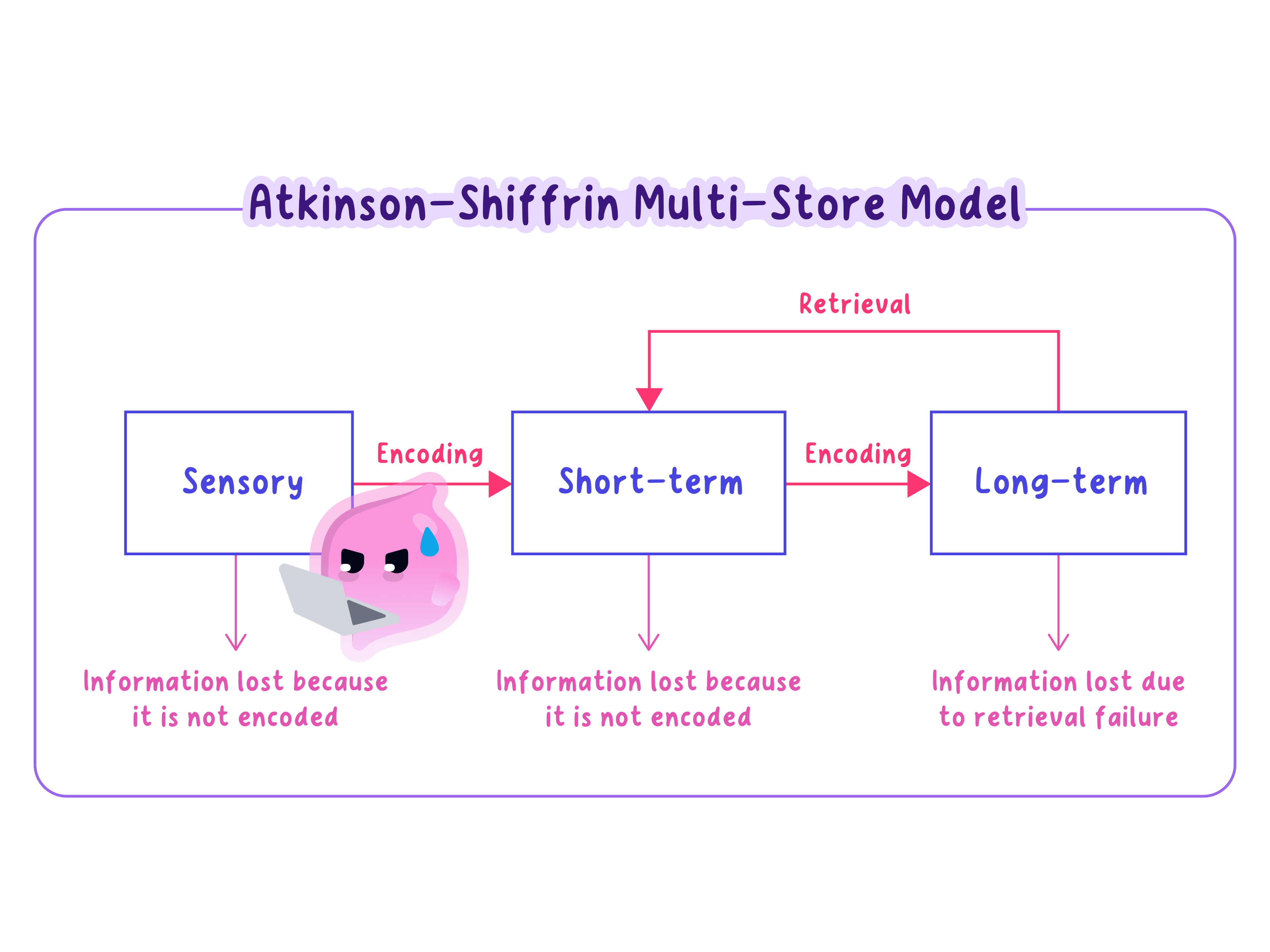
- Sensory register: a split-second snapshot of everything your senses take in, which fades almost at once unless you attend to it.
- Short-term memory: your mental workspace, holding only a few items for a short time while you use them.
- Long-term memory: your vast, lasting archive, holding information from hours to a lifetime.
- The exact coding, capacity and duration of each store is covered when you study the features of the memory stores.
Example
- A friend reads out their number in the corridor, and you hold it just long enough to tap it into your phone, then it is gone.
- It reached short-term memory, but because you never rehearsed it, it never made it into long-term memory.
Moving Information On: Attention and Rehearsal
Definition
Rehearsal
Repeating or actively thinking about information so that it passes from short-term memory into long-term memory.
- Paying attention pulls a snapshot from the sensory register into short-term memory.
- Rehearsing it, by repeating it or thinking it over, moves it from short-term into long-term memory.
- Information in the sensory register that you ignore simply decays, and information in short-term memory can be pushed out by new incoming items.
- Think of your phone: the camera briefly sees everything, the screen shows what you are using now, and only what you deliberately save is kept.
Common Mistake
- Do not assume everything you see or hear gets remembered, because almost all of it fades from the sensory register in an instant.
- Nothing reaches long-term memory on its own, so if you do not rehearse it, it will not stick.
Evaluating the Multi-Store Model
- A strength is the evidence that short-term and long-term memory are genuinely separate stores.
- People with amnesia can lose long-term memory while their short-term memory still works, which fits the model's separate stores.
- A further strength is that it was the first clear model of memory, and it shaped decades of later research.
- A weakness is that it is too simple, because it treats short-term and long-term memory as single stores when there is evidence each has separate parts.
- Another weakness is that rehearsal alone cannot explain everything, because you can remember a dramatic event without ever rehearsing it.
What Examiners Want to See
- Sketch the model first, three stores with arrows running from one to the next, because a clear labelled diagram picks up marks on its own.
- Then talk through the flow, naming attention between the sensory register and short-term memory, and rehearsal between short-term and long-term memory.
- If the question says evaluate, pair a strength such as the amnesia evidence with a weakness such as the model being too simple.
Self review
- What are the three stores of the multi-store model, in order?
- What moves information from the sensory register into short-term memory?
- What moves information from short-term into long-term memory?
- Give one strength and one weakness of the multi-store model.