Wave speed depends on the substance
Definition
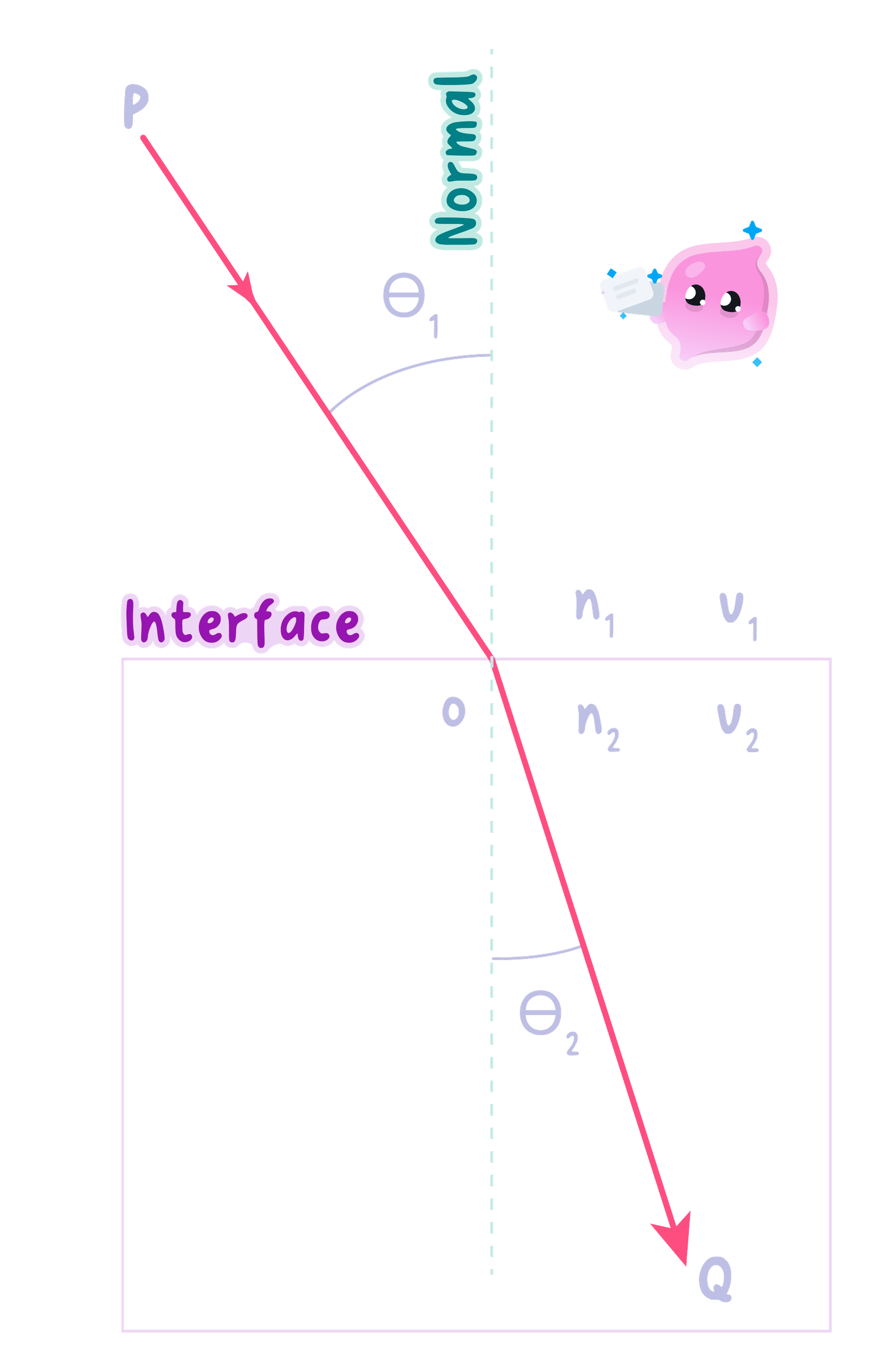
Interface
The boundary where two different materials meet.
- All electromagnetic waves travel through a vacuum at the same speed, about 3.0×10⁸ m/s3.0 \times 10^{8}\ \text{m/s}3.0×108 m/s.
- When an electromagnetic wave enters a transparent substance, it travels more slowly than it does in a vacuum.
- The amount by which the wave slows down depends on the substance, so light has a different speed in air, water and glass.
- Light in air travels at almost exactly its speed in a vacuum, so the two speeds are treated as equal in most calculations.
- Light in water travels at about 2.25×10⁸ m/s2.25 \times 10^{8}\ \text{m/s}2.25×108 m/s, which is roughly three quarters of its speed in air.
- Light in glass travels at about 2.0×10⁸ m/s2.0 \times 10^{8}\ \text{m/s}2.0×108 m/s, which is roughly two thirds of its speed in air.
- A material in which light travels more slowly is often called optically denser, which is not the same as having a greater mass per cubic metre.
- Other electromagnetic waves, such as microwaves, infrared and ultraviolet, also change speed when they pass from one substance into another.
- A change of speed at an interface between two substances is the cause of several effects you can see every day, and the most important of these is refraction.
How a change of speed causes refraction
Definition
Refraction
The change in direction of a wave as it crosses an interface at an angle, caused by a change in its speed.
Definition
Wavefront
A line joining points on a wave that are at the same stage of their oscillation, such as a line along one crest.
Definition
Normal
An imaginary line drawn at right angles to a surface at the point where a ray meets it.
- A beam of light can be pictured as a series of wavefronts, which are lines joining the crests of the wave drawn at right angles to its direction of travel.
- Picture a set of straight wavefronts travelling through air and meeting the flat surface of a glass block at an angle.
- One end of each wavefront reaches the glass first and slows down, while the other end is still moving at the faster speed in air.
- For a short time the end inside the glass covers less distance than the end in the air, so each wavefront swings round.
- When the whole wavefront is inside the glass, it is travelling in a new direction, and this change of direction is refraction.
- The wavefronts inside the glass are also closer together than those in the air, because each one moves forward a smaller distance in the same time.
- A wave that slows down as it crosses an interface bends towards the normal, so its angle of refraction is smaller than its angle of incidence.
- A wave that speeds up as it crosses an interface bends away from the normal, so its angle of refraction is larger than its angle of incidence.
- A wave that meets an interface along the normal changes speed but not direction, because every part of each wavefront reaches the new substance at the same moment.
- Refraction depends entirely on the change of speed, so if two substances carried light at exactly the same speed a ray would cross the interface without bending.
Analogy
A shopping trolley rolling onto grass
- Imagine pushing a shopping trolley at an angle off a smooth car park and onto rough grass.
- One front wheel reaches the grass first and slows down, while the other front wheel is still rolling quickly on the tarmac.
- The slow side holds back and the fast side keeps going, so the trolley swings round and carries on in a new direction.
- If you push the trolley straight onto the grass, both wheels slow at the same moment and it keeps going in a straight line, just like a ray travelling along the normal.
Frequency stays the same but wavelength changes
Definition
Frequency
The number of complete waves passing a point each second.
Definition
Wavelength
The distance from one point on a wave to the equivalent point on the next wave.
- The frequency of a wave is set by the source that produces it, so it does not change when the wave passes into a new substance.
- Every wavefront that arrives at an interface must leave it on the other side, so the number of waves passing each second is the same in both substances.
- Wave speed, frequency and wavelength are linked by the wave equation v=fλv = f\lambdav=fλ.
- If the frequency stays constant while the speed falls, the wavelength must fall by the same proportion.
- Light passing from air into glass keeps the same frequency, but both its speed and its wavelength fall to about two thirds of their values in air.
- Light passing from glass back into air speeds up again, so its wavelength returns to its original value.
Example
Wavelength of red light in glass
- Red light has a frequency of 4.5×10¹⁴ Hz4.5 \times 10^{14}\ \text{Hz}4.5×10¹⁴ Hz and travels through glass at 2.0×10⁸ m/s2.0 \times 10^{8}\ \text{m/s}2.0×108 m/s.
- Rearrange the wave equation to make wavelength the subject.
- Substitute the speed in glass and the frequency.
- In air the same light travels at 3.0×10⁸ m/s3.0 \times 10^{8}\ \text{m/s}3.0×108 m/s, so the same method gives a wavelength of 6.7×10⁻⁷ m6.7 \times 10^{-7}\ \text{m}6.7×10⁻⁷ m.
- The frequency is identical in both materials, so the shorter wavelength in glass comes entirely from the lower speed.
Why white light splits into colours
Definition
Dispersion
The splitting of white light into a spectrum of colours because each wavelength is refracted through a slightly different angle.
- In a vacuum every colour of light travels at the same speed, but in glass or water the speed depends slightly on the wavelength.
- Violet light, which has the shortest wavelength in the visible spectrum, travels a little more slowly in glass than red light, which has the longest.
- Violet light therefore has the largest change of speed at each surface of a prism and is refracted through the largest angle.
- Red light has the smallest change of speed and is refracted the least, so the colours spread out into a spectrum.
- This spreading of white light into its colours is called dispersion, and the same process inside raindrops produces a rainbow.
Everyday effects of changing wave speed
- A straw standing in a glass of water looks bent or broken where it enters the water.
- Light from the underwater part of the straw speeds up as it passes from water into air, so it bends away from the normal at the water surface.
- Your brain assumes that light reaching your eye has travelled in a straight line, so it traces the ray straight back and places the underwater part of the straw higher than it really is.
- A swimming pool looks shallower than it is for the same reason, because light from the bottom bends away from the normal as it leaves the water.
- Seen from directly above, the bottom of a pool appears to be only about three quarters of its real depth.
- A fish in a pond is deeper than it appears, so a kingfisher diving for it must aim below the position where it sees the fish.
- In each case nothing has moved or bent, because only the path of the light has changed as its speed changed at the water surface.
Example
Why a coin in a mug seems to rise
- A coin sits at the bottom of an empty mug, just hidden from your view by the rim.
- Water is poured slowly into the mug without moving the coin.
- Light from the coin now travels from water into air at the surface and speeds up as it crosses the interface.
- The ray bends away from the normal, so it now passes over the rim and reaches your eye.
- Your brain traces this ray back in a straight line, so the coin appears higher in the mug and comes into view.
Common Mistake
- Do not say that light bends because it is attracted to or pulled by the glass, because the change of direction is caused by the change of speed.
- Do not say that the frequency changes at an interface, because only the speed and the wavelength change.
- Do not say that a ray travelling along the normal is refracted, because it changes speed without changing direction.
- Do not link the slowing of light to a material being heavier, because optical density and mass per cubic metre are different properties.
Exam technique
Explaining refraction effects
- Name both substances and say in which one the wave travels faster.
- State that the speed changes at the interface first, then state that this causes the change of direction, because examiners look for cause before effect.
- Say whether the ray bends towards or away from the normal, and link this to the wave slowing down or speeding up.
- For an apparent position, such as a bent straw or a shallow pool, finish by saying that your brain assumes light travels in straight lines.
- In a calculation, write v=fλv = f\lambdav=fλ from memory and keep the frequency unchanged when the wave moves into a new material.
Self review
- State the speed of all electromagnetic waves in a vacuum.
- Explain, using the idea of wavefronts, why light changes direction when it enters glass at an angle.
- State which way a ray bends when it speeds up as it crosses an interface.
- Explain why the wavelength of light decreases when it enters water while its frequency stays the same.
- Explain why a swimming pool looks shallower than it really is.
