The particle model
What you'll learn
- How particles — tiny pieces of matter — are used to explain solids, liquids and gases.
- What an atom — a very small building block of matter — is like, including its nucleus and electrons.
- Why the scientific model — a simplified picture used to explain evidence — of the atom changed over time.
- How to use density, meaning mass per unit volume, in calculations.
Starting point: what counts as a “particle”?
In physics, matter means any substance that has mass and takes up space. A particle is a tiny piece of matter. The tricky part is that the word “particle” can mean different-sized things depending on the question.
Particles, atoms and molecules
- An atom is a tiny building block of matter.
- A molecule is two or more atoms joined together.
- A compound is a substance made from atoms of two or more different elements joined together.
- A subatomic particle is a particle found inside an atom, such as a proton, neutron or electron.
Mixing up particle levels
Do not use atom, molecule and subatomic particle as if they mean the same thing. An electron is inside an atom; a molecule is made from atoms.
Inside the atom
An atom has a tiny central nucleus. The nucleus is positively charged overall and contains almost all the atom’s mass. Around the nucleus are negatively charged electrons.
The radius of something is the distance from its centre to its edge. In an atom, the nuclear radius is much smaller than the radius of the whole atom, so most of the atom is empty space.
Subatomic particles
The three main subatomic particles are protons and neutrons in the nucleus, and electrons around the nucleus. Protons are positive, neutrons are neutral, and electrons are negative.
| Subatomic particle | Relative charge | Relative mass | Position in the atom |
|---|---|---|---|
| Proton | +1 | 1 | Nucleus |
| Neutron | 0 | 1 | Nucleus |
| Electron | -1 | very small | Around the nucleus |
A neutral atom has equal numbers of protons and electrons, so the positive and negative charges balance.
Mass and charge in the atom
Almost all the mass of an atom is in the tiny nucleus, but the negative electrons take up the outer region of the atom.
Atom diagrams are not to scale
Diagrams usually draw the nucleus far too large so you can see it. In a real atom, the nucleus is tiny compared with the whole atom.
The size of atoms
You need to recall the typical order of magnitude of atoms and small molecules. An order of magnitude is the nearest power of ten.
Atoms and small molecules are typically about:
1×10⁻¹⁰ m1 \times 10^{-10}\ \text{m}1×10⁻¹⁰ mThat is incredibly small: about one ten-billionth of a metre.
How the atomic model changed
Scientific models change when new evidence shows that an old model no longer explains observations well enough.
The GCSE story focuses on three important models:
- Thomson model — after electrons were discovered, Thomson suggested the atom was a positive sphere with negative electrons embedded in it. This is often called the “plum pudding” model.
- Rutherford model — Rutherford, using results from Geiger and Marsden’s gold foil experiment, concluded that the atom has a tiny positive nucleus and is mostly empty space.
- Bohr model — Bohr suggested electrons are arranged in fixed shells around the nucleus. This helped explain line spectra, which are patterns of specific colours of light emitted by atoms.
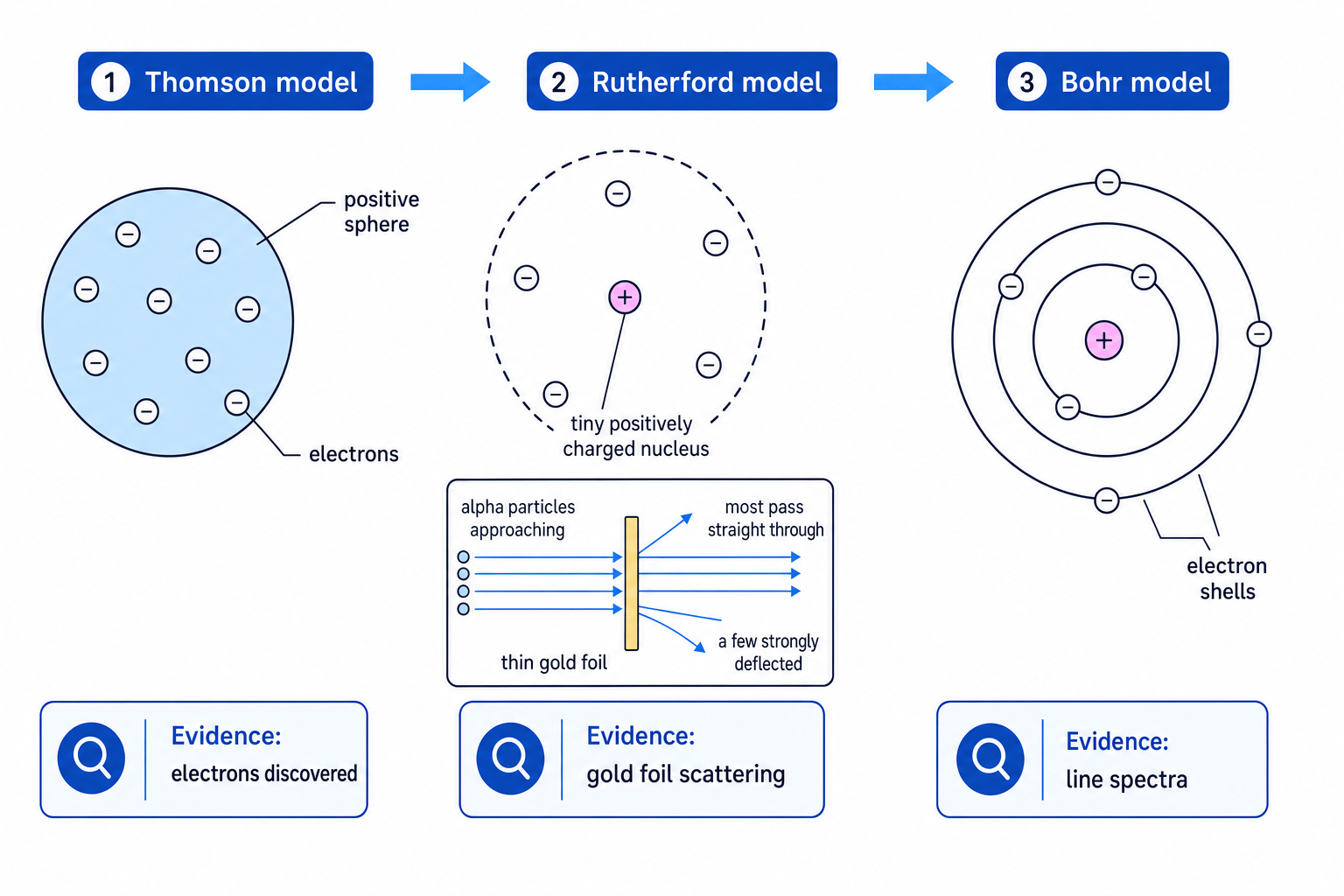
Interpreting gold foil scattering
In the gold foil experiment, positively charged alpha particles were fired at thin gold foil. Most passed straight through, but a few were strongly deflected.
- Because most alpha particles passed straight through, the atom must be mostly empty space rather than filled with positive material all the way across.
- Because a few alpha particles were strongly deflected, there must be a very small region of concentrated positive charge that repels the positive alpha particles.
- Therefore, the evidence supports Rutherford’s nuclear model: a tiny positive nucleus with electrons around it, not Thomson’s positive sphere model.
Density
Mass is the amount of matter in an object, measured in kilograms (kg). Volume is the space an object takes up, measured in cubic metres (m³). Density tells you how much mass is packed into each unit of volume.
Density
Density is mass per unit volume. A material with a high density has a lot of mass packed into a small volume.
You need to recall and apply this equation:
ρ=mV\rho = \frac{m}{V}ρ=Vmwhere ρ\rhoρ is density in kg/m³, mmm is mass in kg, and VVV is volume in m³.
You can rearrange it to find mass or volume:
m=ρVV=mρ\begin{aligned} m &= \rho V\\ V &= \frac{m}{\rho} \end{aligned}mV=ρV=ρmUnits matter
For density calculations, use kilograms for mass and cubic metres for volume if the answer needs to be in kg/m³.
Measuring volume
For a regular cuboid, calculate volume using length, width and height.
For an irregular solid, you can use water displacement: the volume of water displaced is equal to the volume of the object. This links to PAG P1 practical work on measuring density.
A common exam trap is converting cubic centimetres to cubic metres. Since 1 m is 100 cm:
1 m3=100 cm×100 cm×100 cm=1 000 000 cm3\begin{aligned} 1\ \text{m}^3 &= 100\ \text{cm} \times 100\ \text{cm} \times 100\ \text{cm}\\ &= 1\,000\,000\ \text{cm}^3 \end{aligned}1 m3=100 cm×100 cm×100 cm=1000000 cm3So to convert from cm³ to m³, divide by one million.
Converting volume like length
Do not convert cm³ to m³ by dividing by 100. That only works for centimetres to metres. For cubic centimetres to cubic metres, divide by 1,000,000.
Calculating density from mass and volume
A metal block has mass 540 g and volume 200 cm³. Calculate its density in kg/m³.
- Convert the mass into kilograms: 540 g is 0.540 kg.
- Convert the volume into cubic metres: 200 cm3=200×10−6 m3=2.00×10⁻⁴ m3200\ \text{cm}^3 = 200 \times 10^{-6}\ \text{m}^3 = 2.00 \times 10^{-4}\ \text{m}^3200 cm3=200×10−6 m3=2.00×10⁻⁴ m3.
- Substitute into the density equation:
Density and states of matter
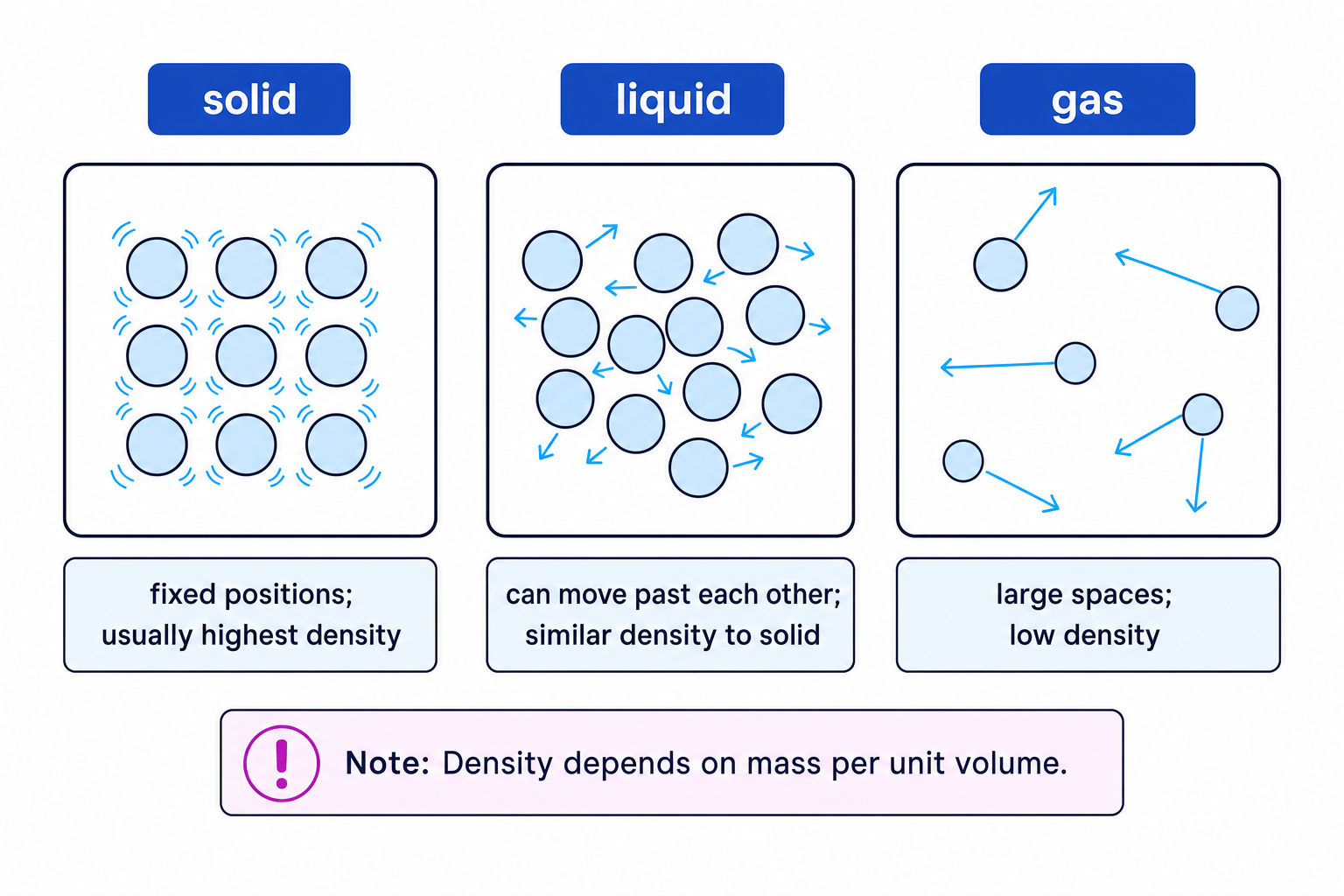
The state of matter means whether a substance is a solid, liquid or gas. The density depends on how closely packed the particles are.
Solids
In a solid, particles are close together in a regular arrangement. They vibrate about fixed positions. Solids usually have high density because there is little empty space between particles.
Liquids
In a liquid, particles are still close together, but arranged irregularly. They can move past each other. Liquids often have densities similar to solids because the particles are still close together.
Gases
In a gas, particles are far apart and move quickly in different directions. Gases have much lower density because the same mass of particles takes up a much larger volume.
Ice is an exception
Most solids are denser than their liquids, but water is unusual: ice is less dense than liquid water, which is why ice floats.
When mass is conserved
Conservation of mass means the total mass stays the same if no matter enters or leaves. For example, if a sealed gas syringe is compressed, the gas particles are still all there, so the mass is unchanged.
If the volume changes while mass stays the same, the density changes.
Same mass, different volume
If mass is conserved, decreasing the volume increases the density. Increasing the volume decreases the density.
Using mass conservation when volume changes
A sealed syringe contains 0.018 kg of gas. The gas is compressed from a volume of 0.012 m³ to 0.0040 m³. Calculate the new density and compare it with the original density.
- Since the syringe is sealed, no gas escapes, so the mass remains 0.018 kg. Use the final volume to find the final density.
- Calculate the final density:
- Compare with the original density:
The density has tripled because the volume became one third as large while the mass stayed the same.
In the exam
- For atomic model questions, link each model to the evidence that caused the change: electrons for Thomson, gold foil scattering for Rutherford, shells for Bohr.
- For density calculations, check units before substituting into ρ=mV\rho = \frac{m}{V}ρ=Vm, especially grams and cm³.
- For state-change or compression questions, ask whether mass is conserved. If no matter enters or leaves, mass stays the same and density changes because volume changes.
Check yourself
- Why did the gold foil experiment suggest that atoms are mostly empty space?
- What is the typical order of magnitude of the size of an atom?
- A sealed container of gas is compressed. What happens to its mass, volume and density?