Parts of an atom
Definition
Atom
The smallest particle of an element, made of a positively charged nucleus surrounded by negatively charged electrons.
Definition
Nucleus
The tiny, positively charged centre of an atom that contains almost all of its mass.
Definition
Subatomic particle
A particle smaller than an atom, such as a proton, a neutron or an electron.
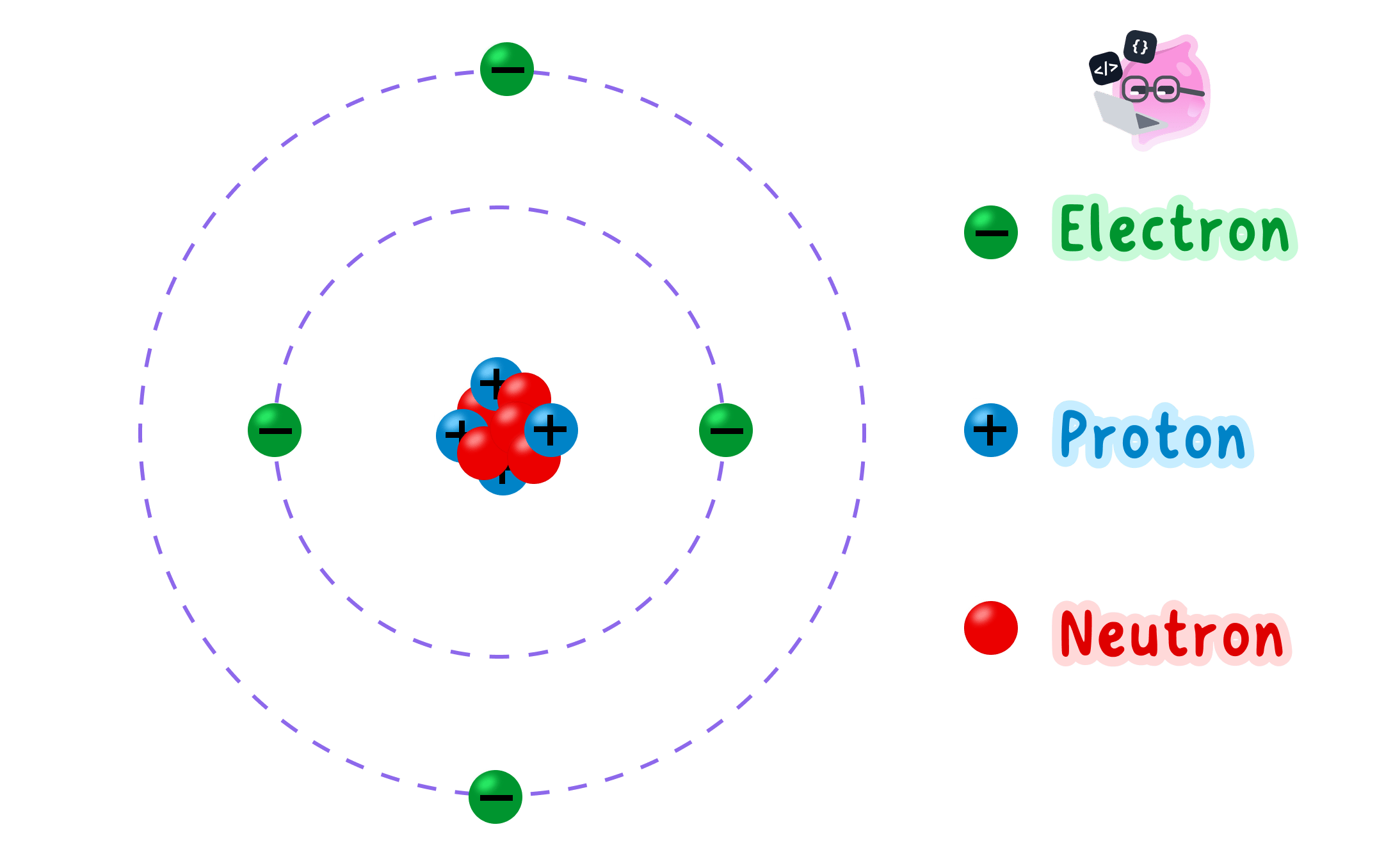
- Every atom has two regions: a central nucleus and the space around it in which the electrons move.
- The nucleus carries a positive charge and sits at the very centre of the atom.
- The nucleus is made of protons, which are positively charged, and neutrons, which have no charge.
- The electrons carry a negative charge and move around the nucleus in energy levels, also called shells.
- Protons, neutrons and electrons are all subatomic particles, because each is much smaller than the atom it belongs to.
- The positive nucleus and the negative electrons attract each other, and this electrostatic attraction holds the electrons in the atom.
- An atom has no overall charge, because the total negative charge of its electrons is equal in size to the total positive charge of its nucleus.
Size of the nucleus
- The radius of the nucleus is much smaller than the radius of the whole atom.
- The radius of a nucleus is less than about one ten-thousandth of the radius of the atom it sits in.
- Almost all of the volume of an atom is therefore the region around the nucleus, where the electrons move through what is otherwise empty space.
- If an atom were scaled up to the size of a football stadium, the nucleus would be about the size of a pea on the centre spot.
- Diagrams of atoms, including the one above, are not drawn to scale, because a nucleus drawn at its true relative size would be too small to see.
Example
Scaling a model atom
- A student makes a scale model of an atom using a bead of diameter 1 mm1\ \text{mm}1 mm as the nucleus.
- The atom's radius is at least 10 00010\,00010000 times the nuclear radius, so the diameters are in the same ratio.
- Diameter of the model atom =10 000×1 mm=10 000 mm= 10\,000 \times 1\ \text{mm} = 10\,000\ \text{mm}=10000×1 mm=10000 mm.
- Converting to metres gives 10 000 mm÷1000=10 m10\,000\ \text{mm} \div 1000 = 10\ \text{m}10000 mm÷1000=10 m.
- The model atom would need to be at least 10 m10\ \text{m}10 m across, larger than a classroom, to hold a nucleus the size of a bead.
Where the mass is
- Almost all of the mass of an atom is found in its nucleus.
- Protons and neutrons have very similar masses, and each is roughly 200020002000 times heavier than an electron.
- The electrons therefore add only a tiny amount to the mass of an atom, typically much less than 0.1%0.1\%0.1% of the total.
- This produces a striking contrast: the nucleus takes up almost none of the volume but holds almost all of the mass.
- The electron region is the opposite, taking up almost all of the volume but holding very little of the mass.
- Because so much mass is packed into such a small volume, the material of a nucleus is extremely dense.
Exam technique
Describing atomic structure
- A full description of an atom needs three separate ideas: the charges and positions of the parts, the relative size of the nucleus and the location of the mass.
- Write much smaller when comparing the nuclear radius with the atomic radius, because a bare smaller does not show the scale of the difference.
- Write almost all of the mass is in the nucleus, because the electrons do have a small mass.
- Name the charges with their signs, positive for the nucleus and negative for the electrons, rather than calling the parts simply charged.
Common Mistake
- Do not write that the nucleus contains all of the mass of an atom, because the electrons contribute a very small amount.
- Do not judge the size of a nucleus from a diagram, because diagrams exaggerate it so that it can be seen.
- Do not describe the electrons as sitting inside the nucleus, because they move in energy levels well outside it.
- Do not confuse the atom with its parts, because the nucleus and the electrons are pieces of one atom and are not atoms themselves.
Self review
- State the charge of the nucleus and the charge of an electron.
- Name the two types of particle found in the nucleus.
- Explain why an atom has no overall charge.
- Compare the radius of the nucleus with the radius of the atom.
- State where almost all of the mass of an atom is found and explain why the electrons add so little.
