Light from distant galaxies
Definition
Galaxy
A huge system of billions of stars, together with gas and dust, held together by gravity.
Definition
Absorption spectrum
A continuous spectrum of colours crossed by dark lines at the particular wavelengths absorbed by the elements in a gas that the light has passed through.
- The Sun is one of more than a hundred billion stars in our own galaxy, the Milky Way, and the universe contains billions of other galaxies.
- Other galaxies are far too distant to visit, so almost everything astronomers know about them comes from studying the light they send to Earth.
- As light from a star passes through the cooler gases in its outer layers, each element in those gases absorbs light of certain exact wavelengths.
- When this light is spread out into a spectrum, it shows a continuous band of colours crossed by narrow dark lines at the absorbed wavelengths.
- This pattern is called an absorption spectrum, and each dark line is a spectral line.
- Every element produces its own fixed pattern of spectral lines, so the pattern works like a fingerprint that identifies the element.
- Scientists measure the wavelengths of these lines for each element in a laboratory on Earth, where the source is not moving away from the measuring equipment.
- Comparing the laboratory pattern with the pattern in light from a galaxy shows whether the lines have shifted, and by how much.
What red-shift is
Definition
Red-shift
The increase in the observed wavelength, and decrease in the observed frequency, of light from a source that is moving away from the observer.
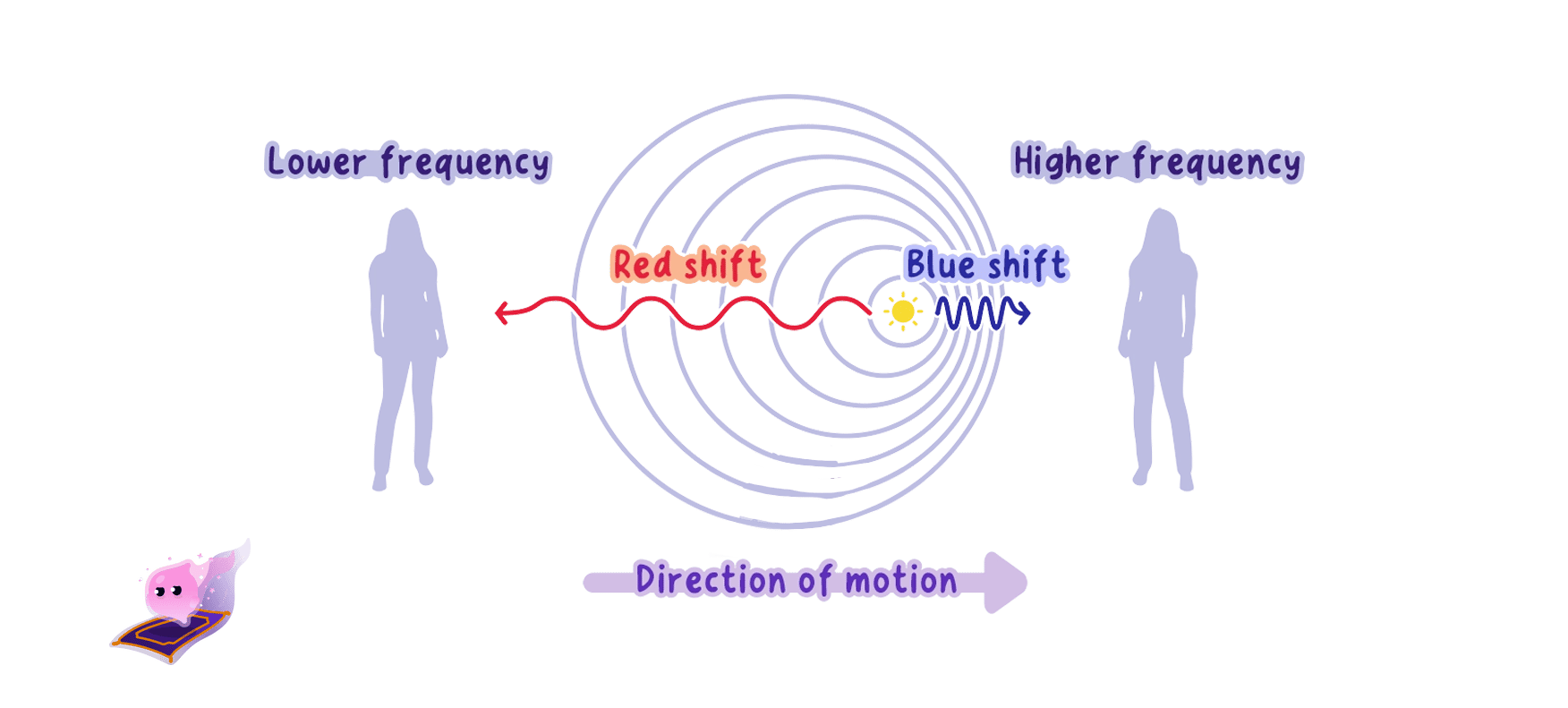
- In the light from almost every distant galaxy, the whole pattern of dark lines is found at longer wavelengths than in the laboratory.
- The red end of the visible spectrum has the longest wavelengths, so a shift to longer wavelengths is a shift towards the red end, which is why it is called red-shift.
- Light always travels at the same speed, so when the wavelength λ\lambdaλ increases in v=fλv = f\lambdav=fλ, the frequency fff must decrease.
- Red-shift therefore means that the observed light has a longer wavelength and a lower frequency than the light measured from the same element in the laboratory.
- The lines keep the same spacing pattern, which is how astronomers know that the same elements are present and that the whole pattern has moved together.
- Light from a source moving towards the observer is shifted the other way, to shorter wavelengths and higher frequencies, which is called blue-shift.
Why receding galaxies show red-shift
Definition
Doppler effect
The change in the observed wavelength and frequency of a wave when its source moves towards or away from the observer.
- Red-shift happens because the galaxy is receding, which means it is moving away from the observer.
- A source of waves sends out one crest after another at regular intervals.
- If the source is moving away, it has travelled a little further away by the time it sends out each new crest.
- Each crest therefore has slightly further to travel than the crest before it, so the crests arrive more spread out.
- Crests that are further apart give a longer observed wavelength, and fewer crests arriving each second give a lower observed frequency.
- The light leaving the galaxy is unchanged, and only the wavelength and frequency measured by the observer are different.
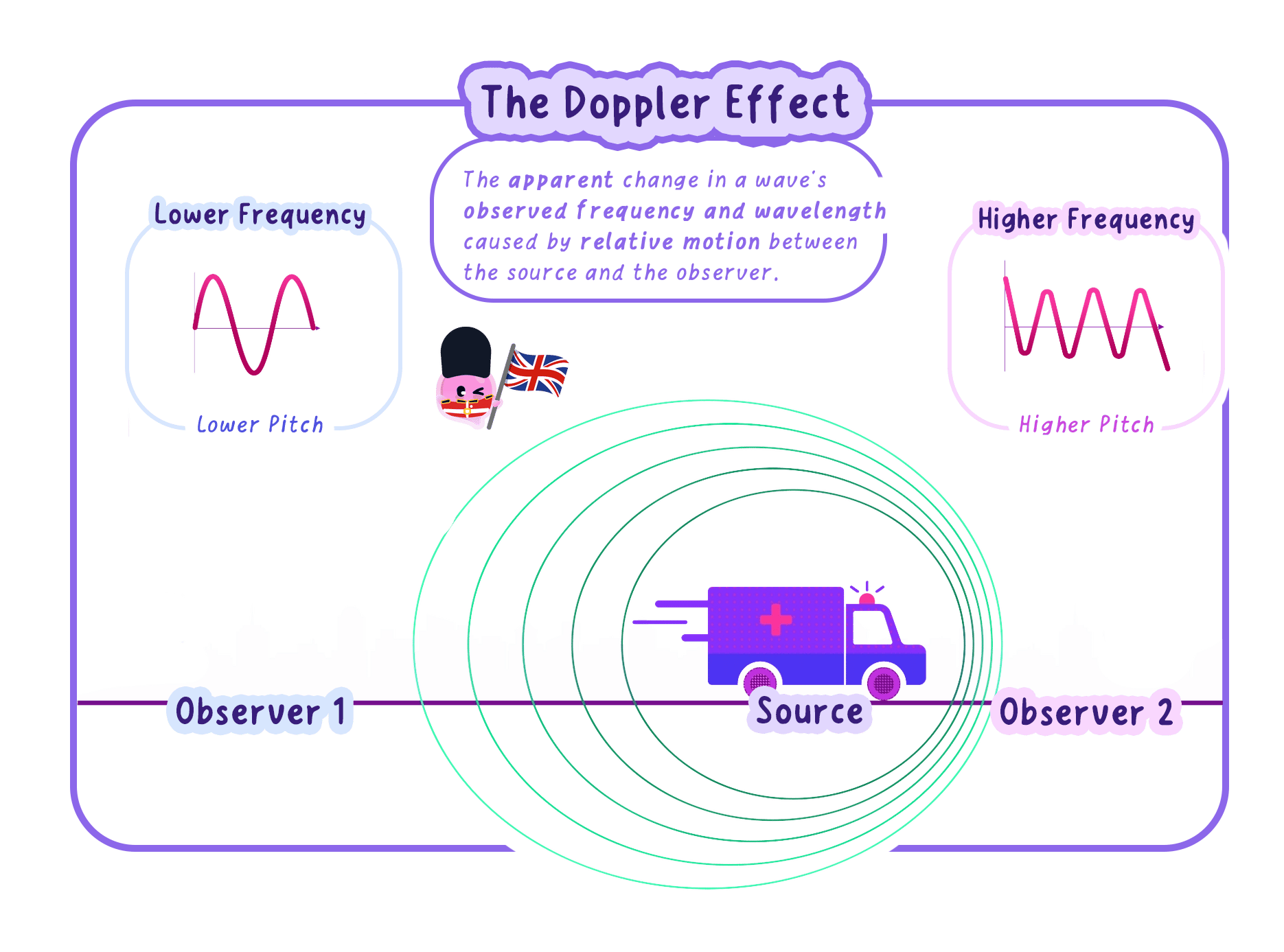
- This change in the observed wavelength and frequency caused by the motion of the source is the Doppler effect.
- You can hear the same effect with sound when an ambulance siren drops to a lower pitch as the ambulance drives away from you, because the sound waves reaching you have been stretched to a lower frequency.
- Light travels so fast that the shift only becomes large for sources moving at enormous speeds, such as galaxies moving away at thousands of kilometres per second.
Bigger shifts mean faster recession
Definition
Recession speed
The speed at which a galaxy is moving away from the observer.
- The size of the red-shift depends on how fast the galaxy is moving away.
- A galaxy receding slowly shows a small shift, and a galaxy receding quickly shows a large shift.
- Measuring how far the lines have moved therefore lets astronomers compare the recession speeds of different galaxies.
- Astronomers also estimate how far away each galaxy is using other methods, such as measuring how bright certain types of star in it appear.
- Plotting recession speed against distance for many galaxies shows that the more distant a galaxy is, the faster it is moving away.
- This link between distance and speed was first reported by the astronomer Edwin Hubble in 1929.
Evidence for an expanding universe
Definition
Expanding universe
The model in which the distances between galaxies increase over time because space itself is stretching.
- Galaxies in every direction show red-shift, so they are moving away from us whichever way we look.
- Astronomers in any other galaxy would see the same pattern, because every distant galaxy is moving away from every other galaxy.
- This pattern is explained if space itself is stretching, carrying the galaxies further apart from each other.
- When space stretches evenly, the gap between two nearby galaxies grows slowly, while the gap between two distant galaxies grows much faster because there is more stretching space between them.
- A useful model is a balloon with dots drawn on it, where blowing up the balloon moves every dot away from every other dot and the furthest dots separate fastest.
- This matches the observed link between distance and recession speed, so the change in speed with distance is evidence that the universe is expanding.
- A few very close galaxies, such as the Andromeda Galaxy, show blue-shift instead, because gravity is pulling them towards the Milky Way more strongly than the expansion carries them away.
Example
Comparing red-shifts from two galaxies
- In a laboratory, one dark line in the spectrum of hydrogen is measured at a wavelength of 656 nm656\ \text{nm}656 nm.
- In light from galaxy A the same line appears at 663 nm663\ \text{nm}663 nm, and in light from galaxy B it appears at 689 nm689\ \text{nm}689 nm.
- Both lines are at longer wavelengths than the laboratory value, so both galaxies show red-shift and both are moving away from Earth.
- The shift for each galaxy is the observed wavelength minus the laboratory wavelength.
- Galaxy B has the larger red-shift, so it has the greater recession speed.
- More distant galaxies recede faster, so galaxy B is most likely the more distant of the two.
Common Mistake
- Do not say that a red-shifted galaxy looks red, because red-shift is a shift of its spectral lines to longer wavelengths, not a change in the colour you would see.
- Do not say that red-shift means the light slows down, because the light still reaches us at the speed of light.
- Do not say that red-shift shows a galaxy is getting closer, because light from an approaching source is shifted to shorter wavelengths.
- Do not write that the wavelength decreases or the frequency increases for a receding galaxy, because both change the other way.
Exam technique
Explaining red-shift
- State the change to both the wavelength and the frequency, because each one can earn a mark.
- Link the observation to the motion directly, for example "the wavelength has increased, so the galaxy is moving away".
- For evidence of expansion, include the distance link, which is that more distant galaxies have larger red-shifts and so are moving away faster.
- Write that the observations are "evidence for an expanding universe" rather than saying that they prove it.
- This topic is qualitative, so you will not be asked to calculate a recession speed from a red-shift.
Self review
- What is red-shift?
- How do the observed wavelength and frequency of light change when its source moves away from the observer?
- Why do astronomers compare the spectral lines from a galaxy with lines measured in a laboratory?
- How does the size of a galaxy's red-shift change as its distance from Earth increases?
- Explain why the link between distance and recession speed is evidence that the universe is expanding.
