Absorbing and emitting radiation
Definition
Equilibrium temperature
The constant temperature an object reaches when it absorbs radiation at the same rate as it emits radiation.
- Every object absorbs some of the radiation that falls on it and emits radiation of its own at the same time.
- Absorbing radiation transfers energy to the object's thermal store, and emitting radiation transfers energy away from it.
- The temperature of the object depends on the balance between the rate at which it absorbs radiation and the rate at which it emits radiation.
- If an object absorbs radiation faster than it emits it, its thermal store increases and its temperature rises.
- If an object emits radiation faster than it absorbs it, its thermal store decreases and its temperature falls.
- If the two rates are equal, there is no overall change in the thermal store, so the temperature stays constant.
- A constant temperature does not mean that radiation has stopped, because the object is still absorbing and emitting, only at equal rates.
Reaching equilibrium
- A hotter object emits radiation at a greater rate, so the rate of emission depends on the object's temperature.
- This makes the balance self-correcting.
- When an object absorbs more than it emits, it warms up, so it emits faster and faster until emission catches up with absorption.
- When an object emits more than it absorbs, it cools down, so it emits more and more slowly until emission falls to match absorption.
- Either way, the object settles at an equilibrium temperature where the two rates are equal.
- Anything that changes the rate of absorption or the rate of emission upsets the balance, so the object warms or cools until it reaches a new equilibrium temperature.
Everyday examples
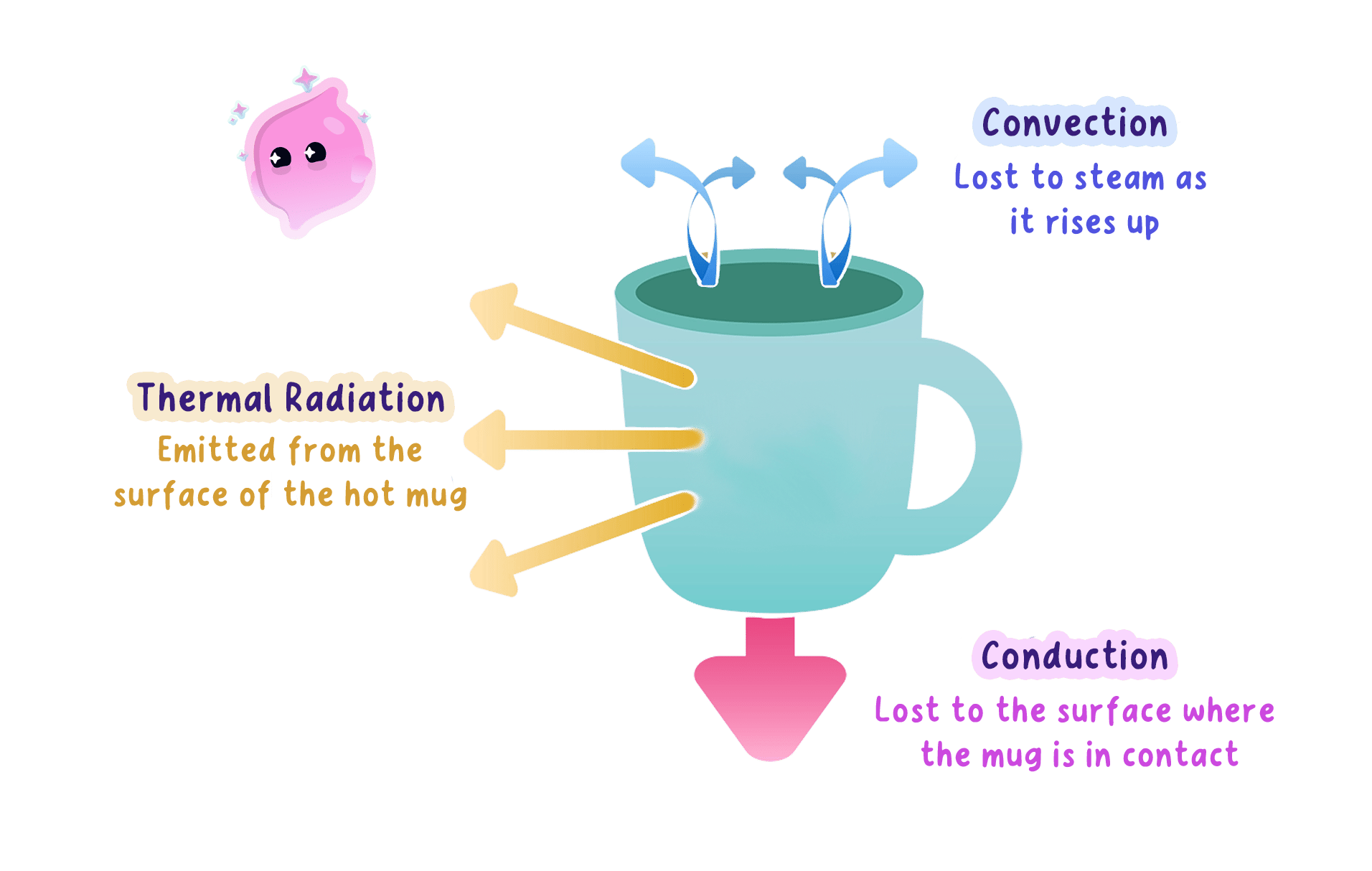
- A mug of hot tea in a room emits radiation faster than it absorbs radiation from the cooler walls around it, so it cools.
- As the tea cools, it emits radiation more slowly, so it cools more and more slowly until it reaches room temperature and the two rates balance.
- A car parked in sunshine absorbs radiation from the Sun faster than it emits radiation, so its temperature rises until its own emission balances the sunlight it absorbs.
- A dark-coloured car reaches a higher equilibrium temperature than a white car in the same sunshine, because a dark, matt surface absorbs a greater share of the radiation falling on it.
- On a clear night, the ground emits infrared into space but receives little radiation back, so it cools quickly and frost can form.
- On a cloudy night, the clouds absorb infrared from the ground and emit some of it back down, so the ground cools more slowly.
Radiation reaching the Earth
Definition
Albedo
The fraction of the radiation falling on a surface that is reflected rather than absorbed.
- The Earth is heated by radiation from the Sun, which arrives mainly as visible light, together with some infrared and ultraviolet.
- The amount of radiation reaching each square metre of the Earth depends on how much radiation the Sun emits and on the distance between the Earth and the Sun.
- About 30%30\%30% of the incoming sunlight is reflected straight back into space by clouds, ice, snow and the atmosphere, so it never heats the Earth.
- Light-coloured surfaces such as ice and snow have a high albedo, so they reflect most of the radiation falling on them.
- Dark surfaces such as oceans and forests have a low albedo, so they absorb most of the radiation falling on them.
- When ice melts, the darker land or sea underneath is uncovered, so more radiation is absorbed and the Earth warms further.
- The atmosphere also changes the Sun's radiation as it passes through, because ozone high in the atmosphere absorbs much of the harmful ultraviolet, while most visible light passes through to the surface.
Radiation leaving the Earth
Definition
Greenhouse gas
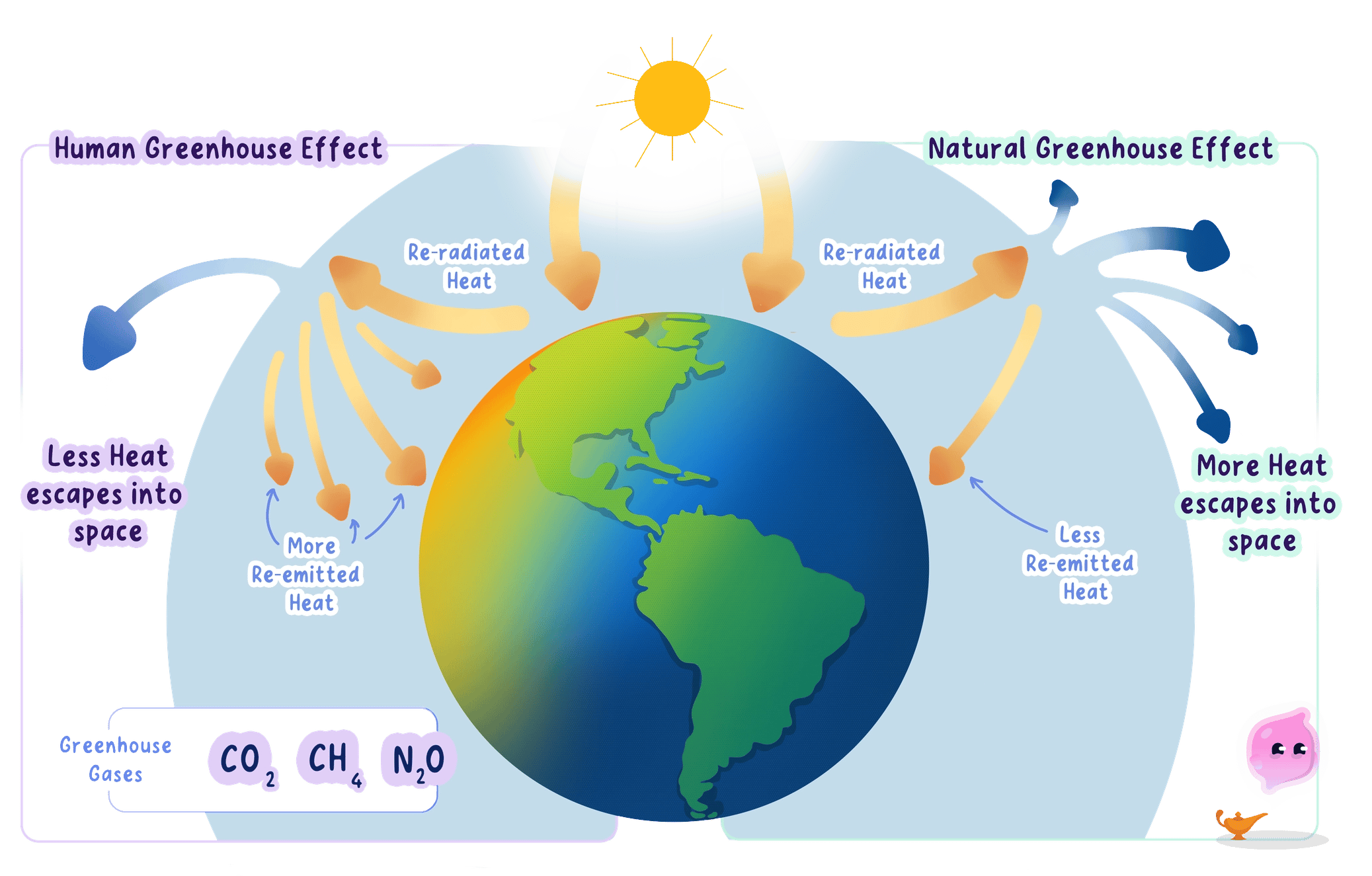
A gas in the atmosphere, such as carbon dioxide, methane or water vapour, that absorbs infrared radiation and then emits it in all directions.
Definition
Greenhouse effect
The warming of the Earth's surface caused by greenhouse gases absorbing infrared radiation emitted by the surface and emitting some of it back towards the ground.
- The Earth's surface is much cooler than the Sun, so it emits radiation at much longer wavelengths, mainly in the infrared.
- Visible light from the Sun passes through the atmosphere easily, but some gases in the atmosphere absorb the longer-wavelength infrared emitted by the surface.
- These greenhouse gases, such as carbon dioxide, methane and water vapour, then emit infrared in all directions, including back down towards the surface.
- Less energy escapes into space each second than would escape without these gases, so the surface warms until it emits enough radiation to restore the balance.
- This greenhouse effect keeps the Earth's average surface temperature at about 15 ∘C15\ ^\circ\text{C}15 ∘C, rather than the −18 ∘C-18\ ^\circ\text{C}−18 ∘C it would be without any greenhouse gases.
- Burning fossil fuels has increased the amount of carbon dioxide in the atmosphere, so less infrared escapes and the Earth now absorbs slightly more energy each second than it emits.
- As a result, the Earth's average temperature is rising towards a new, higher equilibrium temperature.
Example
A bench in the sunshine
- A black metal bench in the shade is at the same temperature as the air around it, so it absorbs and emits radiation at equal rates.
- When the Sun comes out, the bench absorbs far more radiation each second than it emits, so its thermal store increases and its temperature rises.
- As the bench warms, it emits radiation at a greater rate, so its temperature rises more and more slowly.
- At around 45 ∘C45\ ^\circ\text{C}45 ∘C, for example, its rate of emission has risen to equal its rate of absorption, so the bench stays at this equilibrium temperature.
- When a cloud covers the Sun, absorption falls below emission, so the bench cools towards a new, lower equilibrium temperature.
Practical
Investigating radiation balance with painted cans
- Aim: to show that a surface heated by radiation warms up until it reaches an equilibrium temperature, and to compare how the colour of a surface affects that temperature.
- Apparatus: two identical metal cans, one painted matt black and one painted shiny silver, two lids with a hole in each, two thermometers or temperature probes connected to a data logger, a measuring cylinder, water at room temperature, a 100 W100\ \text{W}100 W filament lamp on a stand, a ruler and a stopclock.
- Method:
- Use the measuring cylinder to pour 200 cm3200\ \text{cm}^3200 cm3 of room-temperature water into each can.
- Fit the lids and push a thermometer through each hole so that the bulb sits in the middle of the water.
- Place the cans side by side with each one exactly 20 cm20\ \text{cm}20 cm from the lamp, checked with the ruler, so that both receive the same radiation.
- Record the starting temperature of each can, then switch on the lamp and start the stopclock.
- Record both temperatures every minute for at least 30 minutes, until the readings stop rising.
- Keep the room free from draughts, and do not move the cans or the lamp during the run.
- Variables: the independent variable is the colour of the surface, the dependent variable is the temperature of the water, and the control variables are the volume of water, the distance from the lamp, the lamp and the starting temperature.
- Results: both temperatures rise quickly at first and then more slowly, until each levels off at a steady value, which is that can's equilibrium temperature.
- Explanation: at first each can absorbs radiation faster than it emits it, but as it warms its emission increases until the two rates are equal and its temperature stops rising.
- Comparison: the matt black can reaches the higher equilibrium temperature because it absorbs a greater share of the lamp's radiation.
- Graph: plot temperature against time for both cans on the same axes, and draw a smooth curve of best fit for each one.
- Watch out: the lamp also warms the air around it, so some energy reaches the cans by convection, and keeping the distance fixed for both cans makes the comparison fair.
- Safety: the lamp becomes very hot, so do not touch the bulb or its shade, and let it cool before moving it.
Common Mistake
- Do not say that an object at a constant temperature has stopped absorbing or emitting radiation, because both are still happening at equal rates.
- Do not say that greenhouse gases trap the Sun's visible light, because they absorb the infrared emitted by the Earth's surface.
- Do not describe heat as being stored in the Earth, because heating is an energy transfer and the energy goes into the thermal store.
Exam technique
Writing a radiation balance answer
- Compare the two rates, for example "the rate of absorption is greater than the rate of emission", rather than only saying that the object absorbs radiation.
- Link the imbalance to the thermal store and then to the temperature, one step at a time.
- Include the idea that emission increases as temperature rises, because this explains why the temperature levels off.
- For the Earth, name specific factors, such as reflection by ice and clouds, the distance from the Sun, ozone absorbing ultraviolet, and greenhouse gases absorbing infrared.
Self review
- What happens to the temperature of an object that absorbs radiation faster than it emits it?
- Why does a warming object eventually stop getting hotter?
- Why does a dark surface reach a higher equilibrium temperature than a white surface in sunlight?
- How does the atmosphere affect the Sun's radiation as it passes through?
- Explain how greenhouse gases affect the balance between the radiation the Earth absorbs and the radiation it emits.
