Energy on a common scale
Joule
The unit of energy, equal to the work done when a force of one newton moves an object one metre along the line of action of the force.
- Every energy store and every energy transfer is measured in the same unit, the joule, J\text{J}J.
- This common scale lets you compare transfers by completely different pathways, such as the work done by a crane and the energy needed to boil a kettle.
- Larger amounts are written in kilojoules, where 1 kJ=1000 J1\ \text{kJ} = 1000\ \text{J}1 kJ=1000 J, and megajoules, where 1 MJ=1 000 000 J1\ \text{MJ} = 1\,000\,000\ \text{J}1 MJ=1000000 J.
- Calculating each change in joules shows the redistribution of energy in a system, which means how much energy went to each store.
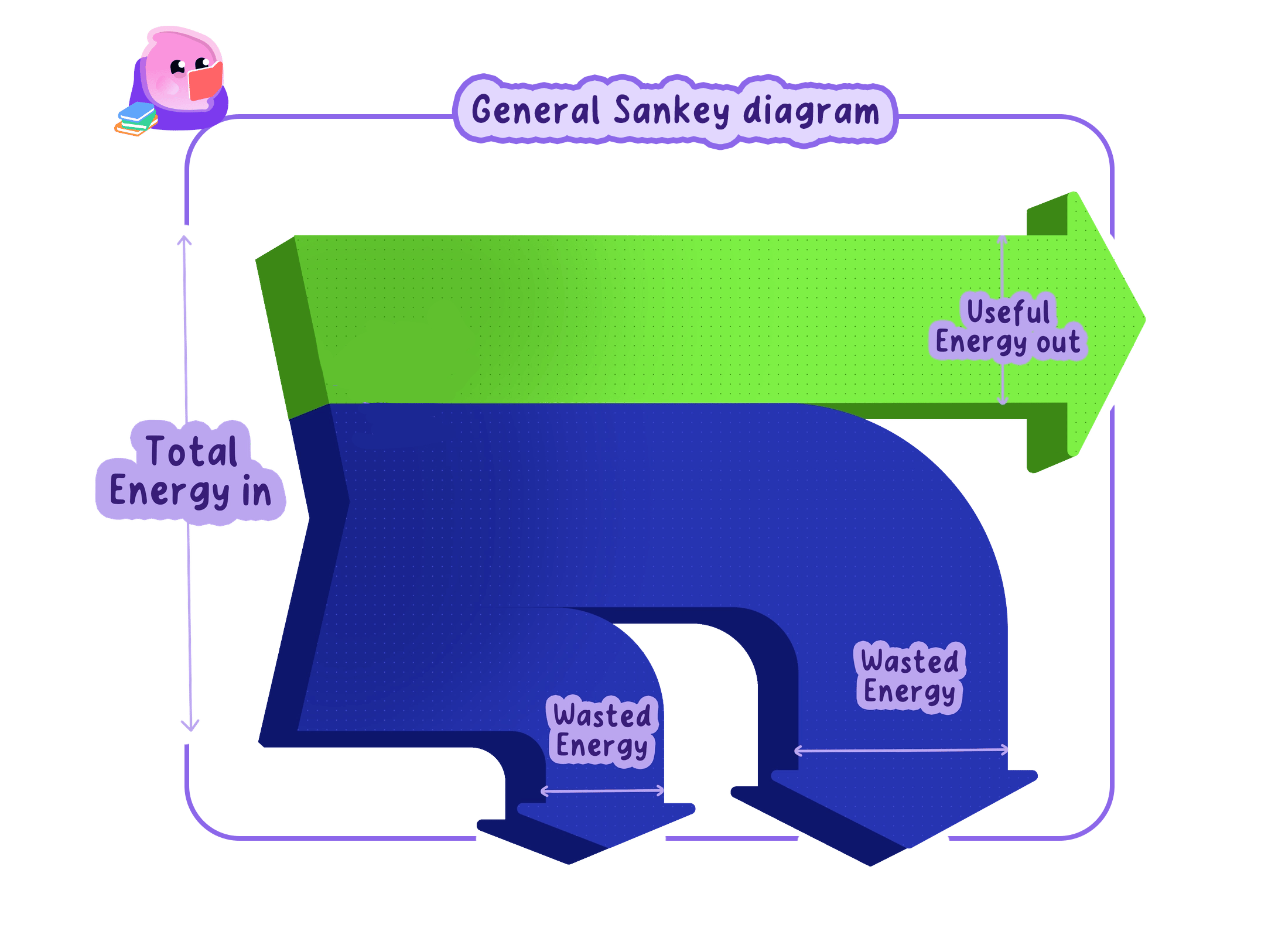
- Because energy is conserved, the energy put into a system always equals the total of all the energy that ends up in its other stores.
- This can be written as total input energy=useful output energy+energy transferred to other stores\text{total input energy} = \text{useful output energy} + \text{energy transferred to other stores}total input energy=useful output energy+energy transferred to other stores.
- In a Sankey diagram like this one, the width of each arrow is proportional to the energy it carries, so the arrows leaving always add up to the arrow entering.
Mechanical work
Work done
The energy transferred when a force moves an object through a distance in the direction of the force.
- Energy transferred by a force is calculated using W=F sW = F\,sW=Fs, which you must learn.
- In this equation WWW is the work done in joules, J\text{J}J, FFF is the force in newtons, N\text{N}N, and sss is the distance moved along the line of action of the force in metres, m\text{m}m.
- Rearranging gives F=WsF = \dfrac{W}{s}F=sW to find a force, and s=WFs = \dfrac{W}{F}s=FW to find a distance.
- One newton-metre, N m\text{N m}N m, of work is exactly the same amount of energy as one joule, so 1 N m=1 J1\ \text{N m} = 1\ \text{J}1 N m=1 J.
- The distance must be measured along the direction of the force, so when an object is lifted the distance is the vertical height gained, not the length of a slope.
- When a force lifts an object at a steady speed, the force equals the object's weight, so the work done equals the weight multiplied by the height gained.
- When friction brings a moving object to rest, the work done against friction equals the energy transferred from its kinetic store to thermal stores.
Work done by a braking force
- A cyclist brakes, and the brakes provide a constant friction force of 150 N150\ \text{N}150 N while the bicycle travels 12 m12\ \text{m}12 m.
- The kinetic store of the cyclist and bicycle decreases by 1800 J1800\ \text{J}1800 J, and the thermal stores of the brakes and the surroundings increase by the same amount.
Electrical work
Kilowatt-hour
The energy transferred by a device with a power of one kilowatt when it runs for one hour.
- The energy transferred when charge flows through a component is calculated using E=Q VE = Q\,VE=QV, which you must learn.
- Here EEE is the energy transferred in joules, J\text{J}J, QQQ is the charge that flows in coulombs, C\text{C}C, and VVV is the potential difference in volts, V\text{V}V.
- The energy transferred by an appliance in a given time is calculated using E=P tE = P\,tE=Pt, which you must also learn.
- Here PPP is the power in watts, W\text{W}W, and ttt is the time in seconds, s\text{s}s, so a 60 W60\ \text{W}60 W lamp transfers 60 J60\ \text{J}60 J every second.
- Convert minutes and hours into seconds before using E=P tE = P\,tE=Pt to find an answer in joules, using 1 min=60 s1\ \text{min} = 60\ \text{s}1 min=60 s and 1 h=3600 s1\ \text{h} = 3600\ \text{s}1 h=3600 s.
- Homes use a much larger unit of energy, the kilowatt-hour, kW h\text{kW h}kW h, because household appliances transfer millions of joules every day.
- To find the energy in kilowatt-hours, use the same equation E=P tE = P\,tE=Pt with the power in kilowatts and the time in hours.
- One kilowatt-hour equals 1000 W×3600 s=3 600 000 J1000\ \text{W} \times 3600\ \text{s} = 3\,600\,000\ \text{J}1000 W×3600 s=3600000 J, which is 3.6 MJ3.6\ \text{MJ}3.6 MJ.
- An electricity meter records the energy supplied to a home in kilowatt-hours, and each kilowatt-hour is called a unit on the electricity bill.
- The cost of running an appliance is the energy it uses in kilowatt-hours multiplied by the price of one unit.
Energy used by a fan heater
- A 2.5 kW2.5\ \text{kW}2.5 kW fan heater runs for 3.03.03.0 hours, and electricity costs 28p28\text{p}28p per unit.
- In joules, the same energy is 7.5×3 600 000=2.7×10⁷ J7.5 \times 3\,600\,000 = 2.7 \times 10^{7}\ \text{J}7.5×3600000=2.7×10⁷ J.
Energy transferred by a flow of charge
- A charge of 40 C40\ \text{C}40 C flows through a lamp connected to a 12 V12\ \text{V}12 V supply.
- The supply transfers 480 J480\ \text{J}480 J to the lamp, which increases the thermal store of the filament before light and infrared radiation carry the energy to the surroundings.
Thermal processes
Specific heat capacity
The energy needed to raise the temperature of 1 kg1\ \text{kg}1 kg of a substance by 1 ∘C1\ ^\circ\text{C}1 ∘C.
Specific latent heat
The energy needed to change the state of 1 kg1\ \text{kg}1 kg of a substance without any change in its temperature.
- The energy needed to change the temperature of a material without changing its state is calculated using ΔE=m c Δθ\Delta E = m\,c\,\Delta\thetaΔE=mcΔθ.
- Here ΔE\Delta EΔE is the change in thermal energy in joules, mmm is the mass in kilograms, ccc is the specific heat capacity in J/kg ∘C\text{J/kg}\ ^\circ\text{C}J/kg ∘C and Δθ\Delta\thetaΔθ is the temperature change in ∘C^\circ\text{C}∘C.
- This is a select and apply equation, so you do not need to memorise it, but you must recognise when to use it.
- The temperature change is always the final temperature minus the starting temperature, never a single thermometer reading.
- The energy needed to change the state of a material without changing its temperature is calculated using E=m LE = m\,LE=mL, which is also a select and apply equation.
- Here LLL is the specific latent heat in J/kg\text{J/kg}J/kg, the energy needed to change the state of 1 kg1\ \text{kg}1 kg of the substance.
- When an electric heater warms a substance, you can set the energy supplied, E=P tE = P\,tE=Pt, equal to m c Δθm\,c\,\Delta\thetamcΔθ if you assume that no energy escapes to the surroundings.
Heating water in a kettle
- A 2000 W2000\ \text{W}2000 W kettle heats 1.5 kg1.5\ \text{kg}1.5 kg of water from 20 ∘C20\ ^\circ\text{C}20 ∘C to 100 ∘C100\ ^\circ\text{C}100 ∘C, and the specific heat capacity of water is 4200 J/kg ∘C4200\ \text{J/kg}\ ^\circ\text{C}4200 J/kg ∘C.
- The temperature change is 100−20=80 ∘C100 - 20 = 80\ ^\circ\text{C}100−20=80 ∘C.
- The kettle supplies 2000 J2000\ \text{J}2000 J every second, so the shortest possible heating time comes from rearranging E=P tE = P\,tE=Pt.
- The real kettle takes longer than 252 s252\ \text{s}252 s, because some energy also increases the thermal stores of the kettle body and the kitchen air.
Showing the redistribution
Joulemeter
A meter connected between a power supply and an appliance that records the energy transferred to the appliance in joules.
- A full redistribution calculation finds the energy input, then each output in joules, and then checks that the outputs add up to the input.
- Any energy not accounted for by the useful output must have gone to other stores, usually the thermal stores of the device and its surroundings.
- Subtracting the useful output from the input gives the energy transferred to these other stores.
- The electrical energy supplied to a device can be measured directly with a joulemeter, which counts the joules passing from the supply to the device.
A motor lifting a crate
- A motor is supplied with 1500 J1500\ \text{J}1500 J while it lifts a crate of weight 200 N200\ \text{N}200 N through a height of 5.0 m5.0\ \text{m}5.0 m.
- This 1000 J1000\ \text{J}1000 J goes into the gravitational potential energy store of the crate.
- The 1500 J1500\ \text{J}1500 J input has been redistributed as 1000 J1000\ \text{J}1000 J in the crate's gravitational potential energy store and 500 J500\ \text{J}500 J in the thermal stores of the motor, the cable and the surrounding air.
Measuring the energy used by appliances
- Aim: to use a joulemeter to measure and compare the energy transferred to different low-voltage electrical appliances in the same time.
- Apparatus: joulemeter, low-voltage power supply set to 12 V12\ \text{V}12 V, connecting leads, a 12 V12\ \text{V}12 V filament lamp in a holder, a 12 V12\ \text{V}12 V immersion heater in a beaker of water, a small 12 V12\ \text{V}12 V motor clamped to the bench, a stopwatch, and an ammeter and voltmeter for a cross-check.
- Variables: the appliance is the independent variable, the energy recorded by the joulemeter is the dependent variable, and the supply potential difference and the running time are controlled.
- Method:
- Connect the power supply to the input terminals of the joulemeter and the appliance to its output terminals, so that every joule reaching the appliance passes through the meter.
- With the supply switched off, reset the joulemeter to zero, or write down its starting reading if it cannot be reset.
- Switch the supply on and start the stopwatch at the same moment.
- Run the appliance for exactly 300 s300\ \text{s}300 s, then switch off and record the final joulemeter reading.
- Subtract the starting reading from the final reading to find the energy transferred, if the meter was not reset.
- Repeat the run three times for each appliance, letting the lamp and heater cool between runs, and calculate a mean after leaving out any anomalous reading.
- For one run, place an ammeter in series and a voltmeter in parallel with the appliance and calculate E=V I tE = V\,I\,tE=VIt as a check on the joulemeter value.
- Results: the appliances record very different energies in the same 300 s300\ \text{s}300 s, so a heater drawing 3.0 A3.0\ \text{A}3.0 A at 12 V12\ \text{V}12 V should record about 12×3.0×300=10 800 J12 \times 3.0 \times 300 = 10\,800\ \text{J}12×3.0×300=10800 J, while a small lamp records only a fraction of that.
- Maths: divide the mean energy by the running time in seconds to find the energy transferred each second in watts, and compare it with the value from V×IV \times IV×I.
- Watch out: a heater that is not fully immersed overheats and gives a reading that cannot be compared, a motor that stalls draws a much larger current, and the joulemeter only tells you the energy supplied, not where it goes afterwards.
- Safety: never switch on an immersion heater unless it is fully under water, keep the beaker away from the power supply and leads, let the lamp and heater cool before handling them, and keep fingers clear of the spinning motor shaft.
- Do not leave the time in minutes or hours when you want an answer in joules, because E=P tE = P\,tE=Pt only gives joules when PPP is in watts and ttt is in seconds.
- Do not mix units in a kilowatt-hour calculation, because the power must be in kilowatts and the time in hours.
- Do not use the length of a slope as sss when calculating the work done in lifting, because only the vertical height is along the line of action of the weight.
- Do not confuse energy in joules with power in watts, because power is the energy transferred each second.
Setting out energy calculations
- Write the equation first, in symbols or in words, before substituting any numbers.
- Show the substituted values on their own line, because a correct substitution earns credit even when the final answer is wrong.
- Convert grams to kilograms, minutes to seconds and kilojoules to joules before substituting, and write the converted value down.
- Give the final answer with its unit, such as J\text{J}J, kJ\text{kJ}kJ or kW h\text{kW h}kW h.
- If you got an earlier part of a question wrong, carry your own value forward into later parts, because an error carried forward can still earn the method marks.
- In a redistribution question, finish by stating where the remaining energy went rather than leaving a bare number.
- State the equation that links work done, force and distance.
- Calculate the energy transferred when 25 C25\ \text{C}25 C of charge flows through a potential difference of 6.0 V6.0\ \text{V}6.0 V.
- How many joules are there in one kilowatt-hour?
- Calculate the energy in kilowatt-hours used by a 1.2 kW1.2\ \text{kW}1.2 kW iron in 303030 minutes.
- State what a joulemeter measures.
- A motor is supplied with 800 J800\ \text{J}800 J and the load it lifts gains 600 J600\ \text{J}600 J of gravitational potential energy. How much energy is transferred to other stores?
