The atom and its nucleus
Definition
Atom
The smallest particle of an element, made of a positively charged nucleus surrounded by negatively charged electrons.
Definition
Nucleus
The tiny, positively charged centre of an atom that contains almost all of its mass.
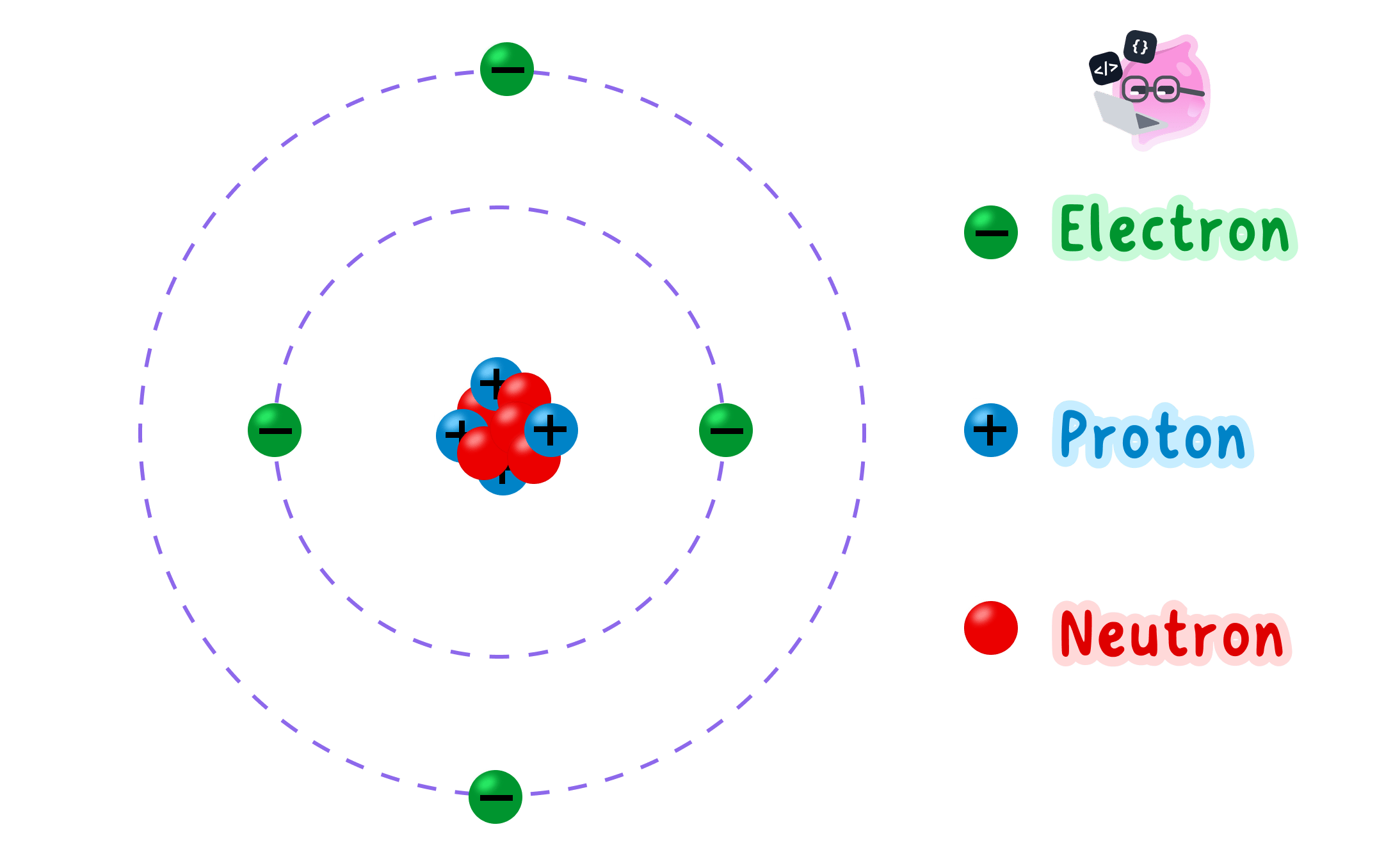
- Every atom has a tiny central nucleus surrounded by electrons.
- The nucleus is extremely small compared with the whole atom, with a radius about 100 000100\,000100000 times smaller than the radius of the atom.
- Almost all of the mass of an atom is concentrated in its nucleus.
- The electrons are negatively charged and occupy the space around the nucleus, and their arrangement is studied separately from the nucleus.
Protons and neutrons
Definition
Proton
A positively charged subatomic particle found in the nucleus of an atom.
Definition
Neutron
An uncharged subatomic particle found in the nucleus of an atom.
- Atomic nuclei are made of two kinds of subatomic particle: protons and neutrons.
- A proton carries a positive charge, with a relative charge of +1+1+1.
- A neutron is neutral, so its relative charge is 000.
- Protons and neutrons are packed tightly together inside the nucleus and are held there by a very strong attraction that acts only over the tiny distances inside the nucleus.
- Every nucleus contains at least one proton, and every nucleus except the simplest form of hydrogen also contains neutrons.
- Protons and neutrons are much smaller than an atom, so they must not be confused with atoms or with molecules, which are groups of atoms joined together.
Nuclear charge
Definition
Nuclear charge
The total positive charge of a nucleus, equal to the number of protons it contains.
- Because neutrons are uncharged, the only source of charge in a nucleus is its protons.
- Each proton adds +1+1+1 to the relative charge, so the nuclear charge is equal to the number of protons in the nucleus.
- A nucleus can therefore never be negatively charged or neutral, because it always contains at least one proton.
- Adding or removing neutrons changes the mass of a nucleus but leaves its charge exactly the same.
Example
Finding the charge of a nucleus
- A gold nucleus contains 797979 protons and 118118118 neutrons.
- Each proton contributes +1+1+1 and each neutron contributes 000.
- The relative charge of the gold nucleus is +79+79+79, and the 118118118 neutrons make no difference to this value.
Each element has its own charge
Definition
Atomic number
The number of protons in the nucleus of an atom.
- The number of protons in a nucleus is called the atomic number, ZZZ.
- Every atom of a particular element has the same number of protons in its nucleus.
- This means that every nucleus of an element has the same positive charge, which is called its characteristic nuclear charge.
- Every hydrogen nucleus has a charge of +1+1+1, every carbon nucleus has a charge of +6+6+6, every oxygen nucleus has a charge of +8+8+8 and every uranium nucleus has a charge of +92+92+92.
- No two elements share the same nuclear charge, so the charge of a nucleus identifies which element it belongs to.
- The elements in the periodic table are arranged in order of increasing atomic number, so their nuclear charge rises by +1+1+1 from one element to the next.
- If the number of protons in a nucleus changes, the nuclear charge changes and the nucleus becomes a nucleus of a different element.
- A neutral atom contains the same number of electrons as protons, so the negative charge of the electrons exactly balances the positive charge of the nucleus.
Common Mistake
- Do not describe a neutron as negatively charged, because a neutron has no charge at all.
- Do not say that neutrons add to the charge of a nucleus, because only the protons do.
- Do not use the word atom when you mean nucleus, because the nucleus is only the central part of the atom.
Exam technique
Explaining nuclear charge
- When asked why a nucleus is positive, state that it contains positively charged protons and that the neutrons are uncharged.
- When asked why the charge is characteristic of an element, add that all nuclei of the same element contain the same number of protons.
- Examiners allow "neutral" or "no charge" for a neutron but do not allow "negative".
- Give charges with their sign, for example +6+6+6 rather than 666, when a question asks for the charge of a nucleus.
Self review
- Which two particles make up an atomic nucleus?
- What is the relative charge of a proton and of a neutron?
- Why does adding a neutron to a nucleus not change its charge?
- What is the relative charge of a nucleus that contains 111111 protons and 121212 neutrons?
- Why does every nucleus of the same element have the same positive charge?
