Question 1
FA student investigates how the number of layers of bubble wrap around a beaker affects how quickly hot water in the beaker cools.
She pours hot water into the beaker and measures the temperature drop in 10 minutes. She repeats this with different numbers of layers of bubble wrap.
The Figure shows her apparatus.
Figure
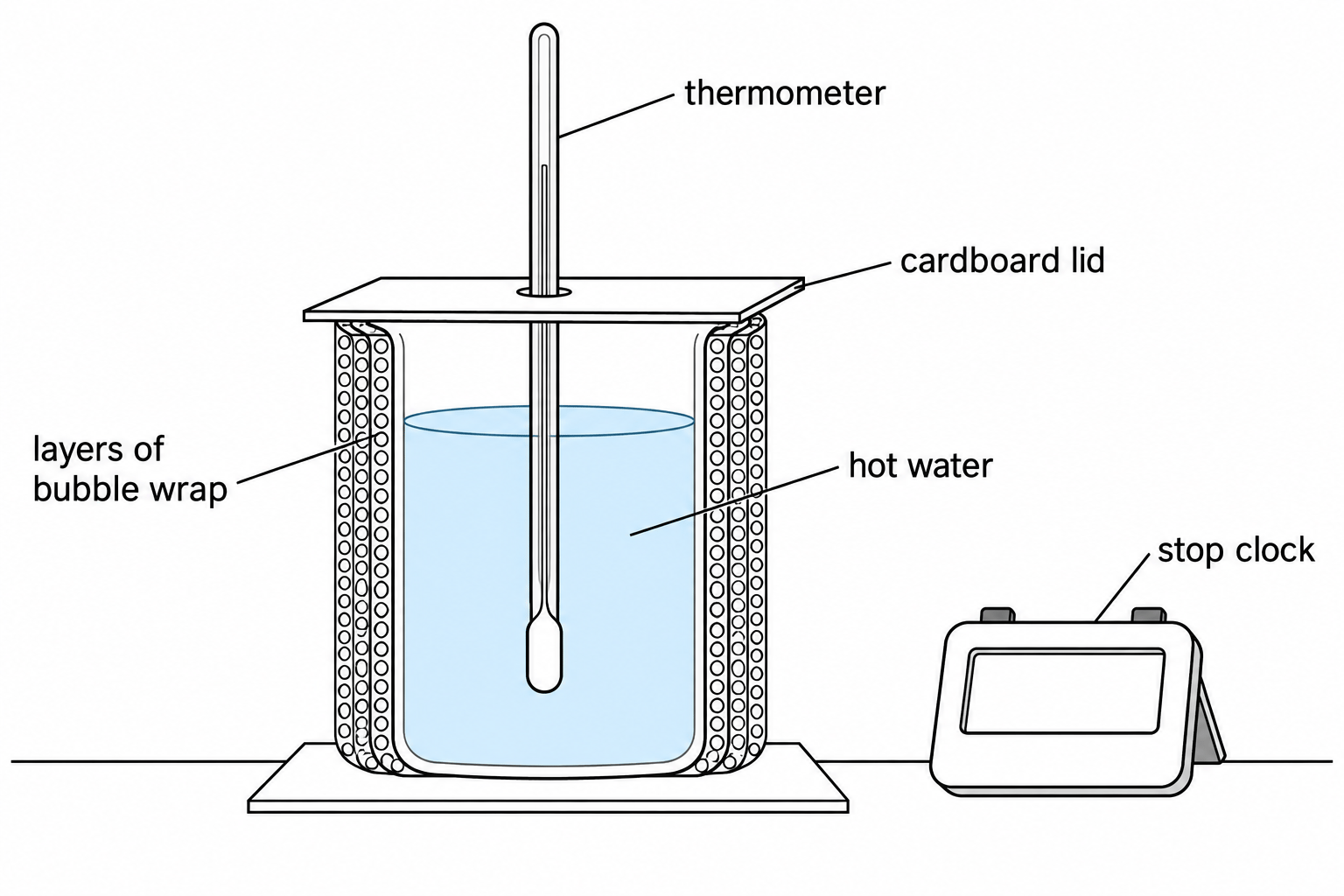
The Table shows her results.
Table
| Number of layers of bubble wrap | Temperature drop in 10 minutes in ∘C^\circ\text{C}∘C |
|---|---|
| 0 | 24 |
| 1 | 16 |
| 2 | 11 |
| 3 | 8 |
| 4 | 7 |
a.[2]
Give two variables the student must keep the same.
b.[2]
Describe the pattern shown by the results.
c.[2]
Explain why adding more layers of bubble wrap reduces the rate of cooling of the water.
d.[1]
The student says:
'Adding a fifth layer of bubble wrap would make the temperature drop 0 ∘C0\ ^\circ\text{C}0 ∘C.'
Use the results to explain why the student is wrong.
7.2 Power and efficiency Questions
50 exam-style questions on OCR GCSE Physics 7.2 Power and efficiency, covering 7.2.1 Dissipation of energy, 7.2.2 Energy transfers in domestic devices, 7.2.3 Power ratings of domestic appliances, 7.2.4 Efficiency of energy transfers, 7.2.5 Ways to increase efficiency, 7.2.6 Reducing unwanted energy transfers, and 7.2.7 Thermal conductivity and the cooling of buildings. Each one has a worked solution and a mark scheme showing where the marks go.