Question 3
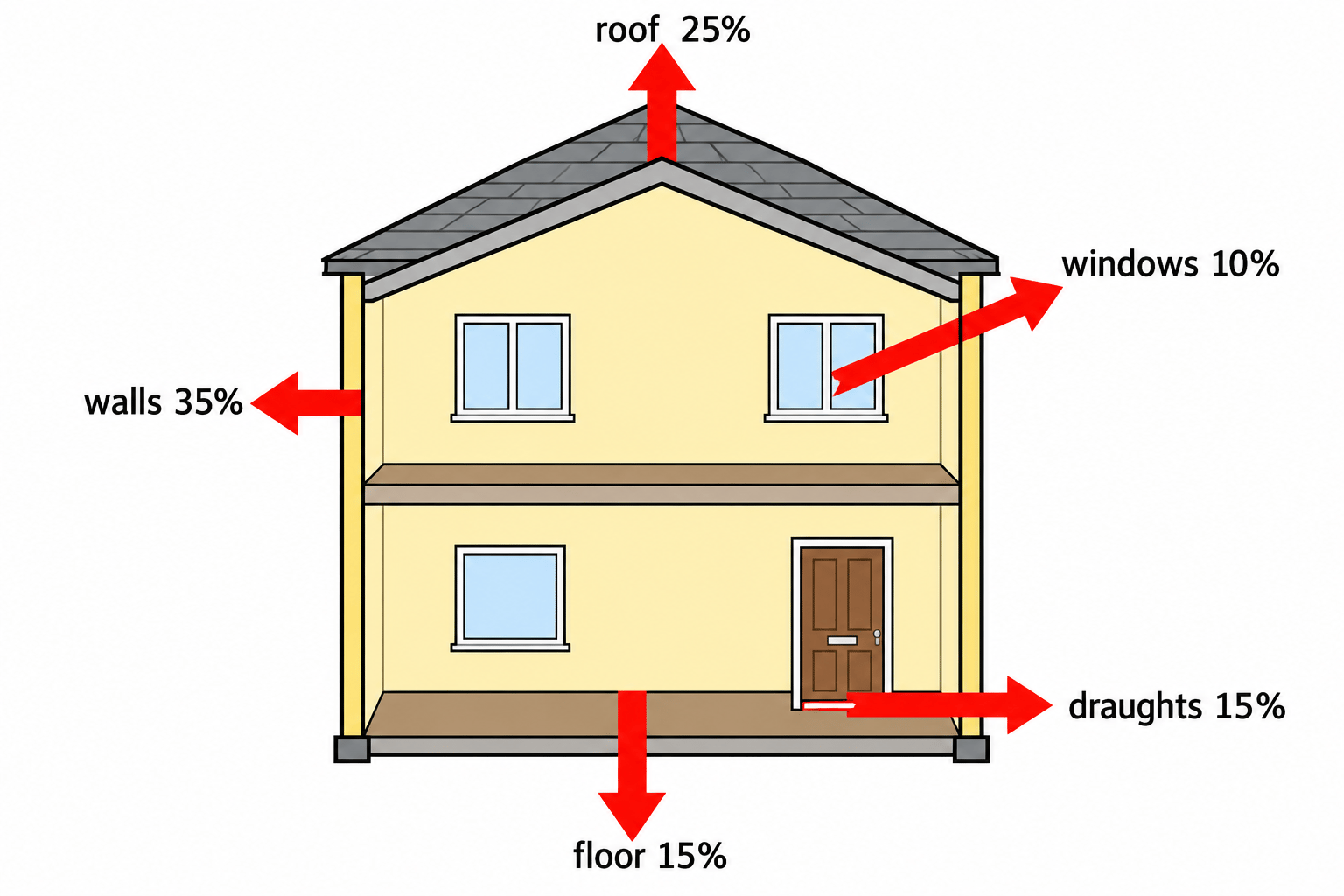
FThe Figure shows how energy is transferred from a house to the surroundings.
Figure
a.[1]
Through which part of the house is the most energy transferred to the surroundings?
b.[2]
Each year, 20 000 kWh20\ 000\ \text{kWh}20 000 kWh of energy is transferred from the house to the surroundings.
Calculate the energy transferred through the roof each year.
c.[3]
Loft insulation reduces the energy transferred through the roof by 60%.
Energy costs 30p per kWh.
Calculate how much money the owner saves each year by fitting loft insulation.
Give your answer in pounds (£).
d.[2]
Cavity wall insulation is a foam that fills the gap between the two layers of brick in the walls. The foam contains many small pockets of trapped air.
Explain how cavity wall insulation reduces the rate at which the house cools.
7.2 Power and efficiency Questions
50 exam-style questions on OCR GCSE Physics 7.2 Power and efficiency, covering 7.2.1 Dissipation of energy, 7.2.2 Energy transfers in domestic devices, 7.2.3 Power ratings of domestic appliances, 7.2.4 Efficiency of energy transfers, 7.2.5 Ways to increase efficiency, 7.2.6 Reducing unwanted energy transfers, and 7.2.7 Thermal conductivity and the cooling of buildings. Each one has a worked solution and a mark scheme showing where the marks go.