Splitting large nuclei
Definition
Nuclear fission
The splitting of a large, unstable nucleus into two smaller nuclei, releasing neutrons and energy.
Definition
Daughter nuclei
The two smaller nuclei formed when a large nucleus splits during nuclear fission.
- Some very large nuclei, such as uranium-235 and plutonium-239, are unstable and can split into two smaller nuclei.
- This splitting of a nucleus is called nuclear fission.
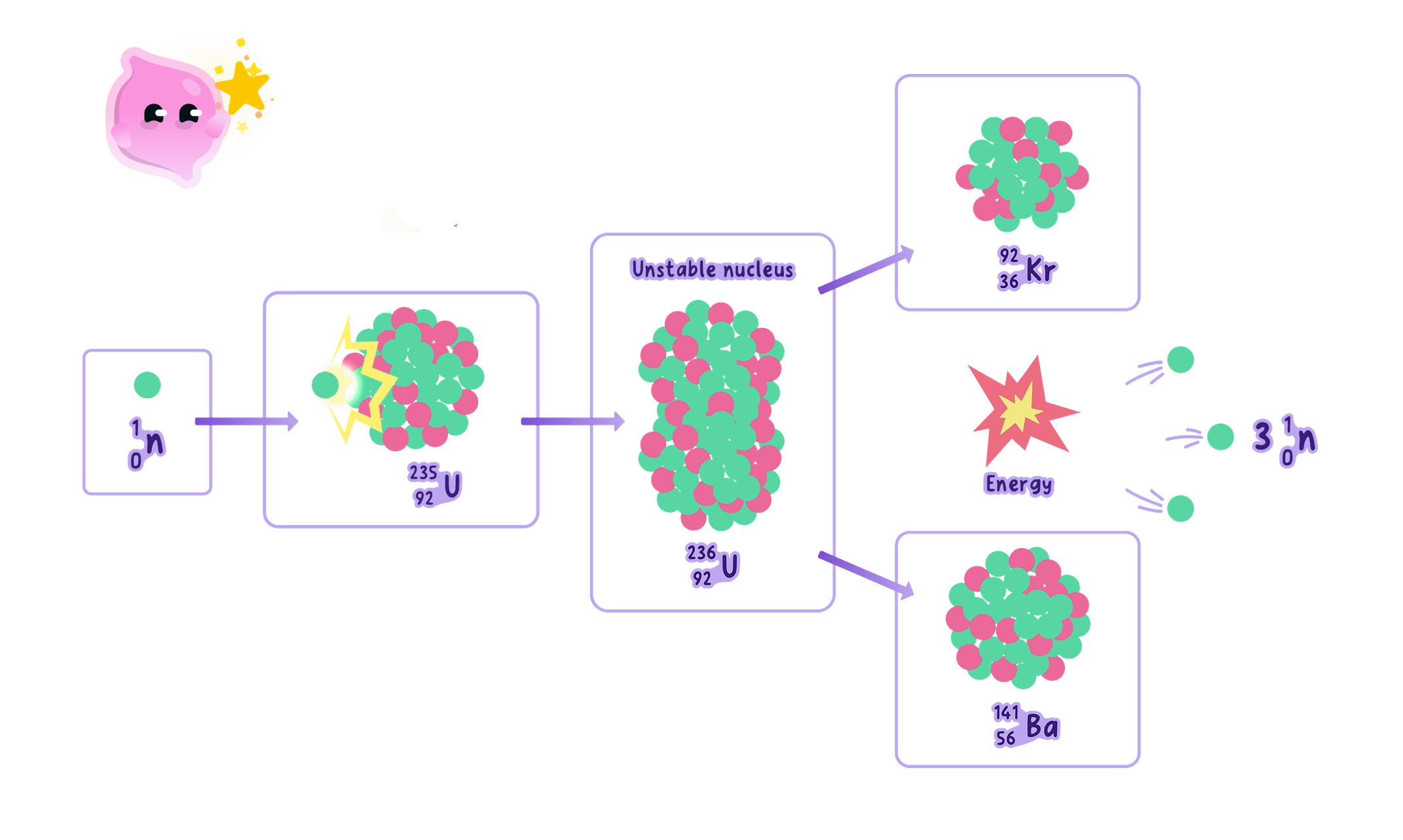
- For fission to happen, the unstable nucleus usually has to absorb a neutron first.
- A neutron has no charge, so it is not repelled by the positive nucleus and can get close enough to be absorbed.
- When uranium-235 absorbs a slow-moving neutron it becomes uranium-236, which is so unstable that it splits almost immediately.
- The two smaller nuclei produced are called daughter nuclei, and they are usually of unequal size, such as barium-141 and krypton-92.
Radiation from fission
- Each fission event releases two or three neutrons as well as the two daughter nuclei.
- Fission also releases gamma rays, because the newly formed nuclei are left with extra energy.
- The daughter nuclei have too many neutrons to be stable, so they go on to decay and emit beta and gamma radiation.
- This is why the spent fuel removed from a nuclear reactor is highly radioactive waste.
- The total number of protons and the total number of neutrons are the same before and after a fission event, which you can check with a nuclear equation.
Example
Checking a fission equation
- A uranium-235 nucleus absorbs a neutron and splits into barium-141, krypton-92 and three neutrons.
- Add the mass numbers on each side to check that the number of nucleons is unchanged.
- Add the atomic numbers on each side to check that the charge is unchanged.
- Both totals balance, so the equation is correct and three free neutrons are available to cause further fission.
Energy transfer in fission
- Each fission event releases a very large amount of energy, millions of times more than a chemical reaction involving a single atom.
- Most of this energy is transferred to the kinetic energy stores of the daughter nuclei and the neutrons, which fly apart at very high speeds.
- Some of the energy is carried away by the gamma rays.
- The fast-moving particles collide with the surrounding atoms, so the energy is transferred to the thermal energy store of the material and it heats up.
- In a nuclear power station, this thermal energy is used to boil water into steam, which drives turbines to generate electricity.
Chain reactions
Definition
Chain reaction
A sequence of fission events in which neutrons released by one fission go on to cause further nuclei to split.
- The two or three neutrons released by one fission can each be absorbed by another uranium-235 nucleus.
- Those nuclei then split and release more neutrons, which can cause still more nuclei to split.
- This self-sustaining process is called a chain reaction.
- If every fission causes more than one further fission, the number of fission events grows extremely quickly, from one to three to nine to twenty-seven and onwards.
- In a nuclear reactor, the chain reaction is controlled, so that on average exactly one neutron from each fission goes on to cause another fission.
- Control rods, made of a material such as boron that absorbs neutrons, are lowered into the reactor to slow the reaction and raised to speed it up.
- In a nuclear weapon, the chain reaction is uncontrolled, so a huge amount of energy is released in a fraction of a second as an explosion.
Analogy
Mousetraps and ping-pong balls
- Picture a room whose floor is covered in set mousetraps, each holding two ping-pong balls.
- Dropping one ball onto a trap sets it off, and it throws its two balls into the air.
- Each of those balls lands on another trap and sets it off, so the number of flying balls grows rapidly until every trap has gone off.
- Laying a sheet over some of the traps catches balls before they can land, which is how control rods absorb neutrons and stop the reaction growing too fast.
Common Mistake
- Do not say that the atom splits, because it is the nucleus that splits in fission.
- Do not say that fission creates energy, because energy is transferred to the kinetic energy stores of the products.
- Do not confuse fission with fusion, because fission splits one large nucleus while fusion joins two light nuclei.
Exam technique
Describing a chain reaction
- Start with a neutron being absorbed by a uranium-235 nucleus, because this first step is the one most often missed.
- State that the nucleus splits into two smaller nuclei and releases two or three neutrons and energy.
- Explain that these neutrons are absorbed by other nuclei, which also split, so the process continues.
- A labelled diagram showing one neutron leading to three fissions, then nine, can earn the same marks as a written description.
- If the question asks about energy, name the store by saying that energy is transferred to the kinetic energy stores of the products.
Self review
- What usually has to happen to a uranium-235 nucleus before it splits?
- Name three things released when a nucleus undergoes fission.
- Explain how one fission event can lead to a chain reaction.
- Why can a neutron be absorbed by a nucleus more easily than a proton?
- What do control rods do in a nuclear reactor?
