Forces, vectors and resultants
Forces, vectors and resultants
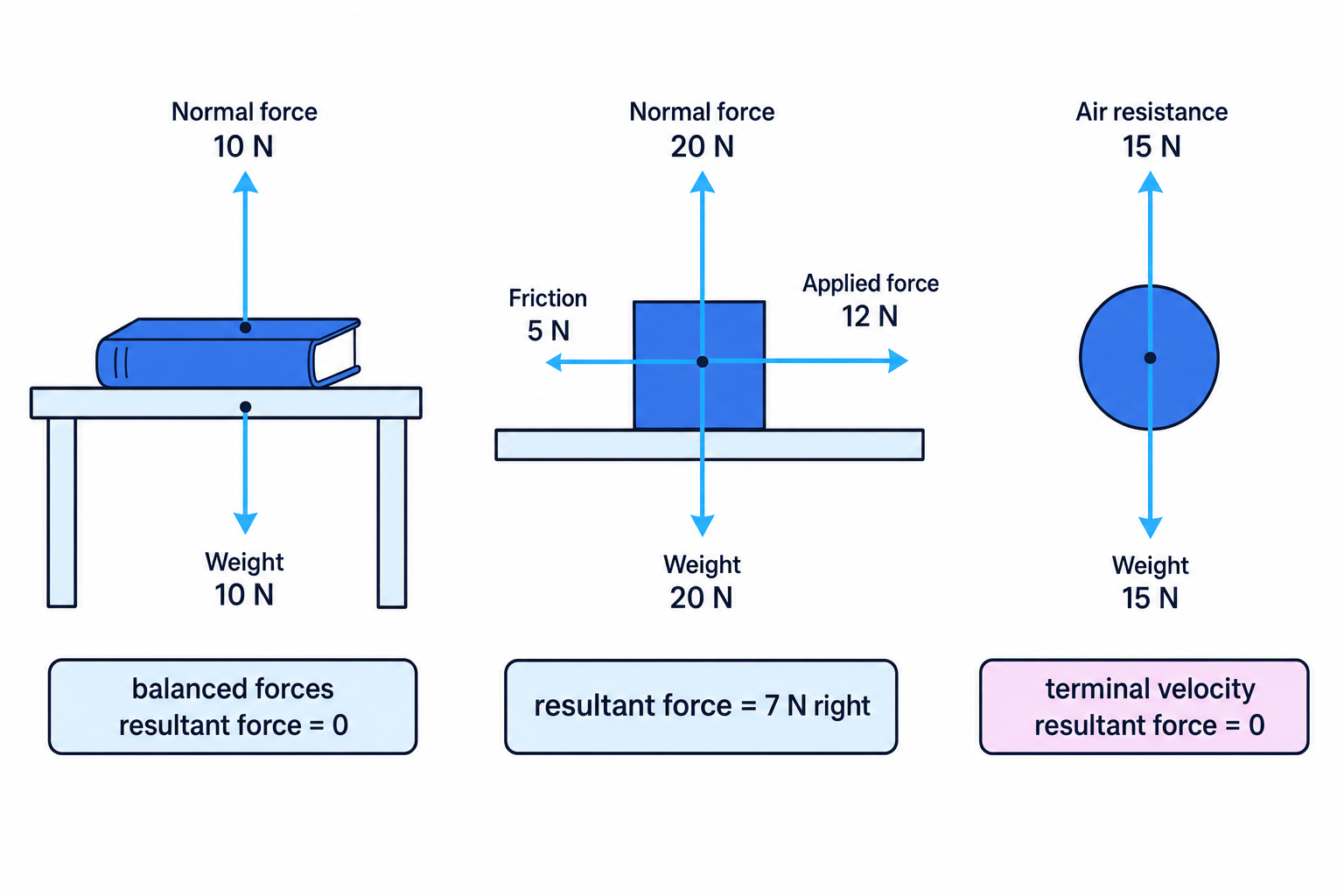
A force is a push or pull caused by an interaction between objects, and it is measured in newtons, N. Force is a vector, so size and direction both matter.
2.2 Newton’s laws Lesson
Step-by-step lessons on OCR GCSE Physics 2.2 Newton’s laws, covering 2.2.1 Interactions between objects, 2.2.2 Force pairs in interactions, 2.2.3 Forces as vectors, 2.2.4 Newton's first law, 2.2.5 Resolving forces with vector diagrams, 2.2.6 Forces acting on an isolated object, 2.2.7 Free body diagrams and resultant force, 2.2.8 Free body diagrams for balanced forces, 2.2.9 Newton's second law, 2.2.10 Inertia and inertial mass, 2.2.11 Momentum in collisions, 2.2.12 Relating force, mass, velocity and acceleration, 2.2.13 Work done by a force, 2.2.14 Work, stored energy and units of energy, 2.2.15 Power as the rate of energy transfer, 2.2.16 Newton's third law, and 2.2.17 Circular motion and changing velocity. Each one builds up to exam-style questions. Paper 2 and Paper 4 include synoptic questions that draw on Topics P1–P4, so revisit earlier topics before final exams rather than treating each paper as self-contained.