Poles and magnetic force
Poles and magnetic force
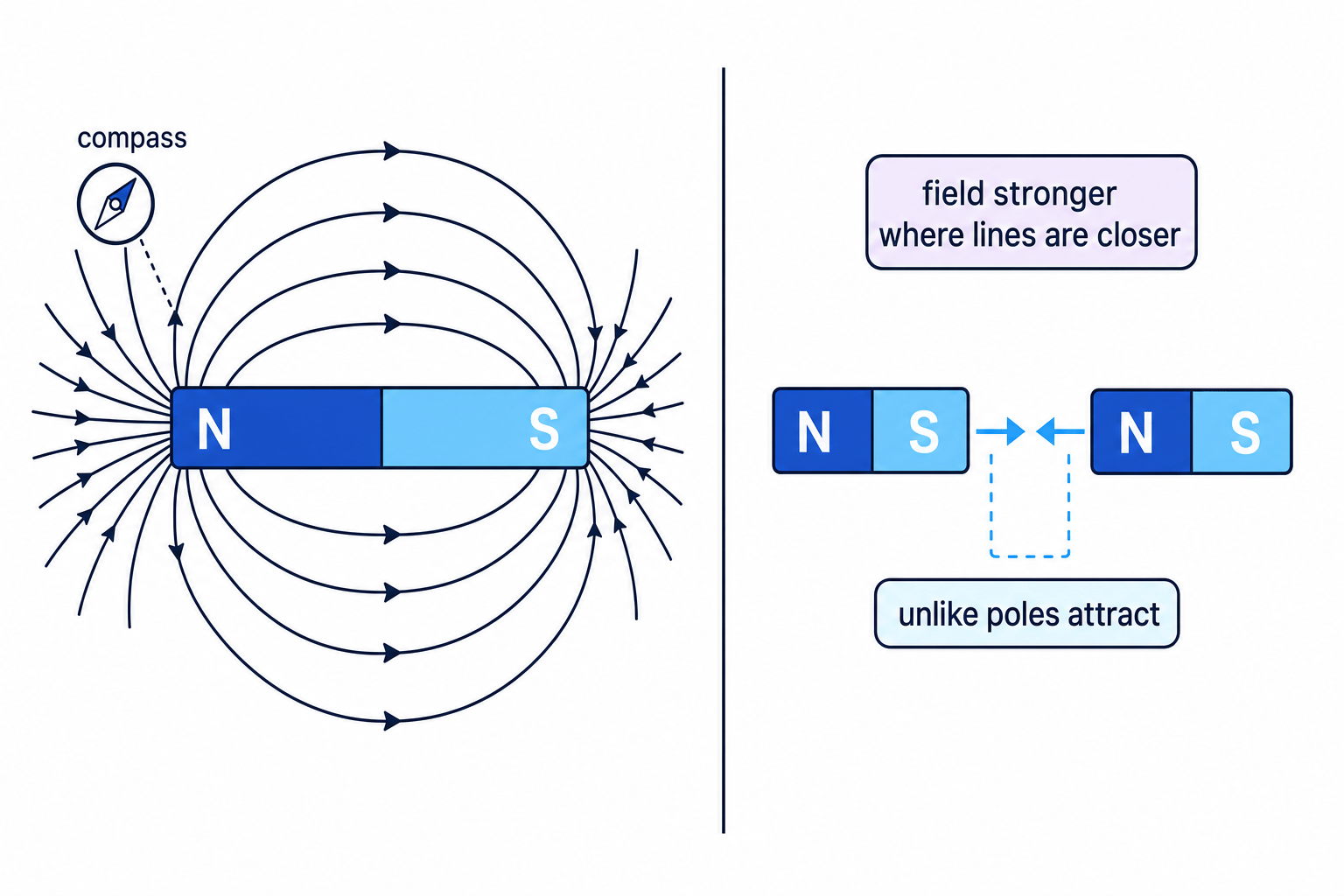 A magnet produces a magnetic field, so it can exert a non-contact force on magnetic materials and on other magnets. The magnetic effect is strongest at the poles, called north and south.
4.1 Magnets and magnetic fields Lesson
Step-by-step lessons on OCR GCSE Physics 4.1 Magnets and magnetic fields, covering 4.1.1 Magnetic poles, attraction and repulsion, 4.1.2 Permanent and induced magnets, 4.1.3 The magnetic field of a magnet, 4.1.4 Compasses and the Earth's magnetic field, 4.1.5 The magnetic field around a current-carrying wire, 4.1.6 Field strength, current and distance, and 4.1.7 Solenoids and electromagnets. Each one builds up to exam-style questions. Paper 2 and Paper 4 include synoptic questions that draw on Topics P1–P4, so revisit earlier topics before final exams rather than treating each paper as self-contained.