Speed and velocity
Definition
Speed
The distance travelled by an object per unit time.
Definition
Velocity
The speed of an object in a stated direction.
- Speed is a scalar quantity, so it tells you only how fast an object is moving.
- Velocity is a vector quantity, so it tells you both how fast an object is moving and in which direction.
- Two objects can have the same speed but different velocities if they are moving in different directions.
- The velocity of an object therefore changes if its speed changes, if its direction changes, or if both change.
- An object moving at a constant speed can still have a changing velocity, as long as its direction of motion is changing.
Moving in a circle
Definition
Circular orbit
An orbit in which the orbiting object stays at a constant distance from the centre of the body it orbits.
Definition
Tangent
A straight line that touches a curve at a single point and has the same gradient as the curve at that point.
Definition
Acceleration
The rate of change of velocity.
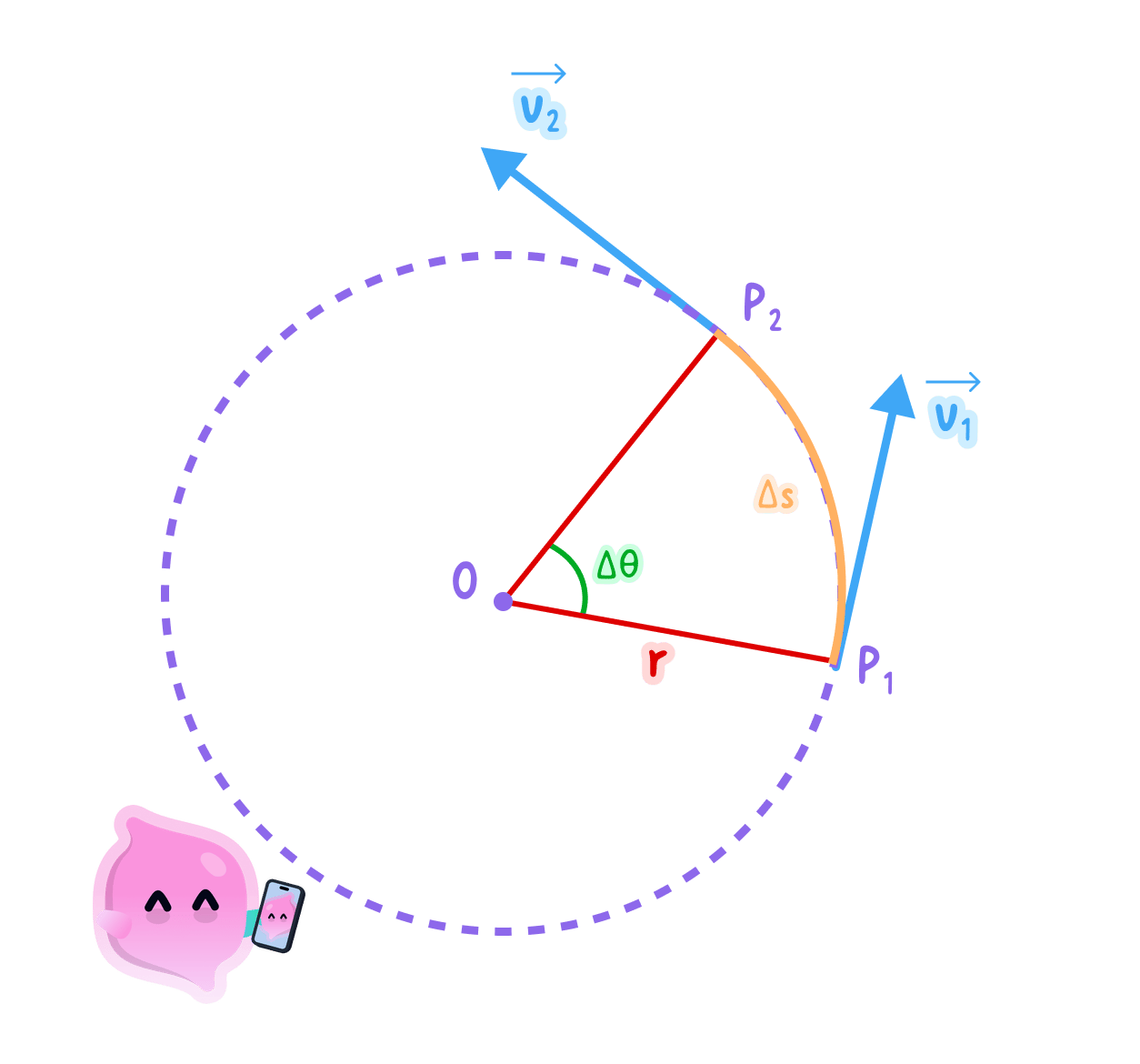
- A planet in a circular orbit stays the same distance from its star and moves at a constant speed.
- At every instant, the planet's velocity points along a tangent to the circle, at right angles to the line joining the planet to the centre.
- As the planet moves round, the direction of this tangent keeps turning, so the direction of the velocity keeps changing.
- The size of the velocity, which is the speed, stays the same, but its direction is never the same from one moment to the next.
- Because the velocity is changing, the planet is accelerating, even though it is not speeding up or slowing down.
Gravity provides the inward force
Definition
Gravitational force
The attractive force that acts between any two objects that have mass.
Definition
Resultant force
The single force that has the same effect on an object as all of the forces acting on it combined.
- By Newton's first law, an object's velocity changes only if a resultant force acts on it.
- Without any force, a planet would carry on in a straight line along the tangent and drift off into space.
- The force that stops this is the gravitational force of attraction between the star and the planet.
- This force acts along the line joining the planet to the star, so it always points towards the centre of the orbit.
- The force continuously pulls the planet away from its straight-line path and bends its motion into a circle.
- The planet's acceleration is in the same direction as the force, so the planet is accelerating towards the centre of the circle.
- Whirling a ball on a string shows the same idea, because the tension in the string pulls the ball towards your hand and keeps it moving in a circle.
- If the string snaps, the inward force disappears and the ball flies off in a straight line along the tangent.
- The same reasoning applies to the Moon orbiting the Earth and to artificial satellites, with the Earth's gravity providing the inward force.
Why the speed does not change
- In a circular orbit, the gravitational force is always at right angles to the direction in which the planet is moving.
- A force at right angles to the motion has no part pulling forwards or backwards along the path, so it cannot speed the planet up or slow it down.
- The force does no work along the direction of motion, so the planet's kinetic energy stays the same and its speed stays constant.
- The only effect of the force is to change the planet's direction, which is why the velocity changes while the speed does not.
Example
Following a planet around a quarter of its orbit
- A planet moves anticlockwise around a star in a circular orbit at a constant speed of 30 km/s30\ \text{km/s}30 km/s.
- At the top of its orbit the planet is moving to the left, so its velocity is 30 km/s30\ \text{km/s}30 km/s to the left.
- A quarter of an orbit later, the planet is at the left-hand side of the circle and moving straight down, so its velocity is 30 km/s30\ \text{km/s}30 km/s downwards.
- The speed is the same at both points, but the direction has turned through 90∘90^\circ90∘, so the velocity has changed.
- At the top, the gravitational force points straight down towards the star, and at the left-hand side it points to the right towards the star, so in both places the force is at right angles to the motion.
Common Mistake
- Do not say that an orbiting planet has a constant velocity, because its direction is always changing.
- Do not say that the planet is not accelerating because its speed is constant, because acceleration is a change in velocity, not only a change in speed.
- Do not say that the gravitational force acts along the direction of motion, because in a circular orbit it acts towards the centre, at right angles to the motion.
- Do not say that there is no gravity in space, because gravity is the force that keeps the planet in orbit.
Exam technique
Explaining constant speed with changing velocity
- Start by stating that velocity is a vector, so a change of direction is a change of velocity.
- Say that gravity acts towards the centre of the orbit, which is at right angles to the planet's motion.
- Explain that a force at right angles to the motion changes only the direction, so the speed stays the same.
- Finish by linking the changing velocity to an acceleration towards the centre, because this final link is the mark most often left out.
Self review
- What is the difference between speed and velocity?
- In which direction does the velocity of a planet in a circular orbit point at any instant?
- In which direction does the gravitational force on an orbiting planet act?
- Why does the gravitational force not change the speed of a planet in a circular orbit?
- Explain why a planet moving at a constant speed in a circular orbit is accelerating.
