Why the frequency range is limited
Definition
Natural frequency
The frequency at which an object vibrates when it is disturbed and then left to vibrate on its own.
Definition
Resonance
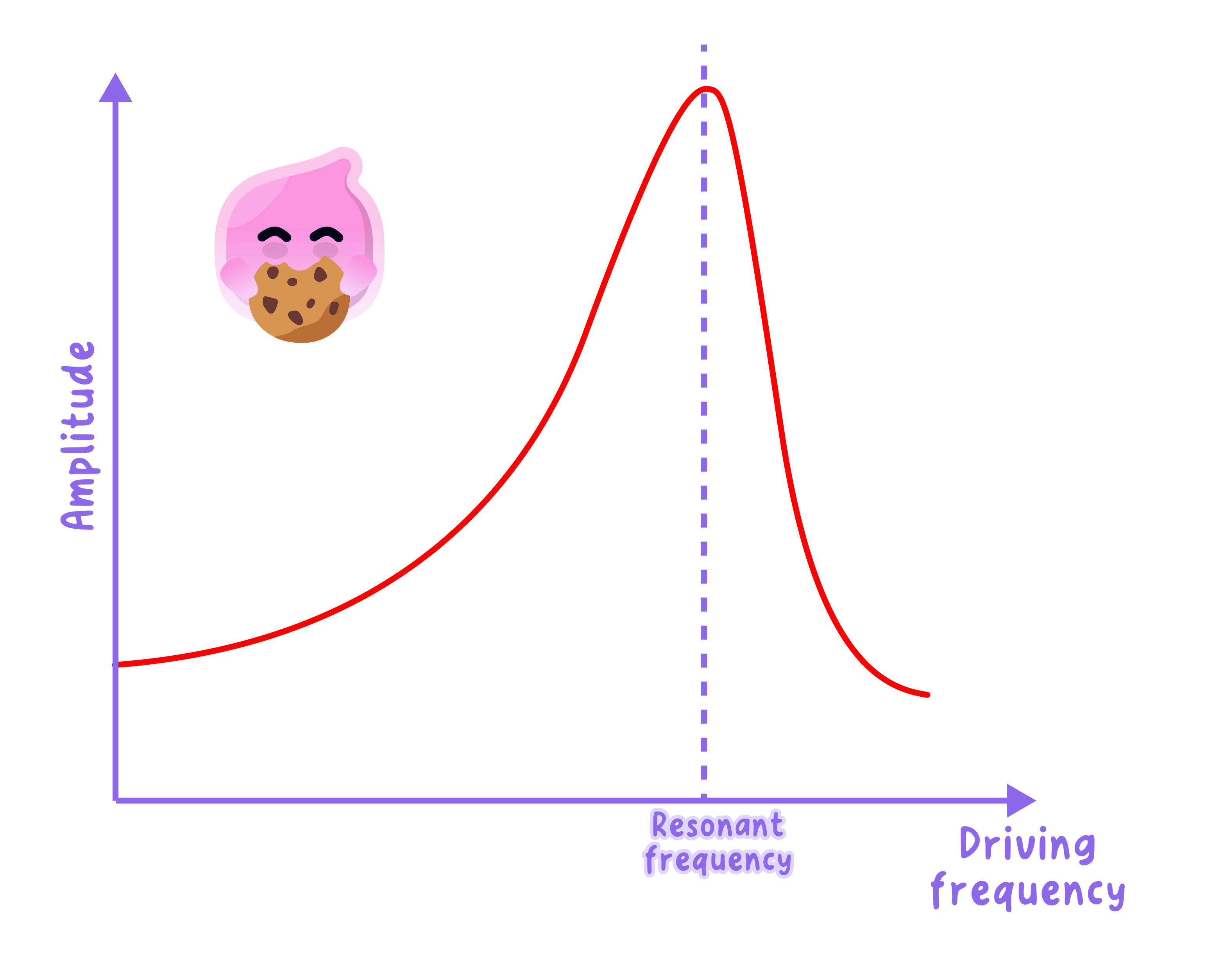
The large increase in the amplitude of an object's vibration when it is driven at its natural frequency.
- Every solid part that converts sound into vibration, such as an eardrum or a microphone diaphragm, has mass and stiffness.
- Together, the mass and stiffness give the part a natural frequency at which it vibrates most easily.
- When sound drives the part at or near its natural frequency, it vibrates with a large amplitude, an effect called resonance.
- The further the frequency of the sound is from the natural frequency, the smaller the amplitude of the vibration becomes.
- At very high frequencies, the part's mass gives it too much inertia to reverse direction quickly enough, so it barely moves.
- At very low frequencies, the slow pressure changes are too weak compared with the part's stiffness to make it vibrate usefully.
- Outside a certain range of frequencies, the vibrations are so small that no useful signal is produced.
- This is why every microphone and loudspeaker has a stated frequency range, and why small earphones struggle to reproduce deep bass notes.
- The same limit applies in reverse, because a solid can only produce sound waves over the range of frequencies at which it can vibrate.
The range of human hearing
Definition
Audible range
The range of sound frequencies a person can hear, about 20 Hz to 20 000 Hz for a young person with healthy hearing.
Definition
Infrasound
Sound with a frequency below 20 Hz, which is too low for humans to hear.
Definition
Ultrasound
Sound with a frequency above 20 000 Hz, which is too high for humans to hear.
Definition
Pitch
How high or low a sound seems to a listener, which is set by the frequency of the sound wave.
- The human ear can only turn sound into nerve signals over a limited range of frequencies, called the audible range.
- For a young person with healthy hearing, this range is about 20 Hz20\ \text{Hz}20 Hz to 20 000 Hz20\,000\ \text{Hz}20000 Hz, or 20 kHz20\ \text{kHz}20 kHz.
- Sound below 20 Hz20\ \text{Hz}20 Hz is called infrasound, and sound above 20 000 Hz20\,000\ \text{Hz}20000 Hz is called ultrasound.
- Infrasound and ultrasound are still sound waves that carry energy, but the parts of the ear cannot respond to them strongly enough to produce signals.
- Within the audible range, the frequency of a sound sets its pitch, so a higher frequency is heard as a higher note.
- The ear is most sensitive to frequencies of a few thousand hertz, which helps you pick out the sounds of speech.
- Other animals have ears built differently, so dogs can hear up to about 45 000 Hz45\,000\ \text{Hz}45000 Hz, bats hear well above 100 000 Hz100\,000\ \text{Hz}100000 Hz, and elephants communicate using infrasound.
How hearing changes with age
Definition
Hair cells
Sensory cells lining the cochlea that produce electrical signals when the fluid around them vibrates.
- Inside the cochlea, rows of hair cells each respond best to a particular frequency.
- Hair cells near the entrance of the cochlea respond to high frequencies, while those deep inside the coil respond to low frequencies.
- Hair cells are gradually damaged over a lifetime and, unlike many cells in the body, they are not replaced.
- The cells that detect high frequencies are usually lost first, so the upper limit of hearing falls as people get older.
- By middle age many adults cannot hear sounds above about 15 000 Hz15\,000\ \text{Hz}15000 Hz, and the limit keeps dropping with age.
- The eardrum and ossicles can also become stiffer with age, so they pass on vibrations less well.
- Repeated exposure to loud sound, such as from concerts, power tools or earphones turned up high, damages hair cells faster and brings hearing loss on earlier.
- Some UK shops have used devices that give out a tone of about 17 000 Hz17\,000\ \text{Hz}17000 Hz to stop groups gathering outside, because most teenagers can hear it while most older adults cannot.
Example
Deciding which sounds can be heard
- A dog whistle produces sound at 25 000 Hz25\,000\ \text{Hz}25000 Hz, which is above the upper limit of 20 000 Hz20\,000\ \text{Hz}20000 Hz, so it is ultrasound and people cannot hear it.
- A dog can hear the same whistle, because its audible range extends to about 45 000 Hz45\,000\ \text{Hz}45000 Hz.
- A distant thunderstorm produces some sound at 10 Hz10\ \text{Hz}10 Hz, which is below 20 Hz20\ \text{Hz}20 Hz, so this part of the sound is infrasound and is not heard.
- A test tone at 17 000 Hz17\,000\ \text{Hz}17000 Hz is heard by a teenager but not by a 60-year-old, because the older person has lost many of the hair cells that detect high frequencies.
Common Mistake
- Do not say that sounds outside the audible range are not sound waves, because infrasound and ultrasound are sound waves that the ear cannot detect.
- Do not confuse pitch with loudness, because pitch depends on frequency while loudness depends on amplitude.
Exam technique
Explaining the limited range
- Link the frequency of the sound to how well a solid part, such as the eardrum, can vibrate at that frequency.
- Say that each part responds strongly near its natural frequency and only weakly far from it.
- Quote the range of human hearing with units, as 20 Hz20\ \text{Hz}20 Hz to 20 000 Hz20\,000\ \text{Hz}20000 Hz.
- For ageing, say that hair cells in the cochlea, especially those for high frequencies, are damaged and not replaced, so the upper limit of hearing falls.
Self review
- Why can a microphone diaphragm only respond well over a limited range of frequencies?
- What is resonance?
- What is the audible range for a young person with healthy hearing?
- What is the difference between infrasound and ultrasound?
- Why do older people often fail to hear very high-pitched sounds?
