From nebula to protostar
Nebula
A huge cloud of dust and gas in space, made mainly of hydrogen and helium.
Protostar
A hot, dense ball of gas formed from a collapsing nebula before nuclear fusion has started in its core.
- The Sun formed about 4.6 billion years ago from a nebula, a vast cloud of dust and gas made mainly of hydrogen.
- Every particle in the nebula has mass, so every particle attracts every other particle by gravity.
- In a slightly denser region of the cloud, gravity pulled the dust and gas inwards, so that part of the cloud began to collapse.
- As the material fell inwards, energy was transferred from the gravitational store of the particles to their kinetic store, so they moved faster.
- The fast-moving particles collided more often and more violently, so energy was transferred to the thermal store of the gas and its temperature rose.
- The collapse also squeezed the particles closer together, so the density and pressure at the centre increased.
- The hot, dense, glowing ball of gas at the centre of the collapsing cloud is a protostar.
- Leftover dust and gas spinning in a flat disc around the young Sun later clumped together to form the planets.
Fusion begins
Nuclear fusion
The joining of two light nuclei to form a single heavier nucleus, releasing energy.
- Hydrogen nuclei are positively charged, so they repel each other strongly.
- Two nuclei can only get close enough to fuse if they collide at extremely high speeds, which needs an extremely high temperature.
- The collisions must also happen very often, which needs a very high density and pressure.
- Gravity kept squeezing the protostar until its core reached a temperature of around 10 million ∘C^\circ\text{C}∘C, which was hot and dense enough for hydrogen nuclei to fuse.
- In the core, hydrogen nuclei fuse to form helium nuclei, and each fusion releases energy from the nuclear store.
- This energy heats the core further and travels outwards, finally leaving the surface as light and other electromagnetic radiation.
- Once fusion is under way, the protostar has become a star.
Stellar equilibrium
Main sequence star
A star in the long, stable stage of its life in which hydrogen nuclei fuse to form helium in its core.
Stellar equilibrium
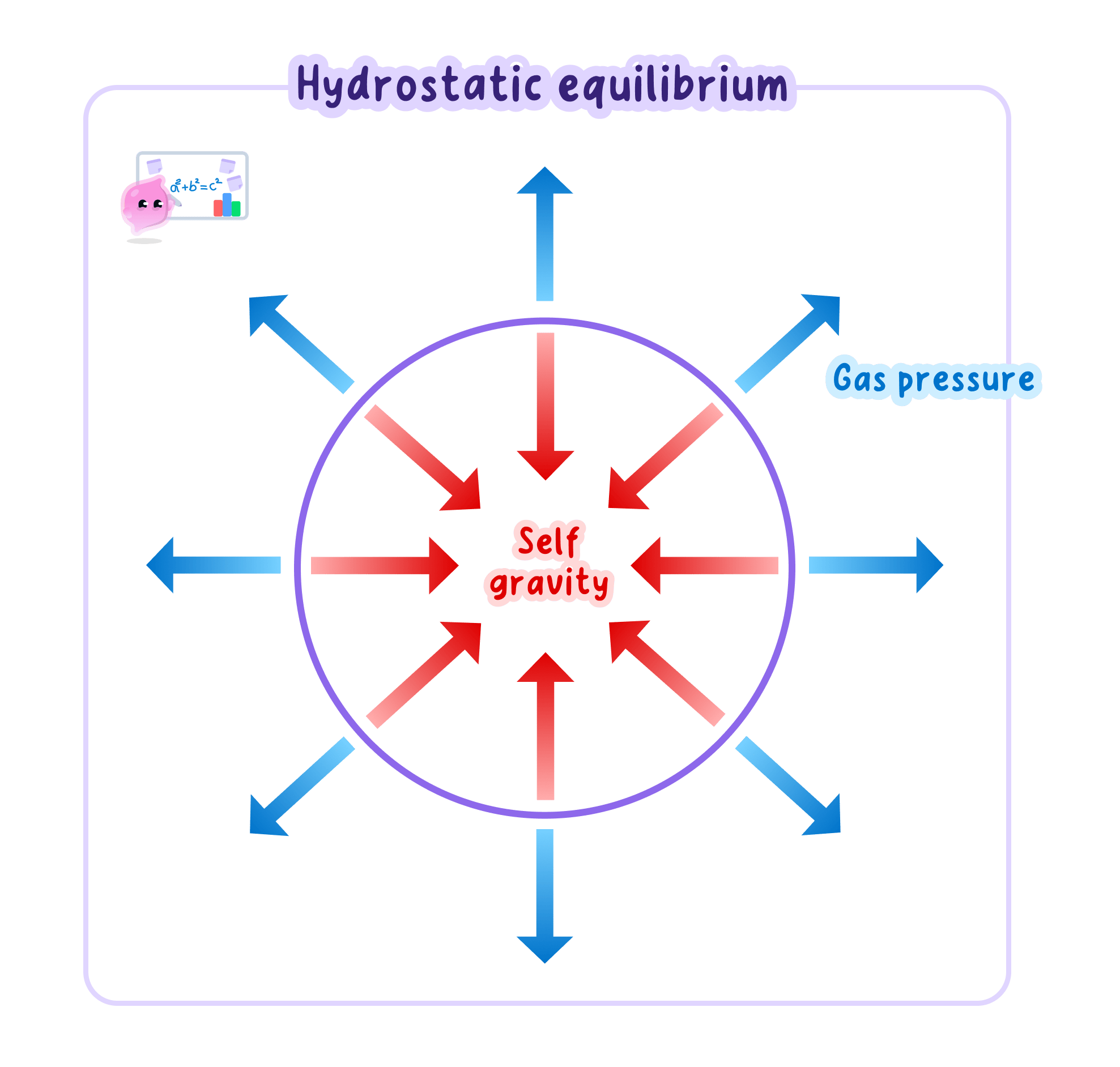
The balance in a star between the inward pull of gravity and the outward pressure caused by the energy released by fusion.
- Two effects act on the material of a star at the same time.
- Gravity pulls all of the star's material inwards, trying to make the star collapse further.
- The energy released by fusion heats the gas, and the pressure of the hot gas pushes outwards, trying to make the star expand.
- When the inward pull of gravity exactly balances the outward push from the energy released by fusion, the star stops changing size.
- This balance is stellar equilibrium, and a star held in this stable state is a main sequence star.
- The balance corrects itself, which is why a main sequence star stays stable for so long.
- If fusion slows slightly, the outward push weakens, so gravity squeezes the core a little.
- Squeezing heats and compresses the core, which speeds fusion back up until the outward push again balances gravity.
- The Sun has been a stable main sequence star for about 4.6 billion years and has enough hydrogen in its core to stay this way for around another 5 billion years.
The life cycle of a star like the Sun
Red giant
A large, cool, red star formed when a star with a mass similar to the Sun's runs out of hydrogen in its core and its outer layers swell.
White dwarf
The small, very hot and dense core left behind when a red giant throws off its outer layers.
- A star stays on the main sequence until the hydrogen in its core starts to run out.
- With less fusion in the core, gravity squeezes the core, which heats it up.
- The extra heat starts fusion in a shell of hydrogen around the core and makes the outer layers swell enormously.
- The outer layers cool as they expand, so they glow red, and the star becomes a red giant.
- In the very hot core of the red giant, helium nuclei fuse to form heavier elements such as carbon and oxygen.
- Eventually the red giant throws off its outer layers into space as a glowing shell of gas.
- The hot, dense core left behind is a white dwarf, which is roughly the size of the Earth.
- No fusion happens in a white dwarf, so it slowly cools and fades over billions of years.
The life cycle of a massive star
Supernova
The huge explosion of a star much more massive than the Sun at the end of its life.
Neutron star
The extremely dense remnant of a supernova, made almost entirely of neutrons.
Black hole
The remnant of the collapse of a very massive star, in which gravity is so strong that not even light can escape.
- A star with at least eight times the mass of the Sun follows a different path.
- Its core is hotter, so it uses up its hydrogen much faster and then swells into a red supergiant, which is even larger than a red giant.
- Its core is hot enough for fusion to build up heavier and heavier elements, as far as iron.
- Fusing iron does not release energy, so once the core is mainly iron, fusion can no longer support the star against gravity.
- The core collapses in less than a second, and the outer layers are blasted into space in a supernova explosion.
- Some elements heavier than iron, such as gold and uranium, are made in supernovae and are scattered through space.
- The dust and gas thrown out can later collapse to form new stars and planets, which is how the Earth came to contain these heavy elements.
- If the collapsed core is up to about three times the mass of the Sun, it becomes a neutron star.
- If the core is even more massive, gravity crushes it further into a black hole.
Tracing two stars through their lives
- Star X has about the same mass as the Sun, and star Y has about twenty times the mass of the Sun.
- Both form from a nebula, collapse into a protostar, and become main sequence stars once hydrogen fusion begins in the core.
- Star Y uses up its core hydrogen in only about ten million years, while star X lasts about ten billion years, because the more massive star has a hotter core in which fusion happens far faster.
- Star X swells into a red giant, throws off its outer layers and ends as a white dwarf.
- Star Y swells into a red supergiant, explodes as a supernova and leaves behind a neutron star or a black hole.
- Do not say that the Sun is burning, because its energy comes from nuclear fusion, not from a chemical reaction with oxygen.
- Do not say that gravity stops acting in a main sequence star, because gravity is still pulling inwards and is balanced by the outward push.
- Do not say that the outward effect is the star exploding, because it is the pressure of gas heated by the energy released in fusion.
Explaining how the Sun formed
- Start from the dust and gas of the nebula and name gravity as the cause of the collapse.
- Explain why the centre heated up, using the idea that the collapse raised the temperature and density of the core.
- State that fusion began when the core was hot and dense enough, and that fusion releases energy.
- For equilibrium, name both effects and their directions, inward gravitational collapse and outward expansion due to the energy released by fusion, and say that they are balanced.
- What was the Sun formed from?
- Explain why the centre of a collapsing nebula becomes hot and dense.
- Why does nuclear fusion need a very high temperature?
- Which two effects are balanced in a main sequence star?
- What are the final stages in the life cycle of a star much more massive than the Sun?
