Force is a vector
Definition
Vector quantity
A quantity that has both magnitude and direction.
Definition
Scalar quantity
A quantity that has magnitude but no direction.
Definition
Magnitude
The size of a quantity, given as a number and a unit.
- Every physical quantity is either a scalar quantity or a vector quantity.
- A scalar has a size only, such as a mass of 5 kg5\ \text{kg}5 kg, a time of 20 s20\ \text{s}20 s or an energy of 300 J300\ \text{J}300 J.
- A vector has a size and a direction, such as a displacement of 40 m40\ \text{m}40 m north or a velocity of 3 m/s3\ \text{m/s}3 m/s to the left.
- Force is a vector, because a push or pull always acts in a particular direction.
- A 20 N20\ \text{N}20 N push to the right has a completely different effect from a 20 N20\ \text{N}20 N push to the left, even though the magnitude is the same.
- To describe a force fully, you must give its magnitude in newtons and its direction, such as "600 N600\ \text{N}600 N downwards" or "50 N50\ \text{N}50 N to the left".
- Direction can be given in words (up, down, left, right, forwards, backwards) or by using positive and negative signs along a chosen line.
- If you choose to the right as positive, a 50 N50\ \text{N}50 N force to the left is written as −50 N-50\ \text{N}−50 N.
Drawing forces as arrows
- A vector is shown on a diagram as an arrow.
- The direction of the arrow shows the direction in which the force acts.
- The length of the arrow shows the magnitude of the force, so a larger force is drawn with a longer arrow.
- Two forces of equal size are drawn as arrows of equal length, even if they point in different directions.
- The arrow is drawn starting from the point where the force acts on the object.
- The weight of an object is drawn from the middle of the object, pointing straight down.
- A push from a hand or a pull from a rope is drawn from the point where the hand or rope touches the object.
- An arrow drawn to scale uses a fixed length for each newton, so the size of a force can be read off the diagram.
- With a scale of 1 cm1\ \text{cm}1 cm to 10 N10\ \text{N}10 N, a 35 N35\ \text{N}35 N force is drawn as an arrow 3.5 cm3.5\ \text{cm}3.5 cm long.
- Every arrow on the same diagram must use the same scale, or the lengths cannot be compared.
- Each arrow is labelled with the name of the force, and with its value when the value is known.
Free body diagrams
Definition
Free body diagram
A diagram of a single object showing every force that acts on it as a labelled arrow.
- A free body diagram shows one object on its own, with an arrow for every force that acts on it.
- The object is drawn as a simple shape, such as a box or a dot, because its detailed appearance does not matter.
- The surroundings, such as the floor, the rope or the Earth, are not drawn, because only their forces on the object are needed.
- Forces that the object exerts on other things are not included, because they act on those other objects.
- To draw a free body diagram, work through the object's interactions one at a time.
- Start with weight, because every object near the Earth has a gravitational force pulling it straight down.
- Add a force for every surface, string, rope or fluid that touches the object.
- Check that each arrow points in the right direction and that larger forces have longer arrows.
- Label every arrow with the name of the force.
- The forces that appear most often on free body diagrams act in predictable directions.
- Weight acts vertically downwards.
- The normal contact force acts at right angles to the surface, so it acts upwards from a flat floor.
- Friction, air resistance and drag act in the opposite direction to the motion, or to the attempted motion.
- Tension acts along a string or rope, pulling away from the object.
- Thrust or driving force acts in the direction in which an engine, a motor or a person pushes the object.
- Upthrust acts vertically upwards on an object in a liquid or gas.
- In the free body diagram of the car, the vertical arrows for weight and normal contact force are the same length, while the forward thrust arrow is longer than the backward friction arrow.
- Reading the arrows tells you which forces are larger, which is the first step in working out how the object will move.
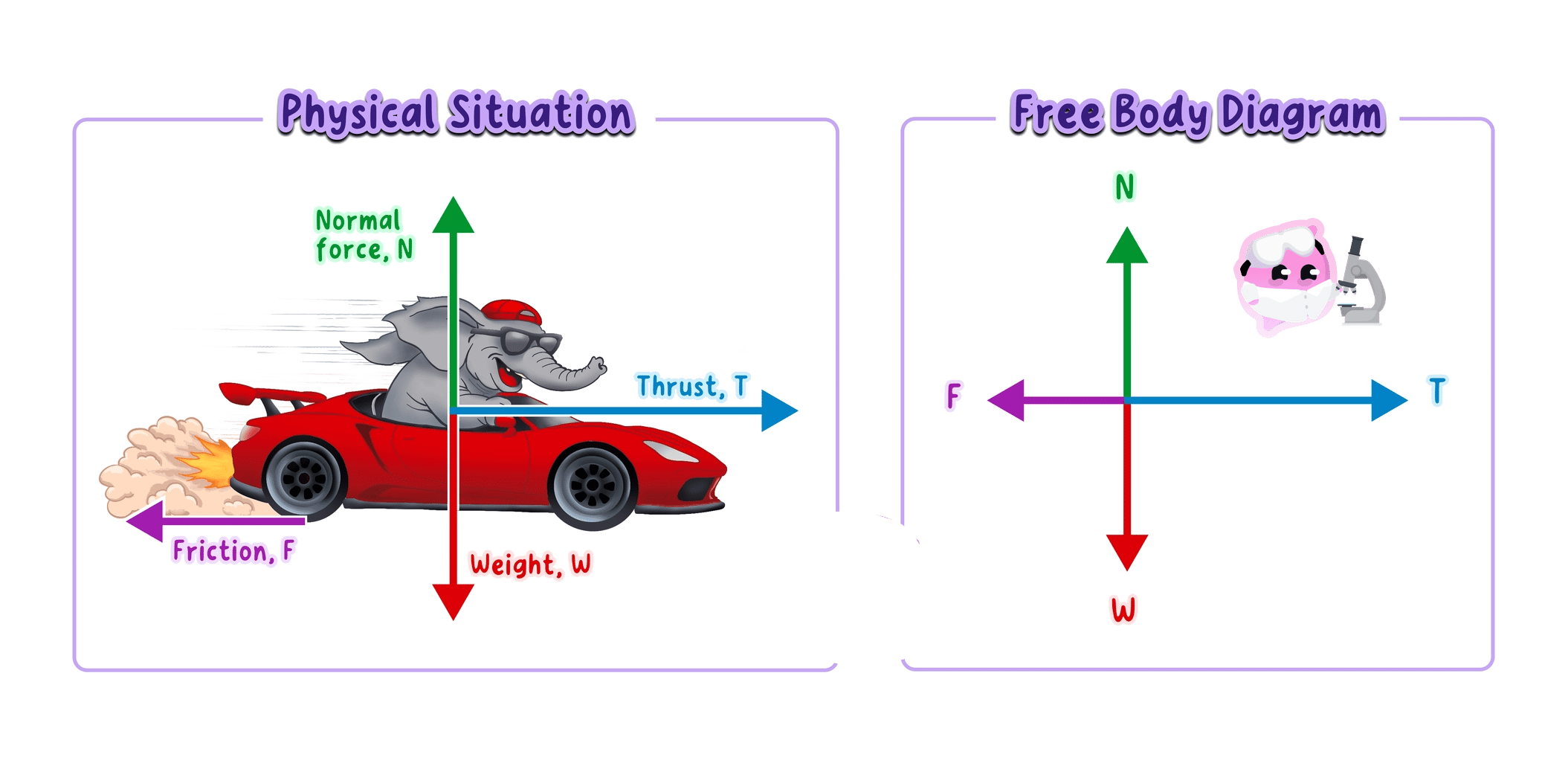
Example
Free body diagram of a hanging lamp
- A lamp hangs from the ceiling of a classroom on a single cable and does not move.
- Draw the lamp as a small box.
- Draw an arrow straight down from the centre of the box and label it weight.
- Draw an arrow straight up from the top of the box, where the cable is attached, and label it tension.
- Make the two arrows the same length, because the lamp is not moving and the two forces are equal in size.
- Do not draw the ceiling or the force of the lamp on the cable, because neither of these is a force on the lamp.
Example
Free body diagram of a box being dragged
- A removal worker drags a heavy box across a carpet to the right by pulling on a horizontal rope, and the box speeds up.
- The box has four forces acting on it.
- Weight acts downwards from the centre of the box.
- The normal contact force from the carpet acts upwards.
- Tension in the rope acts to the right.
- Friction from the carpet acts to the left, opposing the sliding.
- The tension arrow is drawn longer than the friction arrow, because the box is speeding up to the right.
Example
Converting a force into an arrow length
- A force of 240 N240\ \text{N}240 N is to be drawn with a scale of 1 cm1\ \text{cm}1 cm to 40 N40\ \text{N}40 N.
- The force is drawn as an arrow 6.0 cm6.0\ \text{cm}6.0 cm long in the direction of the force.
Common Mistake
- Do not draw a force on a free body diagram only because the object is moving in that direction, because a ball rolling to the right and slowing down has only a backward horizontal force on it.
- Do not include forces that the object exerts on other objects, such as a book pushing down on a table, on the book's free body diagram.
- Do not draw equal forces with different arrow lengths, because examiners use arrow length to check your understanding of magnitude.
Exam technique
Drawing force diagrams for marks
- Use a ruler, and put a clear arrowhead on every arrow.
- Start each arrow on the object, at the point where the force acts.
- Label every arrow with the correct physics name, and include the value with its unit when it is given.
- Make the lengths of the arrows match the sizes of the forces, as a mark is often awarded for equal or unequal lengths drawn correctly.
Self review
- Why is force a vector quantity?
- What two features of a force does an arrow show?
- What is a free body diagram?
- In which direction does the normal contact force on a box on a flat floor act?
- How long is the arrow for a 90 N90\ \text{N}90 N force on a scale of 1 cm1\ \text{cm}1 cm to 20 N20\ \text{N}20 N?
