What efficiency measures
Definition
Efficiency
The fraction of the input energy transfer that is transferred usefully.
Definition
Input energy transfer
The total energy supplied to a device or system during a process.
Definition
Useful energy transfer
The part of an energy transfer that goes to the store or pathway a device is designed to produce.
- Every device receives an input energy transfer, the total energy supplied to it, from a battery, the mains, a fuel or a moving object.
- Part of the input is the useful output energy transfer, the energy that goes where the device was designed to send it.
- The rest is wasted energy, which is dissipated, usually into the thermal energy stores of the device and its surroundings.
- Because energy is conserved, the useful output and the wasted energy always add up to the input, so wasted energy=input energy−useful output energy\text{wasted energy} = \text{input energy} - \text{useful output energy}wasted energy=input energy−useful output energy.
- Efficiency compares the useful output with the input, and it shows what fraction of the energy supplied does the job.
- The equation is efficiency=useful output energy transferinput energy transfer\text{efficiency} = \dfrac{\text{useful output energy transfer}}{\text{input energy transfer}}efficiency=input energy transferuseful output energy transfer, with both energies measured in joules.
- Both energies must be in the same unit, because the units cancel and efficiency itself has no unit.
- Efficiency can be given as a decimal between 000 and 111, or as a percentage by multiplying the decimal by 100100100, so 0.650.650.65 is the same as 65%65\%65%.
- The useful output can never be larger than the input, so efficiency can never be greater than 111 or 100%100\%100%.
- In every real device some energy is dissipated, so the efficiency is always less than 111 or 100%100\%100%.
- Because power is energy transferred per second, efficiency can also be calculated from useful power outputtotal power input\dfrac{\text{useful power output}}{\text{total power input}}total power inputuseful power output, as long as both powers are for the same device over the same time.
Typical efficiencies
- Electric kettle: about 90%90\%90%, because the element sits in the water it is heating.
- Large electric motor: up to about 90%90\%90%, with the rest dissipated by resistance in the coils and friction in the bearings.
- Petrol car engine: about 25%25\%25%, because most of the energy from the fuel leaves as hot exhaust gases and by heating the engine.
- Filament lamp: about 5%5\%5%, because most of the energy is transferred by heating the surroundings instead of by light.
- A device with a high efficiency wastes only a small fraction of its input, while a device with a low efficiency dissipates most of the energy supplied to it.
- Comparing efficiencies tells you which of two devices wastes the smaller fraction of its input, which is not the same as which one wastes less energy in total.
Calculating efficiency
- First decide what the device is for, because that decides which output counts as useful.
- For a lamp the useful output is energy transferred by light, but for an electric heater it is energy transferred by heating.
- Write down the useful output energy and the input energy, checking that both are in joules.
- Divide the useful output by the input to get the efficiency as a decimal.
- Multiply by 100100100 only if the question asks for a percentage, and add the %\%% sign.
- The equation can be rearranged to find a missing energy, giving useful output=efficiency×input\text{useful output} = \text{efficiency} \times \text{input}useful output=efficiency×input and input=useful outputefficiency\text{input} = \dfrac{\text{useful output}}{\text{efficiency}}input=efficiencyuseful output.
- A percentage efficiency must be turned back into a decimal before you rearrange, so 40%40\%40% becomes 0.400.400.40.
- Round the final answer to a sensible number of significant figures, usually the same as the data in the question.
Efficiency from a Sankey diagram
Definition
Sankey diagram
A diagram that shows energy transfers as arrows whose widths are proportional to the amount of energy transferred.
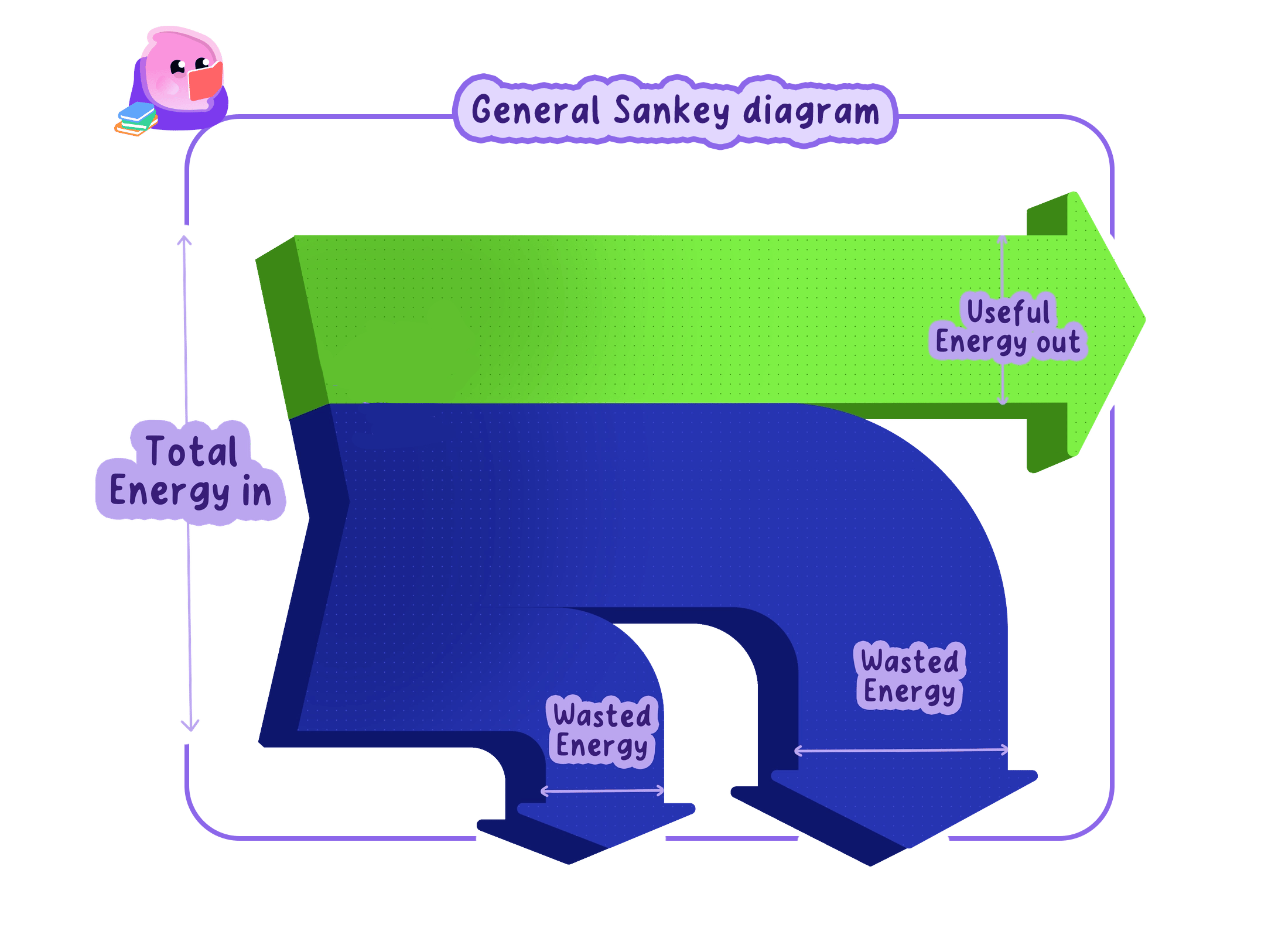
- A Sankey diagram shows energy transfers as arrows, and the width of each arrow is proportional to the energy it represents.
- The input energy enters as one wide arrow on the left.
- The useful output continues straight on, and each wasted transfer branches off and usually curves downwards.
- The widths of all the output arrows add up to the width of the input arrow, which is the conservation of energy shown as a picture.
- When the diagram is drawn on squared paper, each square stands for a fixed amount of energy, so counting squares across an arrow gives its energy.
- The efficiency is the width of the useful arrow divided by the width of the input arrow, so a useful arrow half as wide as the input shows an efficiency of 0.50.50.5 or 50%50\%50%.
- A device with a high efficiency has a wide useful arrow and narrow wasted arrows.
Example
Efficiency of a motor
- An electric motor receives 2400 J2400\ \text{J}2400 J of energy and transfers 1800 J1800\ \text{J}1800 J to the gravitational potential energy store of the load it lifts.
- As a percentage this is 0.75×100=75%0.75 \times 100 = 75\%0.75×100=75%.
- The wasted energy is 2400−1800=600 J2400 - 1800 = 600\ \text{J}2400−1800=600 J, which is dissipated to the thermal energy stores of the motor and the surroundings.
Example
Finding the input energy
- A gas boiler has an efficiency of 90%90\%90% and transfers 45 000 J45\,000\ \text{J}45000 J usefully to the water in a heating system every second.
- Convert the percentage to a decimal: 90%=0.9090\% = 0.9090%=0.90.
- The boiler must take in 50 000 J50\,000\ \text{J}50000 J from its fuel every second, and the other 5000 J5000\ \text{J}5000 J is carried away by the hot exhaust gases.
Example
Efficiency from power
- A food mixer has a power rating of 400 W400\ \text{W}400 W and an efficiency of 0.650.650.65.
- Each second 260 J260\ \text{J}260 J goes to the kinetic energy store of the beaters and the mixture, and the other 140 J140\ \text{J}140 J is dissipated by heating and sound.
Example
Reading a Sankey diagram
- On a Sankey diagram for a filament lamp, each small square represents 5 J5\ \text{J}5 J.
- The input arrow is 202020 squares wide, so the input energy is 20×5=100 J20 \times 5 = 100\ \text{J}20×5=100 J.
- The light arrow is 111 square wide, so the useful output is 5 J5\ \text{J}5 J, and the arrow curving away for heating the surroundings is 191919 squares wide, which is 95 J95\ \text{J}95 J.
- The lamp has an efficiency of 5%5\%5%, so almost all of its input energy is dissipated by heating.
Common Mistake
- Do not divide the input by the useful output, because that gives a number bigger than 111, which is impossible for an efficiency.
- Do not put the wasted energy on the top of the fraction, because the top must always be the useful output energy transfer.
- Do not give an efficiency a unit such as joules, because the units cancel and the answer is a pure number or a percentage.
Exam technique
Efficiency calculations
- You are expected to recall the efficiency equation, so write it down in full before you substitute any numbers.
- Read the question for clues about which output is useful, and check whether the answer is wanted as a decimal or as a percentage.
- If your answer is greater than 111 or 100%100\%100%, you have turned the fraction upside down, so check before moving on.
- When the data are given as powers in watts, use them in the same way as energies, because both the top and bottom of the fraction cover the same time.
Self review
- State the equation for efficiency in terms of energy transfers.
- Explain why efficiency has no unit.
- A motor receives 500 J500\ \text{J}500 J and transfers 350 J350\ \text{J}350 J usefully, so calculate its efficiency as a percentage.
- A device is 20%20\%20% efficient and has an input of 800 J800\ \text{J}800 J, so calculate its useful output.
- Describe how the efficiency is found from a Sankey diagram.
