What dissipation means
Definition
Dissipation
The spreading of energy into the thermal energy stores of the surroundings, where it is stored in a less useful way.
Definition
Useful energy transfer
The part of an energy transfer that goes to the store or pathway a device is designed to produce.
Definition
Wasted energy
Energy that is transferred to stores that do not serve the intended purpose of a device or process.
- Whenever energy is transferred in a system, the total energy stays the same, because energy cannot be created or destroyed.
- Conservation of energy tells you how much energy there is after a transfer, but it does not tell you how useful that energy still is.
- Every real device transfers part of its energy along the pathway it was built for, and this part is its useful energy transfer.
- The rest of the energy goes to stores that do nothing for the purpose of the device, and this energy is described as wasted energy.
- In almost every case the wasted energy ends up in the thermal energy stores of the device and its surroundings, which become slightly warmer.
- This spreading out of energy into the surroundings is called dissipation, and energy that has spread out in this way is said to be dissipated.
- Dissipated energy is stored in a less useful way, because it is shared out among a huge number of particles in the air, the ground and nearby objects.
- Each of those particles gains only a tiny amount of energy, so the temperature of the surroundings rises by only a very small amount.
- Energy is only transferred by heating from a hotter object to a cooler one, so energy spread through surroundings that are all at almost the same temperature has nowhere to flow to and cannot easily be made to do another job.
- A mug of tea at 80 ∘C80\ ^\circ\text{C}80 ∘C holds enough energy in its thermal energy store to warm your hands, but after it has cooled the same energy is spread through all the air in the kitchen and raises its temperature by far less than 1 ∘C1\ ^\circ\text{C}1 ∘C.
- The energy has not disappeared, yet it is now stored in a way that is almost impossible to use.
- Dissipation only happens in one direction, because energy spreads out by itself but never gathers itself back into a concentrated store, so a cold cup of tea never warms up again by taking energy from the room.
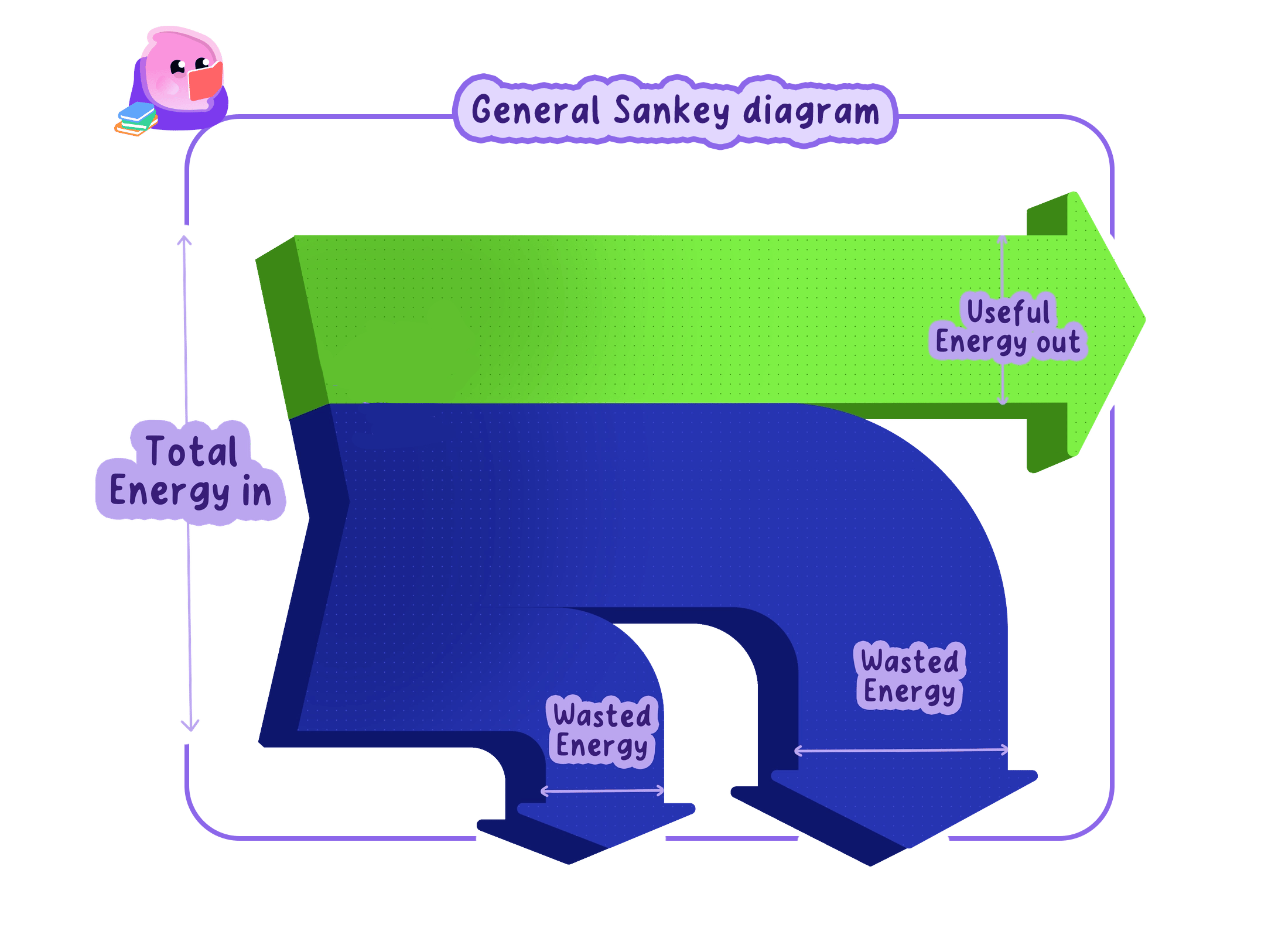
- In an energy transfer diagram such as the one above, the arrow that bends away from the main flow shows energy leaving the useful pathway and being dissipated to the surroundings.
- The useful arrow and the wasted arrow together carry the same amount of energy as the input arrow, because no energy is created or destroyed.
How energy is dissipated
- Friction: when two surfaces slide or rub against each other, work is done against friction, so energy is transferred mechanically into the thermal energy stores of both surfaces.
- Tiny bumps on each surface catch on one another and make the particles at the surfaces vibrate faster, which is why rubbing your hands together on a cold morning warms them.
- Air resistance and drag: an object moving through air or water has to push the fluid out of its way.
- Work done against air resistance transfers energy from the kinetic energy store of the object to the kinetic and thermal energy stores of the air, and this energy spreads out behind the object.
- The faster the object moves, the larger the air resistance, so a car at motorway speed dissipates energy much more quickly than the same car in town.
- Electrical resistance: when a current flows through a wire or component, the moving charges collide with the vibrating ions of the metal.
- These collisions make the ions vibrate more, so energy is transferred into the thermal energy store of the wire, which is why cables, chargers and circuit boards become warm when they carry a current.
- Sound: vibrating parts of a machine make the surrounding air vibrate, and energy is carried away from the machine by sound waves.
- The sound spreads out and is absorbed by walls, furniture and air, so this energy also ends up in thermal energy stores.
- Unwanted heating: any part of a device that is hotter than its surroundings transfers energy to them by heating, including by infrared radiation, even when that transfer is not wanted.
- A light bulb, a games console and the engine of a car all warm the air around them in this way while they are working.
- Each of these processes finishes in the same place, the thermal energy stores of the surroundings, so a full description always names that store rather than only saying that the energy is wasted.
Dissipation in everyday systems
- A car braking: friction between the brake pads and the brake discs transfers energy from the car's kinetic energy store to the thermal energy stores of the brakes.
- After a hard stop from motorway speed the discs can be well over 300 ∘C300\ ^\circ\text{C}300 ∘C, and they then transfer this energy by heating to the air flowing past them.
- None of this energy can be used to speed the car up again, so it has been dissipated.
- A cyclist freewheeling: when a cyclist stops pedalling on a flat road, the bicycle gradually slows down.
- Air resistance and friction in the wheel bearings and tyres transfer energy from the kinetic energy store of the cyclist and bicycle to the thermal energy stores of the air, the road and the bearings.
- A bouncing ball: a dropped ball never bounces back up to the height it was released from.
- Each time it hits the floor the ball is squashed and springs back, and some energy is transferred to the thermal energy stores of the ball and the floor and carried away by sound.
- Less energy returns to the kinetic energy store of the ball, so less can be transferred to its gravitational potential energy store on the way up, and every bounce is lower than the one before.
- A swinging pendulum: a pendulum swings through a smaller arc each time, because air resistance and friction at the pivot dissipate energy from its kinetic and gravitational potential energy stores on every swing.
- A phone charging: the charger and the phone both feel warm, because resistance in their circuits dissipates part of the energy transferred from the mains instead of all of it reaching the chemical energy store of the battery.
- A spinning fairground ride: when the motor of a waltzer is switched off the cars keep turning for a while, then slow to a stop as friction in the bearings and air resistance dissipate the energy in their kinetic energy stores.
Example
Energy dissipated by a bouncing ball
- A tennis ball of mass 0.060 kg0.060\ \text{kg}0.060 kg is dropped from a height of 2.0 m2.0\ \text{m}2.0 m and rebounds to a height of 1.5 m1.5\ \text{m}1.5 m, with g=10 N/kgg = 10\ \text{N/kg}g=10 N/kg.
- Energy in the gravitational potential energy store at the start:
- Energy in the gravitational potential energy store at the top of the bounce:
- The energy dissipated during the bounce is the difference between the two values:
- This 0.30 J0.30\ \text{J}0.30 J has been transferred to the thermal energy stores of the ball, the floor and the air, partly by sound, so the total energy is unchanged but less of it is in a useful store.
Example
Energy dissipated by braking
- A car of mass 1200 kg1200\ \text{kg}1200 kg travelling at 15 m/s15\ \text{m/s}15 m/s brakes to a stop at a set of traffic lights.
- Energy in the kinetic energy store of the car before braking:
- When the car has stopped its kinetic energy store is empty, so all 135 000 J135\,000\ \text{J}135000 J has been transferred by friction to the thermal energy stores of the brake pads and discs.
- The hot brakes then transfer this energy by heating to the air flowing past them, so it is dissipated to the surroundings and cannot be used to move the car again.
Common Mistake
- Do not write that energy is lost, used up or destroyed, because dissipated energy still exists in the thermal energy stores of the surroundings.
- Do not write heat energy, because heating is a way of transferring energy, so name the thermal energy store instead.
- Do not call sound an energy store, because sound is a pathway that carries energy away and ends up in thermal energy stores.
Exam technique
Describing dissipation
- Start by naming the store the energy comes from, such as the kinetic energy store of a moving car.
- Name the process that causes the transfer, such as friction, air resistance or electrical resistance.
- Name the store the energy ends up in, which is almost always the thermal energy store of the object and its surroundings.
- Finish by saying that the energy has spread out into the surroundings and is now stored in a less useful way, because this last link is the mark most often left out.
- When a question asks for examples, give a named situation, such as the brakes of a car or a bouncing ball, rather than a general statement.
Self review
- What is meant by energy being dissipated?
- Name the energy store that most dissipated energy ends up in.
- Describe how friction in the brakes of a car dissipates energy.
- Explain why a bouncing ball rises to a lower height after each bounce.
- Explain why dissipated energy is described as being stored in a less useful way.
