Particles and density
Definition
Particle model
A model in which all matter is made of tiny particles whose arrangement and movement explain the properties of solids, liquids and gases.
- The particle model describes every substance as a huge number of tiny particles, which are atoms in some substances and molecules in others.
- When a substance changes from one state to another, its particles stay the same particles with the same mass, and only their arrangement and spacing change.
- The density of a state therefore depends on how closely the particles are packed.
- The fairest way to compare states is to imagine the same volume of each, such as a 1 cm31\ \text{cm}^31 cm3 box filled with the solid, the liquid or the gas.
- If the particles are packed more closely, more particles fit inside the box, so the box contains more mass and the state has a higher density.
- If the particles are spread further apart, fewer particles fit inside the box, so the box contains less mass and the state has a lower density.
- The gaps between particles contain nothing at all, so they add volume without adding any mass.
Solids, liquids and gases
Definition
Solid
A state of matter in which the particles are packed closely in a regular arrangement and vibrate about fixed positions.
Definition
Liquid
A state of matter in which the particles are close together in an irregular arrangement and can move past one another.
Definition
Gas
A state of matter in which the particles are far apart in a random arrangement and move quickly in all directions.
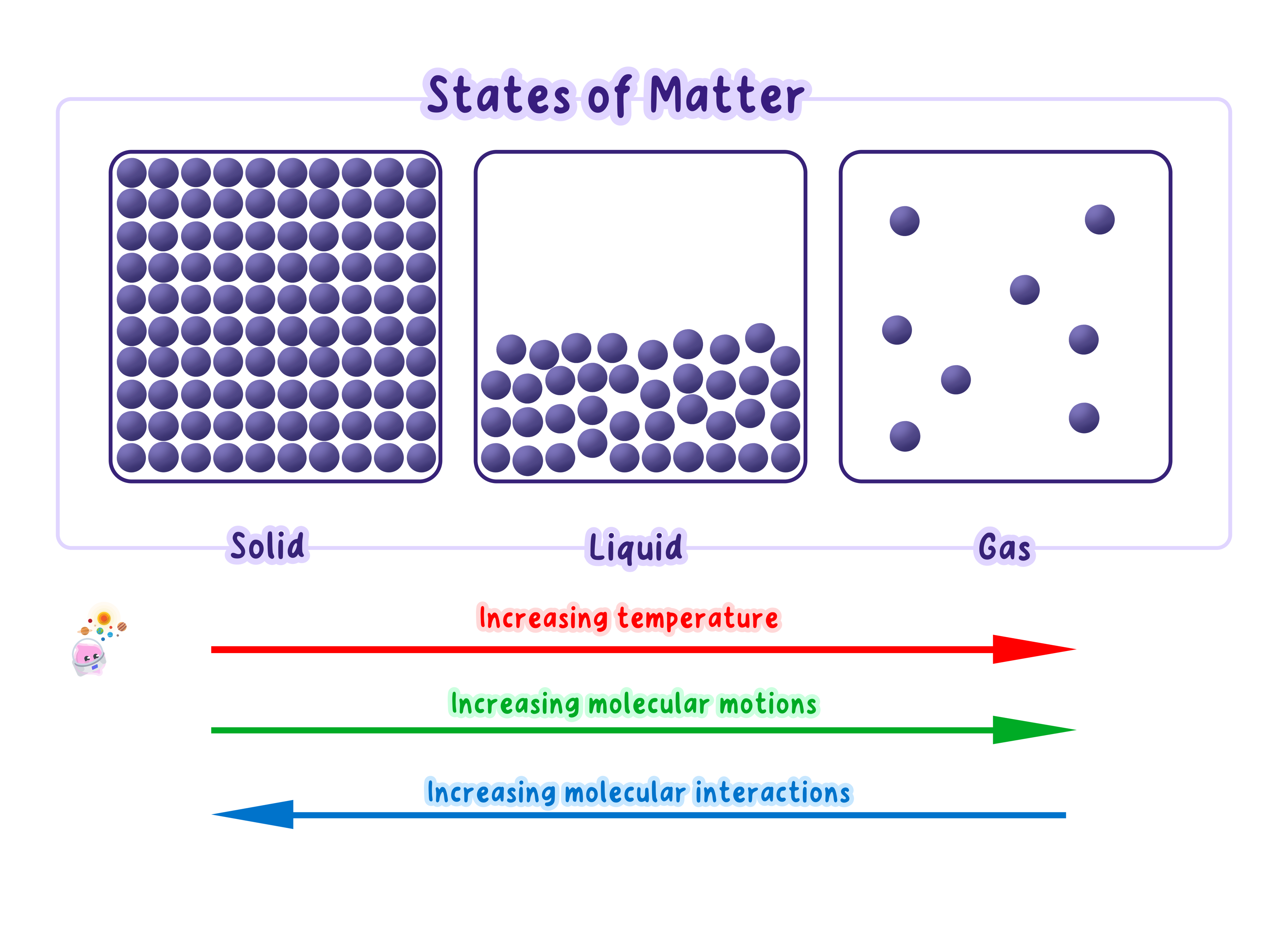
- In a solid, the particles are packed very closely in a regular arrangement and vibrate about fixed positions.
- So many particles fit into each unit of volume that solids usually have the highest density of the three states.
- In a liquid, the particles are still close together and touching, but they are arranged irregularly and can move past one another.
- The irregular arrangement leaves slightly more space than the ordered packing of a solid, so a liquid is usually slightly less dense than the solid of the same substance.
- For many metals the liquid is only a few per cent less dense than the solid, because the particle spacing hardly changes on melting.
- In a gas, the particles are far apart in a random arrangement, with distances between them many times larger than the particles themselves.
- A given volume of gas contains very few particles, so a gas has a very low density, typically around a thousand times lower than the liquid.
- Liquid water has a density of about 1000 kg/m31000\ \text{kg/m}^31000 kg/m3, while steam at 100 ∘C100\ ^\circ\text{C}100 ∘C has a density of only about 0.6 kg/m30.6\ \text{kg/m}^30.6 kg/m3.
- For most substances the order from highest to lowest density is therefore solid, then liquid, then gas.
Example
Same volume, different states
- A 2.0 m32.0\ \text{m}^32.0 m3 tank is filled first with liquid water and then with steam.
- Liquid water has a density of 1000 kg/m31000\ \text{kg/m}^31000 kg/m3, so its mass is m=ρV=1000×2.0=2000 kgm = \rho V = 1000 \times 2.0 = 2000\ \text{kg}m=ρV=1000×2.0=2000 kg.
- Steam has a density of 0.6 kg/m30.6\ \text{kg/m}^30.6 kg/m3, so its mass is m=0.6×2.0=1.2 kgm = 0.6 \times 2.0 = 1.2\ \text{kg}m=0.6×2.0=1.2 kg.
- The liquid has about 170017001700 times more mass in the same volume, because its molecules are packed so much more closely.
Water and ice
- Water is an important exception to the usual pattern, because solid ice is less dense than liquid water.
- When water freezes, its molecules lock into an open, regular structure that holds them slightly further apart than in the liquid.
- Ice has a density of about 920 kg/m3920\ \text{kg/m}^3920 kg/m3, which is lower than the 1000 kg/m31000\ \text{kg/m}^31000 kg/m3 of liquid water.
- This is why ice cubes float in a drink and why ponds freeze from the top downwards, leaving liquid water underneath.
- The explanation still uses the same idea as every other substance: the molecules in ice are spaced further apart, so there is less mass in each unit of volume.
Exam technique
Explaining density differences
- Build the answer as a chain: the spacing of the particles, then the number of particles in the same volume, then the mass in that volume, then the density.
- Always compare the same volume of each state, because density is about mass in a given volume, not about the size of the sample.
- Use the words atoms or molecules where the question names the substance, and particles when it does not.
- Describe both the arrangement and the spacing, for example regular and close together for a solid.
Common Mistake
- Do not write that the particles in a gas are lighter, smaller or less dense than in a liquid, because the particles themselves do not change.
- Do not say that the spaces between gas particles are filled with air, because the spaces are empty.
- Do not state that a solid is always denser than its liquid, because ice is less dense than water.
- Do not describe liquid particles as far apart, because they are almost as close together as in a solid.
Self review
- Describe the arrangement of particles in a solid, a liquid and a gas.
- Explain, in terms of particles, why a gas is much less dense than a liquid.
- State why a liquid is usually slightly less dense than the solid of the same substance.
- Explain why ice floats on liquid water.
- State what is found in the spaces between the particles of a gas.
