Speed and velocity
Definition
Speed
The distance travelled by an object per unit time.
Definition
Velocity
The speed of an object in a stated direction.
- Speed is a scalar, so it tells you only how fast an object is moving.
- Velocity is a vector, so it tells you how fast an object is moving and in which direction.
- Two cars travelling at 13 m/s13\ \text{m/s}13 m/s, one heading north and one heading east, have the same speed but different velocities.
- The velocity of an object changes if its speed changes, if its direction changes, or if both change.
- This means an object can keep a constant speed while its velocity changes, as long as its direction is changing.
Moving in a circle
Definition
Tangent
A straight line that touches a curve at a single point and has the same gradient as the curve at that point.
- An object moving in a circle is always changing the direction in which it travels.
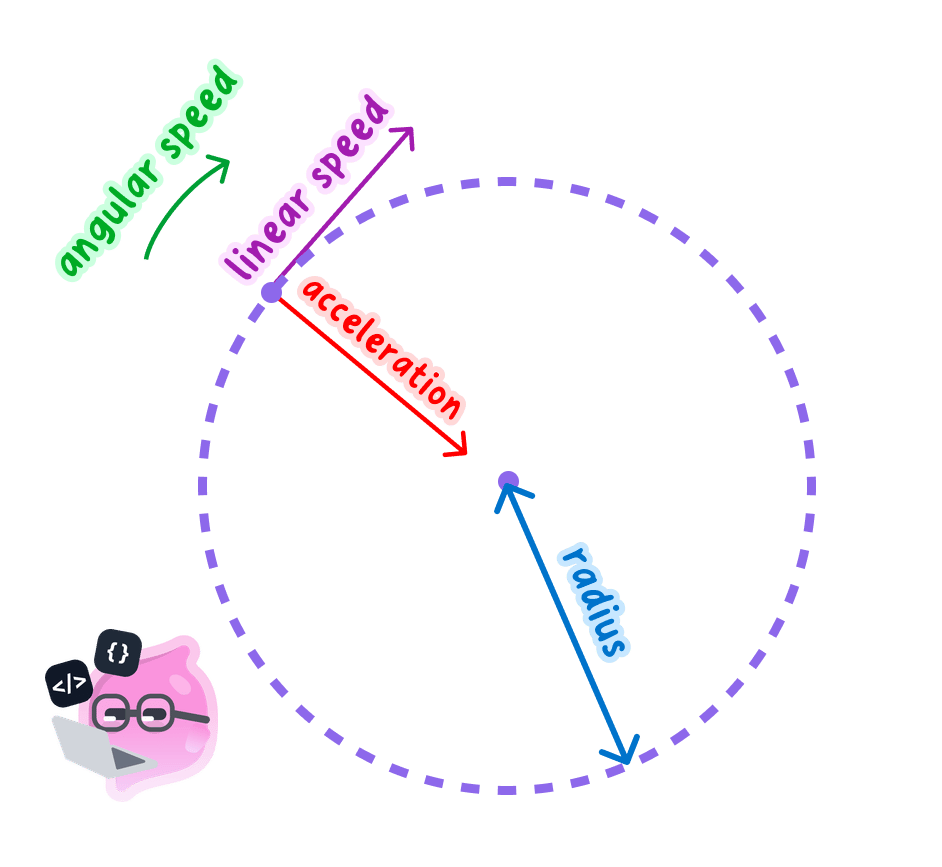
- At any instant, the object moves along the tangent to the circle, which is at right angles to the radius at that point.
- As the object moves round, the tangent points in a different direction at every point on the circle.
- If the object moves at a constant speed, the velocity arrows all have the same length, but each one points in a different direction.
- The velocity is therefore continuously changing, even though the speed is not.
- A car driving round a roundabout at a steady 10 m/s10\ \text{m/s}10 m/s shows this clearly.
- At one point the car is heading east at 10 m/s10\ \text{m/s}10 m/s.
- A quarter of the way round, the car is heading north at 10 m/s10\ \text{m/s}10 m/s.
- Halfway round, the car is heading west at 10 m/s10\ \text{m/s}10 m/s, which is the opposite velocity to the one it started with.
Acceleration in a circle
Definition
Acceleration
The rate of change of velocity.
- Acceleration is the rate of change of velocity, not only the rate of change of speed.
- An object moving in a circle at a constant speed has a changing velocity, so it is accelerating all the time.
- By Newton's first law, a changing velocity needs a resultant force, so there must be a resultant force on any object moving in a circle.
- This resultant force acts towards the centre of the circle, which is why the direction of motion keeps turning inwards.
- Different forces provide this inward resultant force in different situations.
- For a conker whirled on a string, the tension in the string pulls the conker towards the centre.
- For a car on a roundabout, friction between the tyres and the road pushes the car towards the centre.
- For a rider on a fairground ride, the normal contact force from the seat or the wall pushes the rider towards the centre.
- If the inward force suddenly disappears, the object stops turning and carries on in a straight line along the tangent, as Newton's first law predicts.
- If the string of a whirling conker snaps, the conker flies off along the tangent, not outwards along the radius.
Example
Explaining the changing velocity of a cyclist on a velodrome
- A cyclist rides round a circular velodrome track at a steady speed of 15 m/s15\ \text{m/s}15 m/s.
- Velocity is a vector, so it depends on direction as well as speed.
- As the cyclist moves round the track, the direction of motion changes continuously.
- So the velocity of the cyclist changes continuously, even though the speed stays at 15 m/s15\ \text{m/s}15 m/s.
- A changing velocity means the cyclist is accelerating, and the resultant force causing this acts towards the centre of the track.
Example
Following a hammer thrower's hammer
- A hammer thrower swings a heavy ball on a wire in a horizontal circle at a steady speed.
- The tension in the wire pulls the ball towards the centre of the circle, so its direction keeps changing.
- When the thrower lets go, the tension disappears and there is no longer an inward resultant force.
- The ball then flies off along the tangent to the circle at the point of release.
Common Mistake
- Do not say that an object moving in a circle at a constant speed has a constant velocity, because its direction is changing.
- Do not say that an object moving in a circle at a constant speed is not accelerating, because any change in velocity is an acceleration.
- Do not say that an object flies outwards along the radius when the inward force is removed, because it moves off along the tangent.
Exam technique
Explaining circular motion
- Start by stating that velocity is a vector, so it has a direction.
- Then say that the direction of the object changes continuously as it moves round the circle.
- Conclude that the velocity changes even though the speed is constant, and that the object is therefore accelerating.
- Avoid writing only "because it is moving in a circle", as this repeats the question without explaining it.
Self review
- What is the difference between speed and velocity?
- In which direction does an object moving in a circle travel at any instant?
- Explain why an object moving in a circle at a constant speed has a changing velocity.
- In which direction does the resultant force on an object moving in a circle act?
- Describe what happens to a whirling conker if its string snaps.
