Mass, weight and gravitational field
Definition
Mass
Mass is a measure of the amount of matter in an object and is measured in kilograms.
Definition
Weight
Weight is the force acting on an object because of a gravitational field.
Definition
Gravitational field strength
Gravitational field strength is the force per unit mass acting on an object placed in a gravitational field, measured in newtons per kilogram (N/kg).
- Mass is the quantity of matter in an object, it is measured in kilograms, and it has the same value wherever the object is taken.
- Weight is a force measured in newtons, and it exists only because a gravitational field is pulling on the mass of the object.
- Every object that has mass produces a gravitational field in the space around it, and any second mass placed in that field is attracted towards the first.
- The gravitational field strength at a point is the force acting on each kilogram of mass placed there, it is given the symbol ggg, and it is measured in newtons per kilogram, N/kg\text{N/kg}N/kg.
- The three quantities are linked by W=m×gW = m \times gW=m×g
- In that equation WWW is weight in newtons (N\text{N}N), mmm is mass in kilograms (kg\text{kg}kg) and ggg is gravitational field strength in newtons per kilogram (N/kg\text{N/kg}N/kg).
- The rearranged forms are m=Wgm = \dfrac{W}{g}m=gW and g=Wmg = \dfrac{W}{m}g=mW.
- Because the mass of a given object is fixed, any change in its weight must come from a change in ggg.
Why g differs between bodies
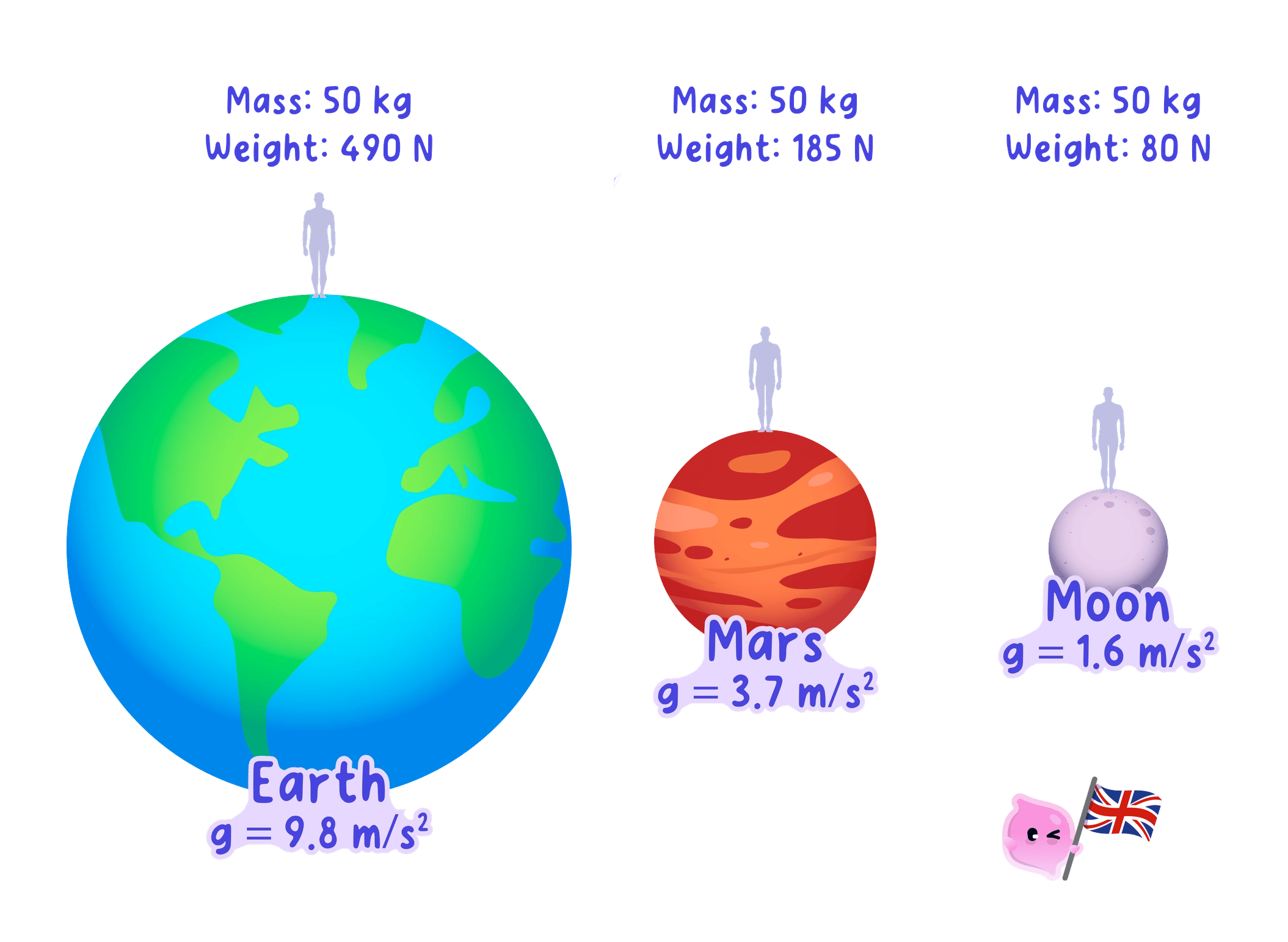
- The value of ggg at the surface of a planet or moon is set by two properties of that body, its mass and its radius.
- A body of greater mass produces a stronger gravitational field, so the pull on each kilogram at its surface is larger and ggg is larger.
- A body of larger radius holds its surface further from its centre, and gravitational field strength falls as distance from the centre increases, so ggg at the surface is smaller.
- These two effects work against each other, so a physically large body does not automatically have a large surface value of ggg.
- The Moon has roughly one eightieth of the mass of the Earth and roughly one quarter of its radius, the mass difference dominates, and the surface value falls to about 1.6 N/kg1.6\ \text{N/kg}1.6 N/kg against about 10 N/kg10\ \text{N/kg}10 N/kg on Earth.
- Mars is both less massive and smaller than the Earth and has a surface value near 3.7 N/kg3.7\ \text{N/kg}3.7 N/kg, while Jupiter is very large but far more massive still, giving a surface value near 25 N/kg25\ \text{N/kg}25 N/kg.
- Moving an object from the Earth to the Moon therefore divides its weight by about six and leaves its mass completely unchanged.
How the field falls with distance
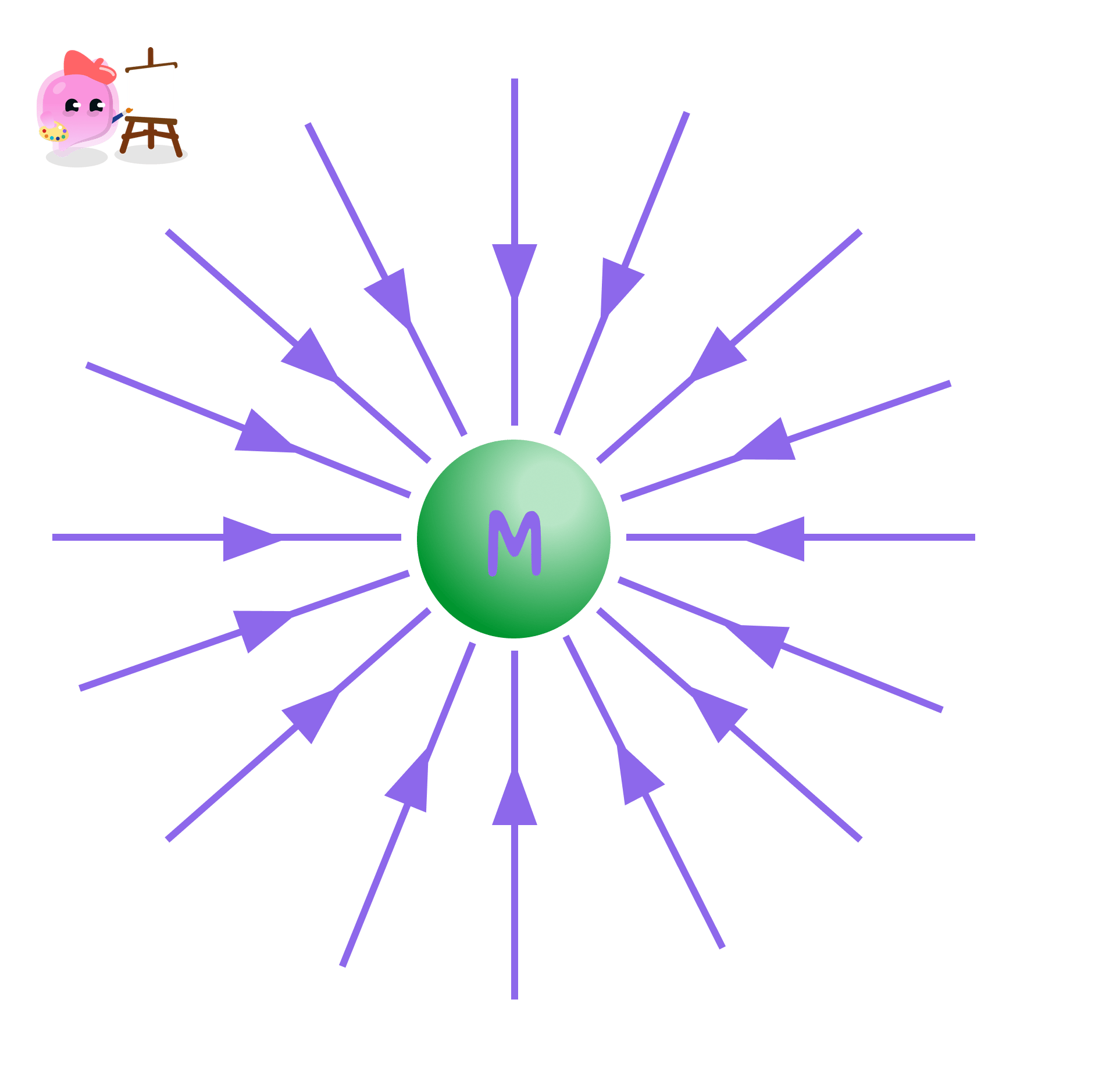
- The gravitational field around a spherical body is radial, which means the field lines point inwards towards the centre of the body.
- The lines are closest together at the surface and spread further apart with distance, and closely spaced lines represent a stronger field.
- A surface value of ggg is measured at a distance from the centre equal to the radius of that body, which is why the radius appears in any comparison between two bodies.
- Rising above the surface increases the distance from the centre and reduces ggg, so an object weighs very slightly less at the top of Snowdon than at sea level.
- That reduction is far too small to notice on ordinary scales, whereas the change between the Earth and the Moon alters a newtonmeter reading by a factor of about six.
Example
Weight of a rover on the Moon
- A rover of mass 180 kg180\ \text{kg}180 kg is landed on the Moon, where g=1.6 N/kgg = 1.6\ \text{N/kg}g=1.6 N/kg.
- Start from the equation W=m×gW = m \times gW=m×g.
- Substituting gives W=180×1.6W = 180 \times 1.6W=180×1.6.
- The weight on the Moon is 288 N288\ \text{N}288 N.
- On Earth the same rover would weigh 180×10=1800 N180 \times 10 = 1800\ \text{N}180×10=1800 N, and its mass would still be 180 kg180\ \text{kg}180 kg in both places.
Example
Finding g from a measured weight
- A 2.5 kg2.5\ \text{kg}2.5 kg instrument package rests on the surface of Mars and its weight is measured as 9.3 N9.3\ \text{N}9.3 N.
- Rearranging W=m×gW = m \times gW=m×g gives g=Wmg = \dfrac{W}{m}g=mW.
- Substituting gives g=9.32.5g = \dfrac{9.3}{2.5}g=2.59.3.
- The gravitational field strength at the surface of Mars is 3.7 N/kg3.7\ \text{N/kg}3.7 N/kg.
Example
Comparing weight on two bodies
- An astronaut and their suit have a combined mass of 130 kg130\ \text{kg}130 kg, and the weight on the Moon is to be compared with the weight on Earth.
- On Earth the weight is W=130×10=1300 NW = 130 \times 10 = 1300\ \text{N}W=130×10=1300 N.
- On the Moon the weight is W=130×1.6=208 NW = 130 \times 1.6 = 208\ \text{N}W=130×1.6=208 N.
- The difference in weight is 1300−208=1092 N1300 - 208 = 1092\ \text{N}1300−208=1092 N.
- The cause is the much smaller mass of the Moon, which gives it a weaker surface field, while the mass of the astronaut is unchanged.
Exam technique
Answering weight comparison questions
- Say which quantity stays the same and which quantity changes, because a mark is usually reserved for stating that the mass is unchanged.
- Name the cause of the change in ggg by referring to the mass and radius of the body, rather than writing only that gravity is weaker.
- Write W=m×gW = m \times gW=m×g before substituting, and show the substitution on its own line so a method mark survives an arithmetic slip.
- Use the value of ggg printed in the question rather than assuming 10 N/kg10\ \text{N/kg}10 N/kg, since astronomy questions rarely use the Earth value.
- Attach N\text{N}N to a weight, kg\text{kg}kg to a mass and N/kg\text{N/kg}N/kg to a field strength, because the unit is often the difference between two marks and one.
Common Mistake
- Do not write that an astronaut loses mass on the Moon, because only the weight changes.
- Do not quote a weight in kilograms, since kilograms measure mass and newtons measure weight.
- Do not assume the largest planet has the largest surface value of ggg, because a larger radius reduces the field strength at the surface.
- Do not describe the Moon as having no gravity, because its surface field strength is about 1.6 N/kg1.6\ \text{N/kg}1.6 N/kg rather than zero.
Self review
- State the equation linking weight, mass and gravitational field strength, with the unit of each quantity.
- Explain why the mass of an object is the same on the Earth and on the Moon while its weight is not.
- Give the two properties of a body that decide the value of ggg at its surface.
- Calculate the weight of a 45 kg45\ \text{kg}45 kg probe on the Moon, where g=1.6 N/kgg = 1.6\ \text{N/kg}g=1.6 N/kg.
- Explain why gravitational field strength decreases as distance from the centre of a planet increases.
