4.1.1 Waves transfer energy and information
Waves carry energy without carrying matter
Wave
An oscillation that transfers energy and information from one place to another without transferring matter.
- A wave begins with an oscillating source, such as a loudspeaker cone, a vibrating string or a dipper in a ripple tank.
- The source transfers energy to nearby particles or fields, and the disturbance passes from one place to the next.
- Particles in a material medium oscillate about fixed positions and have no net movement with the wave.
- A wave can carry information when variations in the wave form a signal, such as speech in sound or digital data in radio waves.
The disturbance transfers energy and information, while matter in the medium only oscillates locally.
Water waves leave the water behind
- A floating cork moves up and down as crests and troughs pass, but remains in approximately the same horizontal position.
- If the water travelled with the wave, the cork would be carried continuously across the tank.
- The travelling crests and the stationary average position of the cork show that the wave transfers energy without a net transfer of water.
Sound waves leave the air behind
- A loudspeaker cone moves backwards and forwards, producing compressions and rarefactions in the surrounding air.
- Each air particle oscillates about a fixed position and transfers energy to neighbouring particles.
- Sound reaches a listener without producing a continuous wind or moving all the air towards one wall.
- This shows that the sound disturbance travels while the air has no net movement from speaker to listener.
Do not state that particles travel with the wave; state that they oscillate about fixed positions while energy is transferred.
- Name the observation and link it directly to the conclusion.
- For water, state that a float oscillates but is not carried across; for sound, state that sound arrives without a flow of air.
- What does a wave transfer?
- What happens to particles as a wave passes?
- How does a floating cork show that water is not transferred?
- How does sound arriving without a wind show that air is not transferred?
4.1.2 Frequency, wavelength, amplitude, period and wavefronts
Wave quantities describe size, spacing and timing
Frequency
The number of complete waves or oscillations passing a point each second.
Wavelength
The distance between consecutive points on a wave that are at the same stage of an oscillation.
Amplitude
The maximum displacement of a point on a wave from its undisturbed position.
- Frequency has symbol fff and unit hertz, Hz\text{Hz}Hz, where 1 Hz1\ \text{Hz}1 Hz means one complete oscillation each second.
- Wavelength has symbol λ\lambdaλ and SI unit metre, m\text{m}m.
- Measure wavelength from crest to crest, trough to trough or compression to compression.
- Measure amplitude from the equilibrium line to a crest or trough.
- The crest-to-trough height is twice the amplitude.
Do not use the full crest-to-trough height as the amplitude; divide that height by two.
Period is the time for one oscillation
Period
The time taken for one complete oscillation or for one complete wave to pass a fixed point.
- Period has symbol TTT and SI unit second, s\text{s}s.
- Frequency and period are reciprocals: f=1Tf=\dfrac{1}{T}f=T1 and T=1fT=\dfrac{1}{f}T=f1.
Finding frequency from period
- A wave has period 0.0040 s0.0040\ \text{s}0.0040 s.
- Use f=1Tf=\dfrac{1}{T}f=T1.
- f=10.0040=250 Hzf=\dfrac{1}{0.0040}=250\ \text{Hz}f=0.00401=250 Hz.
Wavefronts join points moving in step
Wavefront
A line joining points on a wave that are at the same stage of an oscillation.
- Neighbouring wavefronts are one wavelength apart, and the direction of travel is perpendicular to the wavefronts.
- A straight source produces plane wavefronts, while a point source produces circular wavefronts.
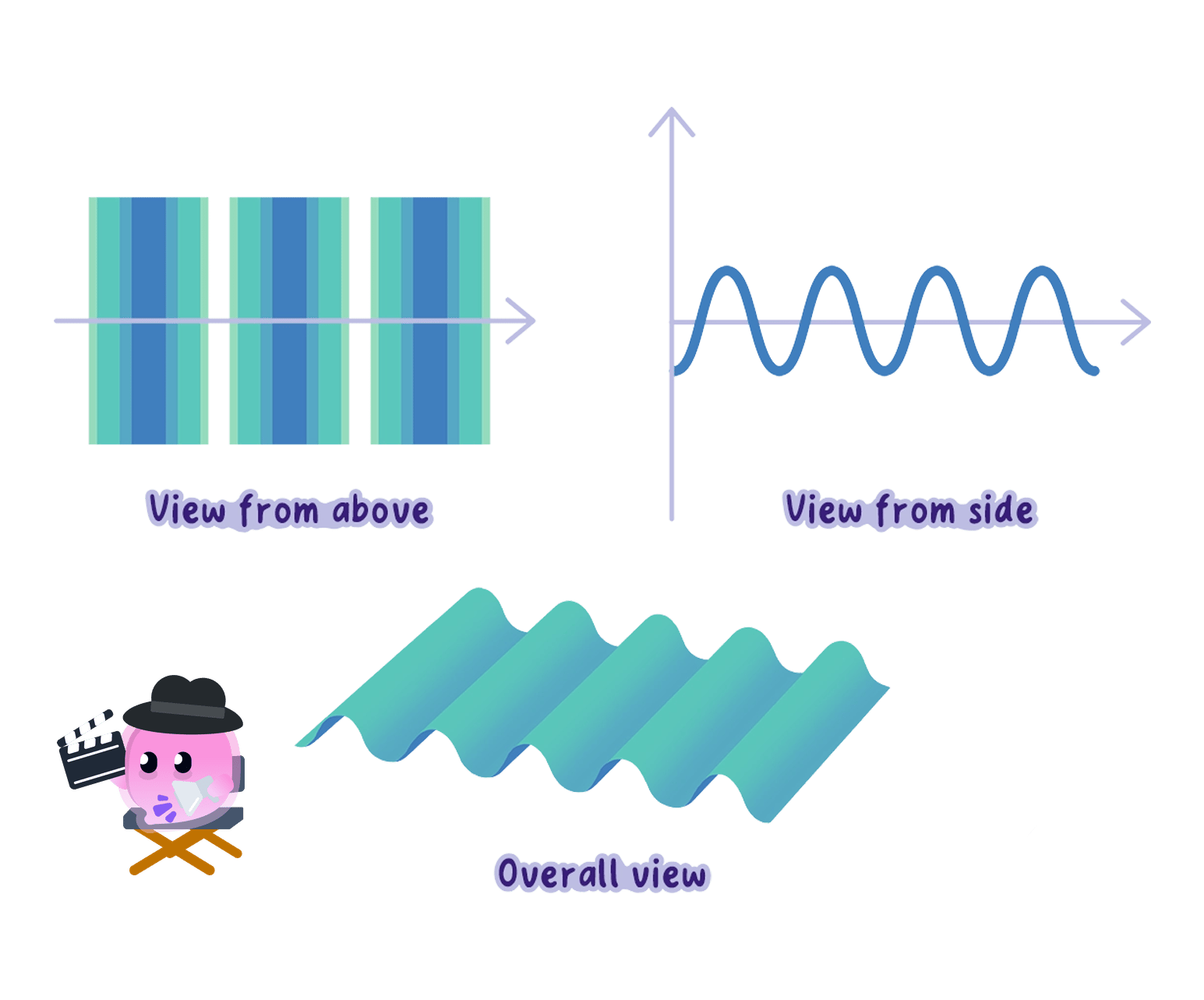
- Measure between matching points and use the diagram scale.
- Measure across several wavelengths and divide by their number to reduce percentage uncertainty.
- Define frequency and state its unit.
- Define wavelength and state two valid measurement points.
- Define amplitude.
- State the relationship between frequency and period.
- What does a wavefront represent?
4.1.3 Longitudinal and transverse waves
Wave type depends on oscillation direction
Transverse wave
A wave in which the oscillations are perpendicular to the direction of energy transfer.
Longitudinal wave
A wave in which the oscillations are parallel to the direction of energy transfer.
- Transverse waves have crests and troughs when shown as displacement diagrams.
- Electromagnetic waves, seismic S waves and water surface waves are transverse examples.
- Longitudinal waves contain compressions, where particles are closer together, and rarefactions, where particles are farther apart.
- Sound waves in air and seismic P waves are longitudinal examples.
Compare oscillation with energy transfer
- For a transverse wave, the vibration arrow is at 90∘90^\circ90∘ to the direction of travel.
- For a longitudinal wave, the vibration arrow lies along the direction of travel.
- Both types transfer energy without a net transfer of matter.
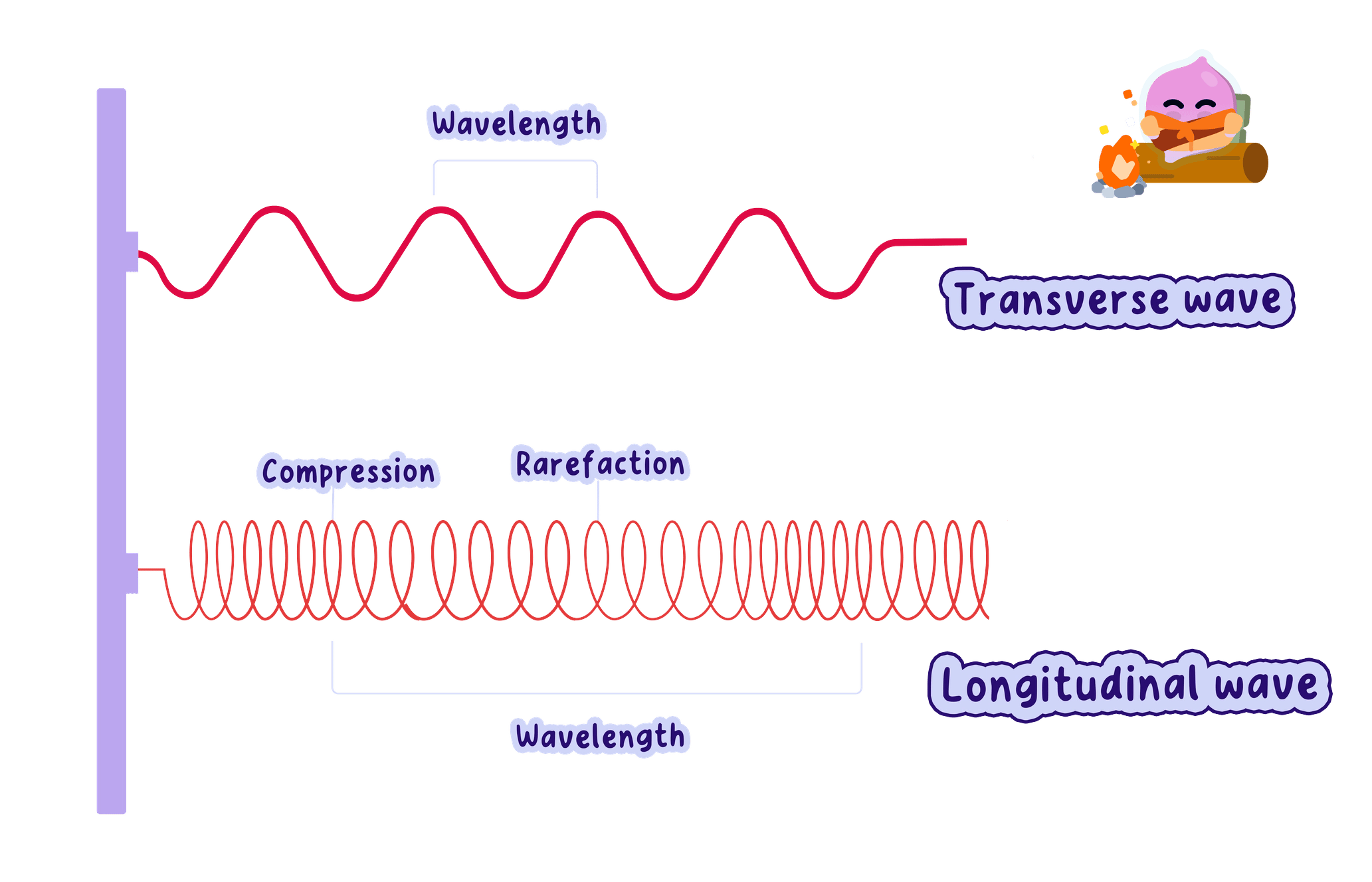
Classifying a wave from its motion
- Particles vibrate left and right while the disturbance travels to the right.
- The oscillations are parallel to the direction of energy transfer.
- The wave is longitudinal, with compressions and rarefactions.
- Do not classify a wave from whether its diagram is curved; compare oscillation direction with energy-transfer direction.
- Sound is longitudinal, while every electromagnetic wave is transverse.
- State perpendicular for transverse waves and parallel for longitudinal waves.
- Pair every named example with its wave type.
- Define a transverse wave.
- Define a longitudinal wave.
- What are compressions and rarefactions?
- Classify sound, electromagnetic, seismic P and seismic S waves.
- How do water surface particles move relative to energy transfer?
4.1.4 The wave speed equations
Two equations calculate wave speed
Wave speed
The distance travelled by a wavefront per unit time.
- The frequency-wavelength equation is v=fλv=f\lambdav=fλ.
- The distance-time equation is v=xtv=\dfrac{x}{t}v=tx.
- Use vvv in m/s\text{m/s}m/s, fff in Hz\text{Hz}Hz, λ\lambdaλ and xxx in m\text{m}m, and ttt in s\text{s}s.
Rearrange before substituting
- From v=fλv=f\lambdav=fλ, use f=vλf=\dfrac{v}{\lambda}f=λv or λ=vf\lambda=\dfrac{v}{f}λ=fv.
- From v=xtv=\dfrac{x}{t}v=tx, use x=vtx=vtx=vt or t=xvt=\dfrac{x}{v}t=vx.
- Convert units first: 1 kHz=103 Hz1\ \text{kHz}=10^3\ \text{Hz}1 kHz=103 Hz, 1 MHz=106 Hz1\ \text{MHz}=10^6\ \text{Hz}1 MHz=106 Hz and 1 cm=10−2 m1\ \text{cm}=10^{-2}\ \text{m}1 cm=10−2 m.
Calculating wave speed
- A wave has frequency 8.0 Hz8.0\ \text{Hz}8.0 Hz and wavelength 0.75 m0.75\ \text{m}0.75 m.
- Use v=fλv=f\lambdav=fλ.
- v=8.0×0.75=6.0 m/sv=8.0\times0.75=6.0\ \text{m/s}v=8.0×0.75=6.0 m/s.
Calculating wavelength
- Sound travels at 340 m/s340\ \text{m/s}340 m/s with frequency 680 Hz680\ \text{Hz}680 Hz.
- Use λ=vf\lambda=\dfrac{v}{f}λ=fv.
- λ=340680=0.50 m\lambda=\dfrac{340}{680}=0.50\ \text{m}λ=680340=0.50 m.
Frequency and wavelength vary inversely
- Wave speed is approximately constant for a wave travelling in a fixed medium.
- Because v=fλv=f\lambdav=fλ, doubling frequency halves wavelength when speed is constant.
- Do not add frequency and wavelength; their product gives wave speed.
- Do not substitute non-SI units without converting them.
- Write the equation, substitute consistent units, calculate and state the final unit.
- Visible stages preserve method marks if an arithmetic error occurs.
- State both wave speed equations.
- State the SI units of vvv, fff and λ\lambdaλ.
- Rearrange v=fλv=f\lambdav=fλ for λ\lambdaλ.
- What happens to wavelength when frequency doubles at constant speed?
- Why must centimetres be converted?
4.1.5 Measuring wave velocity
Choose a method that matches the wave
Wave velocity
The distance travelled by a wavefront per unit time.
- A direct method measures distance and time, then uses v=xtv=\dfrac{x}{t}v=tx.
- An indirect method measures frequency and wavelength, then uses v=fλv=f\lambdav=fλ.
- Equipment suitability depends on wave speed, available distance and whether wavefronts can be observed or detected.
Measure sound speed electronically
- Place two microphones a measured distance apart and connect them to an oscilloscope or data logger.
- Create a short sound near the first microphone and measure the delay between the detected signals.
- Calculate v=xtv=\dfrac{x}{t}v=tx from the separation and delay.
- A larger separation reduces percentage uncertainty, while electronic timing removes human reaction time.
Sound speed from a delay
- Two microphones are 1.50 m1.50\ \text{m}1.50 m apart and detect a pulse 4.4×10⁻³ s4.4\times10^{-3}\ \text{s}4.4×10⁻³ s apart.
- Use v=xtv=\dfrac{x}{t}v=tx.
- v=1.504.4×10−3=3.4×10² m/sv=\dfrac{1.50}{4.4\times10^{-3}}=3.4\times10^2\ \text{m/s}v=4.4×10−31.50=3.4×102 m/s.
Measuring waves in a fluid and a solid
- Aim: investigate the suitability of equipment for measuring wave speed, frequency and wavelength in water and in a solid.
- Water apparatus: ripple tank, shallow water, straight dipper, vibration generator, signal generator, lamp or strobe, screen, ruler and video camera or stopwatch.
- Water variables: frequency or depth is the independent variable, wave speed is calculated, and depth, temperature, dipper shape and method are controlled when comparing readings.
- Method, water:
- Level the tank, add a shallow uniform layer of water and adjust the dipper to produce clear parallel wavefronts.
- Set and record a stable frequency, using a strobe or video when crests move too quickly to observe accurately.
- Measure perpendicular to the wavefronts across at least five complete wavelengths, then divide by the number of wavelengths.
- Repeat in different positions, calculate a mean wavelength and use v=fλv=f\lambdav=fλ.
- Check by timing a wavefront over a measured distance and using v=xtv=\dfrac{x}{t}v=tx.
- Solid apparatus: long metal rod, secure clamps, vibration generator, signal generator, pickup or microphone, oscilloscope and ruler or tape measure.
- Method, solid:
- Support the rod securely and produce a steady vibration at a measured frequency.
- Use the pickup and oscilloscope, or the demonstrated resonance method, to locate repeating nodes or antinodes.
- Measure across several intervals; adjacent nodes are λ2\dfrac{\lambda}{2}2λ apart, so double the mean node spacing.
- Read the frequency and calculate v=fλv=f\lambdav=fλ, then repeat and compare values.
- Expected pattern: in a fixed medium, higher frequency gives shorter wavelength while wave speed remains approximately constant.
- Suitability: electronic frequency measurement and measurements across several wavelengths are better than hand timing for rapid waves over short distances.
- Uncertainty and improvements: avoid parallax, measure several wavelengths, use video or a strobe, repeat, calculate means, and control depth and temperature.
- Safety: mop up spills, keep electrical equipment away from water, secure the rod and apparatus, avoid sharp ends and keep sound at a safe level.
A boundary changes speed and wavelength
- When sound enters another medium, frequency stays constant because the source still oscillates at the same rate.
- Speed changes because wave speed depends on the medium.
- Since v=fλv=f\lambdav=fλ and fff is unchanged, wavelength changes in the same ratio as speed.
- Do not hand-time sound over a short laboratory distance because reaction time is too large.
- Do not measure one wavelength when several can be measured and divided.
- Link an equipment feature to measurement quality, such as electronic timing reducing timing uncertainty.
- State each improvement and its effect on uncertainty or reliability.
- State two methods for measuring wave speed.
- Why are two microphones suitable for sound speed?
- How does measuring several wavelengths reduce uncertainty?
- What remains constant when sound enters another medium?
- State two ripple-tank safety controls.
4.1.6 Calculating depth or distance from waves
Echo time gives a two-way distance
Echo sounding
A method of determining distance by transmitting a wave pulse, measuring the time for its reflection to return and using the wave speed.
- A pulse travels to a boundary, reflects and returns to the detector.
- The measured echo time is normally the total time for both journeys.
- The total distance is x=vtx=vtx=vt, so the one-way depth is d=vt2d=\dfrac{vt}{2}d=2vt.
- If the given time is explicitly one-way, do not divide by two.
Use the speed in the stated medium
- Use the wave speed for the material through which the pulse travels.
- Typical values are about 340 m/s340\ \text{m/s}340 m/s in air, 1500 m/s1500\ \text{m/s}1500 m/s in water and 3.0×10⁸ m/s3.0\times10^8\ \text{m/s}3.0×108 m/s for radio waves in air.
- Convert times using 1 ms=10−3 s1\ \text{ms}=10^{-3}\ \text{s}1 ms=10−3 s and 1 μs=10−6 s1\ \mu\text{s}=10^{-6}\ \text{s}1 μs=10−6 s.
Finding seabed depth
- A sonar pulse returns after 0.16 s0.16\ \text{s}0.16 s and travels at 1500 m/s1500\ \text{m/s}1500 m/s.
- Total distance: x=vt=1500×0.16=240 mx=vt=1500\times0.16=240\ \text{m}x=vt=1500×0.16=240 m.
- Depth: d=2402=120 md=\dfrac{240}{2}=120\ \text{m}d=2240=120 m.
Finding aircraft distance
- A radar pulse returns after 4.0×10⁻⁴ s4.0\times10^{-4}\ \text{s}4.0×10⁻⁴ s at 3.0×10⁸ m/s3.0\times10^8\ \text{m/s}3.0×108 m/s.
- Total distance: x=(3.0×10⁸)(4.0×10⁻⁴)=1.2×10⁵ mx=(3.0\times10^8)(4.0\times10^{-4})=1.2\times10^5\ \text{m}x=(3.0×10⁸)(4.0×10⁻⁴)=1.2×10⁵ m.
- One-way distance: d=6.0×10⁴ m=60 kmd=6.0\times10^4\ \text{m}=60\ \text{km}d=6.0×10⁴ m=60 km.
Rearrange for time or speed
- From d=vt2d=\dfrac{vt}{2}d=2vt, use t=2dvt=\dfrac{2d}{v}t=v2d or v=2dtv=\dfrac{2d}{t}v=t2d.
- Keep the factor of two attached to the two-way journey.
- Divide the total echo distance by two exactly once.
- Do not halve when the stated time is one-way.
- Do not treat milliseconds or microseconds as seconds.
- Write x=vtx=vtx=vt for the total journey, then show the division by two.
- Include the final unit and a sensible number of significant figures.
- Why is echo time usually two-way?
- State the depth equation.
- When should you not divide by two?
- How do you convert milliseconds to seconds?
- Rearrange d=vt2d=\dfrac{vt}{2}d=2vt for ttt.
