Question 26
FA student builds a model of the national grid.
In Experiment 1, a 12 V alternating current supply is connected to a 12 V lamp through two long, thin resistance wires. The lamp is very dim.
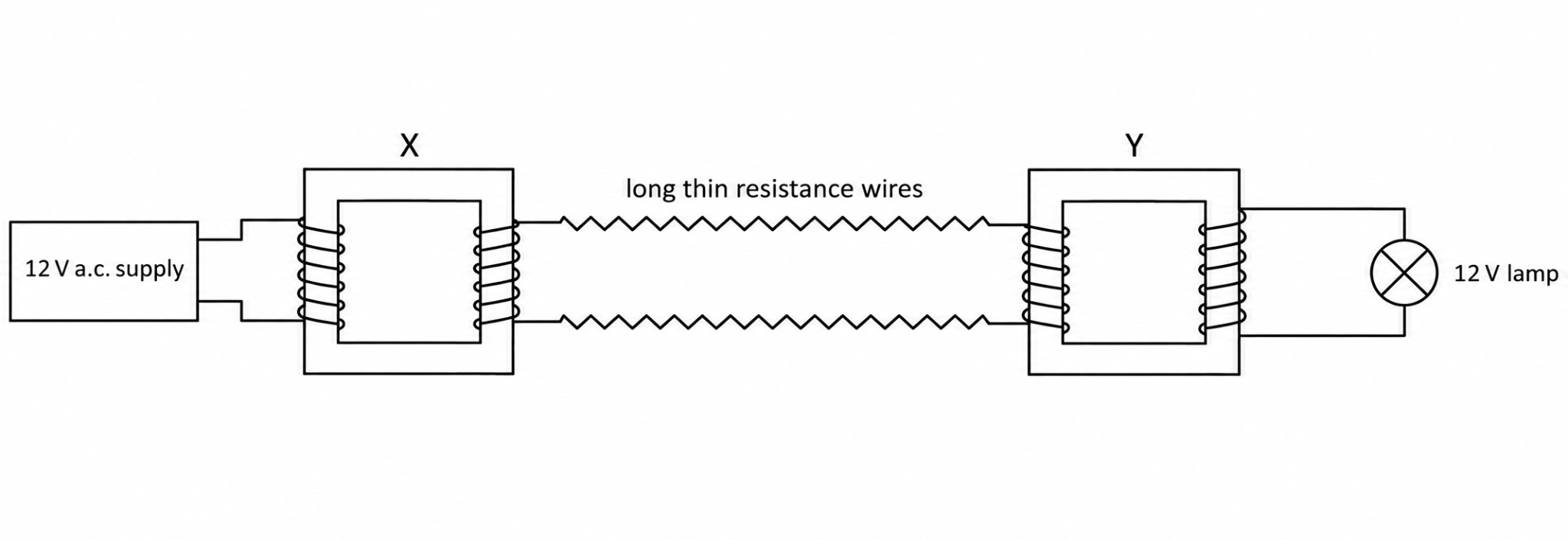
In Experiment 2, the student adds two transformers, X and Y, as shown in the Figure. The lamp is now bright.
Figure
a.[2]
State which transformer, X or Y, is the step-down transformer.
Give a reason for your answer.
b.[3]
Explain why the lamp is very dim in Experiment 1.
c.[3]
Explain why the lamp is bright in Experiment 2.
d.[1]
State what the long, thin resistance wires represent in the national grid.
13.2 Transformers and the National Grid Questions
108 exam-style questions on Edexcel GCSE Physics 13.2 Transformers and the National Grid, covering 13.2.1 Transformers and induction, 13.2.2 The transformer turns-ratio equation, 13.2.3 The National Grid, 13.2.4 The transformer power equation, and 13.2.5 Advantages of high-voltage transmission. Each one has a worked solution and a mark scheme showing where the marks go.