5.3.1 Emission of radiation and temperature
Temperature controls thermal radiation
Thermal radiation
Electromagnetic radiation emitted by an object because of its temperature.
- Every object above absolute zero emits electromagnetic radiation, including objects that feel cold.
- At everyday temperatures, most emitted radiation is infrared, which is invisible to the human eye.
- As temperature rises, the total intensity of emitted radiation increases, so more energy is transferred each second from each square metre of surface.
- A sufficiently hot object also emits visible light, changing from dull red towards orange, yellow and white as its temperature rises.
Hotter objects emit shorter wavelengths
Wavelength distribution
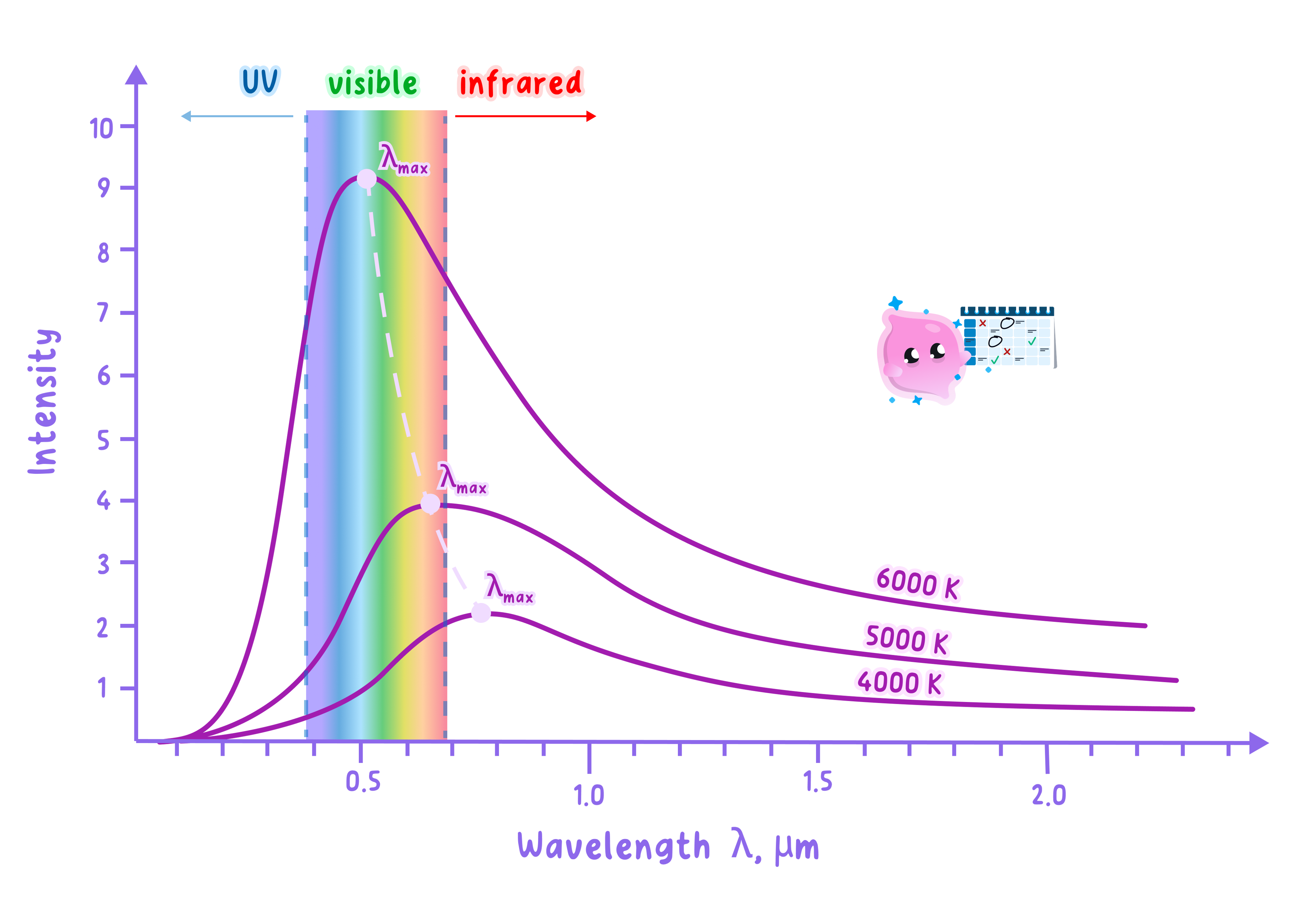
A graph or pattern showing how the intensity of radiation emitted by an object is spread across a range of wavelengths.
- An object emits a continuous range of wavelengths rather than one exact wavelength.
- The peak wavelength is the wavelength at which the emitted intensity is greatest.
- As temperature increases, the curve becomes higher and its peak shifts to a shorter wavelength.
- The greater area beneath the hotter curve represents a greater total power emitted.
Comparing two identical surfaces
- A surface at 600 K600\,\text{K}600K emits radiation with greater total intensity than the same surface at 300 K300\,\text{K}300K.
- Its wavelength distribution peaks at a shorter wavelength.
- Both surfaces still emit a range of wavelengths, mainly in the infrared at these temperatures.
Do not write that only glowing objects emit radiation; glowing objects are hot enough for part of their emission to lie in the visible range.
Write a complete comparison
- State that both objects emit radiation.
- State that the hotter object emits with greater intensity.
- State that the hotter object's distribution peaks at a shorter wavelength.
- What is thermal radiation?
- How does emitted intensity change as temperature rises?
- What happens to peak wavelength as temperature rises?
- Why can a very hot object glow visibly?
5.3.2 Radiation balance and constant temperature
Constant temperature requires radiation balance
Thermal equilibrium
The condition in which an object has no net transfer of energy with its surroundings, so its temperature stays constant.
- An object continually absorbs electromagnetic radiation from its surroundings and emits electromagnetic radiation to its surroundings.
- Its temperature depends on the balance between the average power absorbed and the average power emitted.
- If average power absorbed is greater than average power emitted, the object's internal energy increases and its temperature rises.
- If average power emitted is greater than average power absorbed, the object's internal energy decreases and its temperature falls.
- At constant temperature, average power emitted equals average power absorbed, so the net energy transfer is zero.
Temperature changes restore the balance
- A warmer object emits radiation at a greater intensity than the same object when cooler.
- If absorption temporarily exceeds emission, the object warms and its emitted power rises until balance is restored.
- If emission temporarily exceeds absorption, the object cools and its emitted power falls until balance is restored.
- Equal powers do not mean that emission and absorption stop; both transfers continue at equal average rates.
Radiation balance over one minute
- A surface absorbs 2400 J2400\,\text{J}2400J and emits 1800 J1800\,\text{J}1800J in 60 s60\,\text{s}60s.
- The net energy gain is 2400−1800=600 J2400-1800=600\,\text{J}2400−1800=600J.
- The average net power is P=Et=60060=10 WP=\dfrac{E}{t}=\dfrac{600}{60}=10\,\text{W}P=tE=60600=10W, so the surface warms.
- As it warms, its emitted power increases and the imbalance becomes smaller.
Do not state that an object at constant temperature emits no radiation; it emits and absorbs equal average powers.
Use power, not a single photon
- Compare the average rates of energy transfer when explaining whether temperature rises, falls or stays constant.
- Write absorbed power equals emitted power for a constant temperature.
- Use P=EtP=\dfrac{E}{t}P=tE when energy and time are supplied.
- What two radiation transfers occur continuously?
- What happens when absorbed power exceeds emitted power?
- What condition keeps an object's temperature constant?
- Why does emission continue at thermal equilibrium?
5.3.3 The temperature of the Earth
Earth's temperature depends on radiation balance
Radiation balance
The comparison between the average power a body absorbs and the average power it emits, which determines whether its temperature rises, falls or stays constant.
- The Sun supplies Earth mainly with short-wavelength radiation, including visible light and some ultraviolet and infrared radiation.
- Some incoming radiation is reflected by clouds, the atmosphere, ice and light-coloured surfaces.
- The remaining radiation is absorbed by the atmosphere, land and oceans, increasing their internal energy.
- Earth emits energy to space mainly as long-wavelength infrared radiation.
- Earth warms when absorbed solar power exceeds emitted infrared power and cools when emitted power exceeds absorbed power.
- A stable average temperature requires the average incoming absorbed power to equal the average outgoing emitted power.
The atmosphere changes outgoing radiation
Greenhouse effect
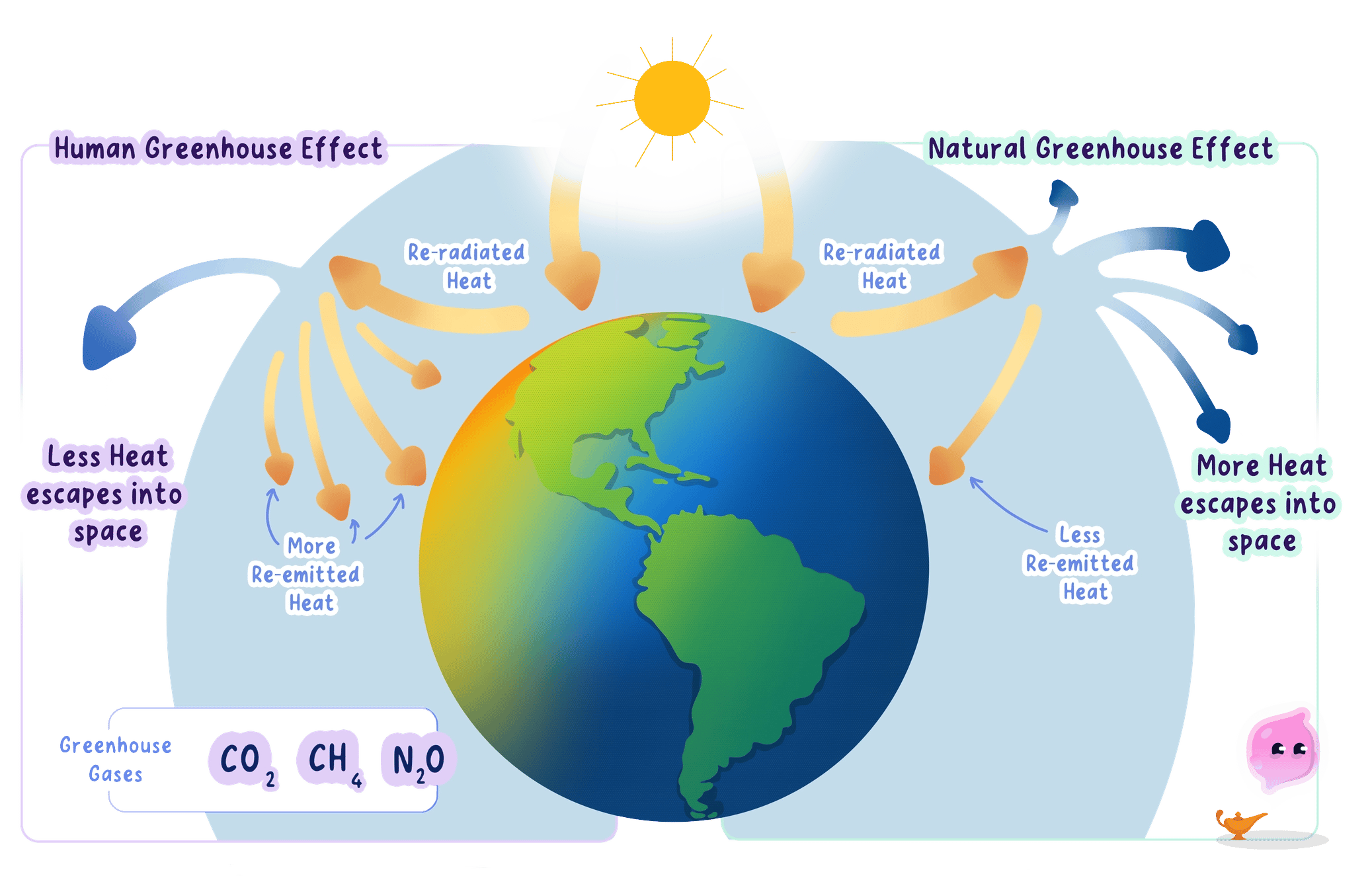
The warming caused when atmospheric gases absorb infrared radiation emitted by the Earth and re-emit it in all directions, including back towards the surface.
- Greenhouse gases such as carbon dioxide, methane and water vapour allow much incoming visible radiation to pass through the atmosphere.
- They absorb some outgoing infrared radiation at particular wavelengths.
- They re-emit infrared radiation in random directions, including back towards Earth's surface.
- This reduces the net rate at which energy escapes to space, so the surface and lower atmosphere warm until outgoing power again balances absorbed incoming power.
- An increase in greenhouse-gas concentration strengthens this effect, although clouds, oceans, ice cover and surface reflectivity also affect Earth's energy balance.
Surface finish and thermal radiation
- Aim: investigate how surface finish affects the rate of infrared emission using otherwise identical containers.
- Apparatus: identical metal containers with matt black, white and shiny surfaces, equal volumes of hot water, lids, temperature probes or thermometers, measuring cylinder, stopwatch, heatproof mat and data logger if available.
- Independent variable: surface finish.
- Dependent variable: temperature decrease in a fixed time or the gradient of a temperature-time graph.
- Control variables: container size and material, water volume, starting temperature, lid, probe depth, position, timing and room conditions.
- Method:
- Place the identical containers in the same room position and add the same measured volume of hot water to each.
- Adjust the water so every container begins at the same temperature, fit identical lids and place each probe at the same depth without touching the container.
- Start timing together and record every temperature at fixed intervals until a clear fall has occurred.
- Repeat the investigation, calculate mean readings and plot temperature against time for each surface.
- Compare gradients over the same temperature range because radiation rate depends on the temperature difference from the surroundings.
- Expected pattern: a matt black surface is the best emitter and cools fastest, while a shiny light surface is a poor emitter and cools more slowly.
- Uncertainty and improvements: use simultaneous probes, identical containers and lids, equal starting temperatures, fixed probe positions, repeated trials and means; shield the apparatus from draughts without covering the tested surfaces.
- Safety: use a heatproof mat, keep containers away from bench edges, handle hot water carefully and keep electrical equipment dry.
Interpreting cooling curves
- At the same temperature above room temperature, the matt black container has a steeper negative gradient than the shiny container.
- The steeper gradient means a greater rate of temperature decrease and therefore a greater rate of energy transfer.
- Because all other variables are controlled, the difference supports the conclusion that the matt black surface is the better infrared emitter.
Explain a change in Earth temperature
- Identify the change in absorbed or emitted power.
- State whether Earth gains or loses energy overall.
- Link the energy change to a rise or fall in average temperature until a new balance is reached.
Do not describe greenhouse gases as a solid blanket or say they reflect all infrared radiation; they absorb selected wavelengths and re-emit radiation in all directions.
- What determines whether Earth's average temperature rises or falls?
- Which radiation does Earth mainly emit to space?
- How do greenhouse gases reduce the net energy loss to space?
- Which surface is usually the best infrared emitter?
- Why must cooling curves be compared over the same temperature range?
