7.1.1 Weight and g on different bodies in space
Mass, weight and gravitational field
Mass
Mass is a measure of the amount of matter in an object and is measured in kilograms.
Weight
Weight is the force acting on an object because of a gravitational field.
Gravitational field strength
Gravitational field strength is the force per unit mass acting on an object placed in a gravitational field, measured in newtons per kilogram (N/kg).
- Mass is the quantity of matter in an object, it is measured in kilograms, and it has the same value wherever the object is taken.
- Weight is a force measured in newtons, and it exists only because a gravitational field is pulling on the mass of the object.
- Every object that has mass produces a gravitational field in the space around it, and any second mass placed in that field is attracted towards the first.
- The gravitational field strength at a point is the force acting on each kilogram of mass placed there, it is given the symbol ggg, and it is measured in newtons per kilogram, N/kg\text{N/kg}N/kg.
- The three quantities are linked by W=m×gW = m \times gW=m×g
- In that equation WWW is weight in newtons (N\text{N}N), mmm is mass in kilograms (kg\text{kg}kg) and ggg is gravitational field strength in newtons per kilogram (N/kg\text{N/kg}N/kg).
- The rearranged forms are m=Wgm = \dfrac{W}{g}m=gW and g=Wmg = \dfrac{W}{m}g=mW.
- Because the mass of a given object is fixed, any change in its weight must come from a change in ggg.
Why g differs between bodies
- The value of ggg at the surface of a planet or moon is set by two properties of that body, its mass and its radius.
- A body of greater mass produces a stronger gravitational field, so the pull on each kilogram at its surface is larger and ggg is larger.
- A body of larger radius holds its surface further from its centre, and gravitational field strength falls as distance from the centre increases, so ggg at the surface is smaller.
- These two effects work against each other, so a physically large body does not automatically have a large surface value of ggg.
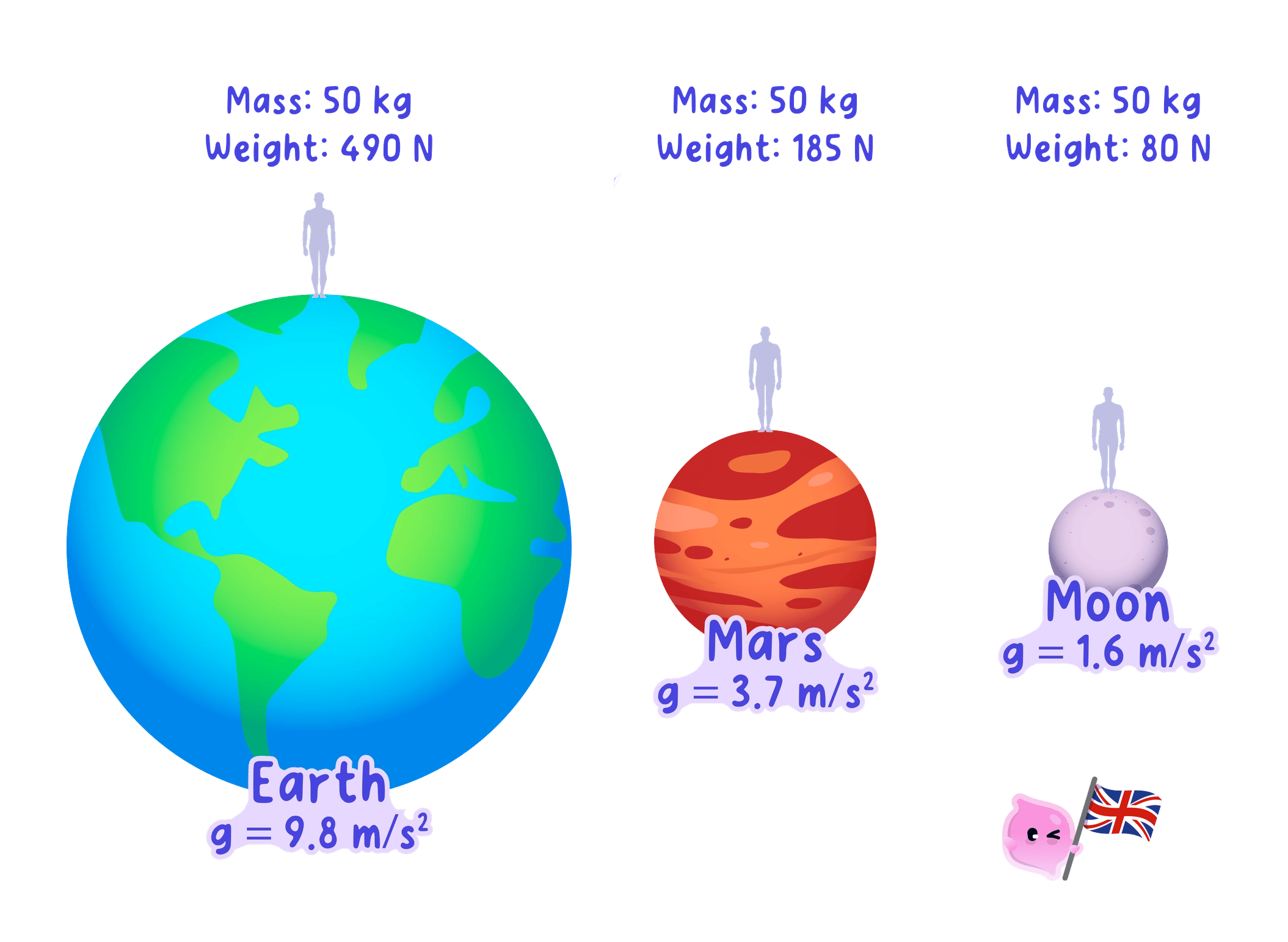
- The Moon has roughly one eightieth of the mass of the Earth and roughly one quarter of its radius, the mass difference dominates, and the surface value falls to about 1.6 N/kg1.6\ \text{N/kg}1.6 N/kg against about 10 N/kg10\ \text{N/kg}10 N/kg on Earth.
- Mars is both less massive and smaller than the Earth and has a surface value near 3.7 N/kg3.7\ \text{N/kg}3.7 N/kg, while Jupiter is very large but far more massive still, giving a surface value near 25 N/kg25\ \text{N/kg}25 N/kg.
- Moving an object from the Earth to the Moon therefore divides its weight by about six and leaves its mass completely unchanged.
How the field falls with distance
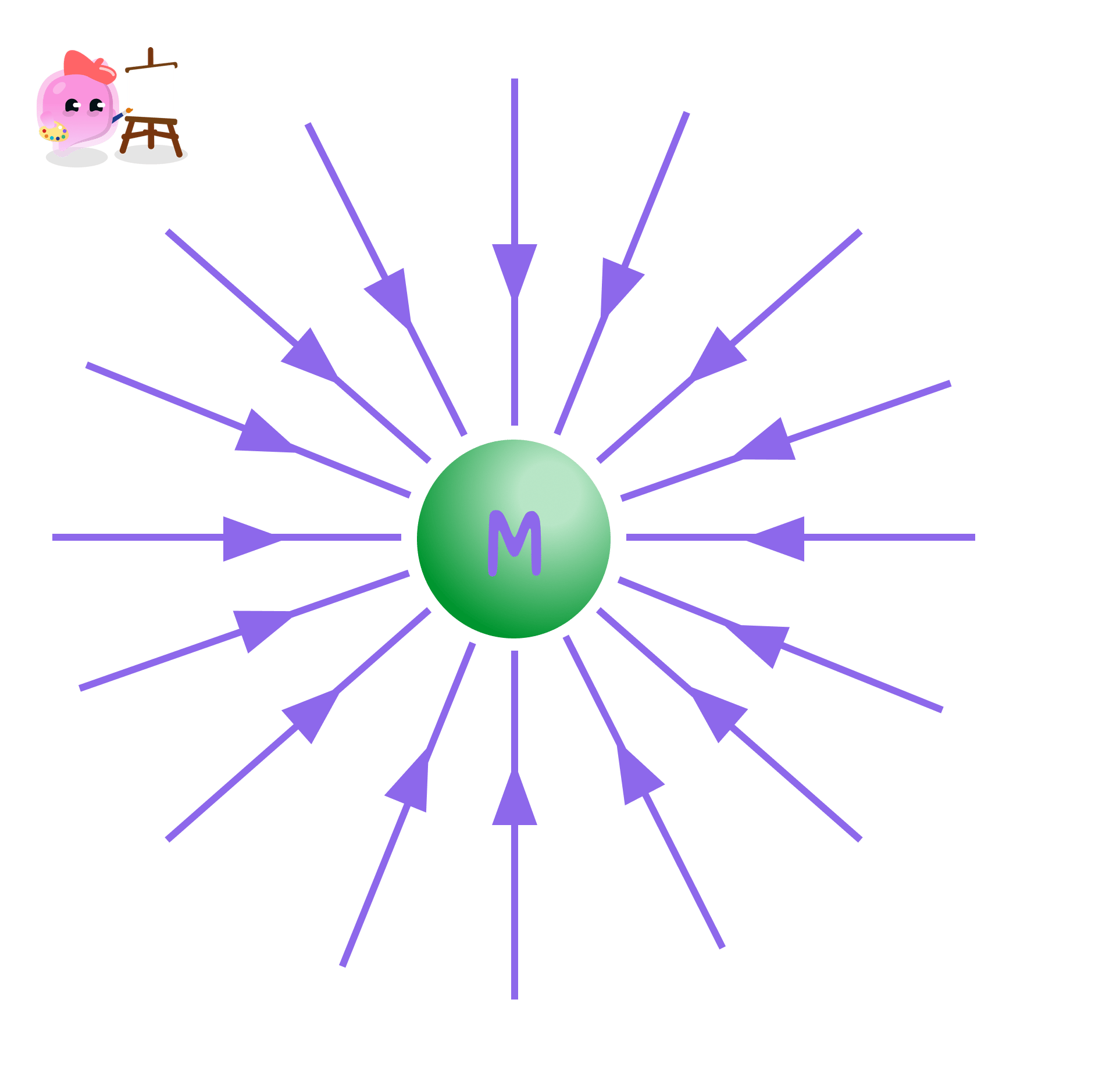
- The gravitational field around a spherical body is radial, which means the field lines point inwards towards the centre of the body.
- The lines are closest together at the surface and spread further apart with distance, and closely spaced lines represent a stronger field.
- A surface value of ggg is measured at a distance from the centre equal to the radius of that body, which is why the radius appears in any comparison between two bodies.
- Rising above the surface increases the distance from the centre and reduces ggg, so an object weighs very slightly less at the top of Snowdon than at sea level.
- That reduction is far too small to notice on ordinary scales, whereas the change between the Earth and the Moon alters a newtonmeter reading by a factor of about six.
Weight of a rover on the Moon
- A rover of mass 180 kg180\ \text{kg}180 kg is landed on the Moon, where g=1.6 N/kgg = 1.6\ \text{N/kg}g=1.6 N/kg.
- Start from the equation W=m×gW = m \times gW=m×g.
- Substituting gives W=180×1.6W = 180 \times 1.6W=180×1.6.
- The weight on the Moon is 288 N288\ \text{N}288 N.
- On Earth the same rover would weigh 180×10=1800 N180 \times 10 = 1800\ \text{N}180×10=1800 N, and its mass would still be 180 kg180\ \text{kg}180 kg in both places.
Finding g from a measured weight
- A 2.5 kg2.5\ \text{kg}2.5 kg instrument package rests on the surface of Mars and its weight is measured as 9.3 N9.3\ \text{N}9.3 N.
- Rearranging W=m×gW = m \times gW=m×g gives g=Wmg = \dfrac{W}{m}g=mW.
- Substituting gives g=9.32.5g = \dfrac{9.3}{2.5}g=2.59.3.
- The gravitational field strength at the surface of Mars is 3.7 N/kg3.7\ \text{N/kg}3.7 N/kg.
Comparing weight on two bodies
- An astronaut and their suit have a combined mass of 130 kg130\ \text{kg}130 kg, and the weight on the Moon is to be compared with the weight on Earth.
- On Earth the weight is W=130×10=1300 NW = 130 \times 10 = 1300\ \text{N}W=130×10=1300 N.
- On the Moon the weight is W=130×1.6=208 NW = 130 \times 1.6 = 208\ \text{N}W=130×1.6=208 N.
- The difference in weight is 1300−208=1092 N1300 - 208 = 1092\ \text{N}1300−208=1092 N.
- The cause is the much smaller mass of the Moon, which gives it a weaker surface field, while the mass of the astronaut is unchanged.
Answering weight comparison questions
- Say which quantity stays the same and which quantity changes, because a mark is usually reserved for stating that the mass is unchanged.
- Name the cause of the change in ggg by referring to the mass and radius of the body, rather than writing only that gravity is weaker.
- Write W=m×gW = m \times gW=m×g before substituting, and show the substitution on its own line so a method mark survives an arithmetic slip.
- Use the value of ggg printed in the question rather than assuming 10 N/kg10\ \text{N/kg}10 N/kg, since astronomy questions rarely use the Earth value.
- Attach N\text{N}N to a weight, kg\text{kg}kg to a mass and N/kg\text{N/kg}N/kg to a field strength, because the unit is often the difference between two marks and one.
- Do not write that an astronaut loses mass on the Moon, because only the weight changes.
- Do not quote a weight in kilograms, since kilograms measure mass and newtons measure weight.
- Do not assume the largest planet has the largest surface value of ggg, because a larger radius reduces the field strength at the surface.
- Do not describe the Moon as having no gravity, because its surface field strength is about 1.6 N/kg1.6\ \text{N/kg}1.6 N/kg rather than zero.
- State the equation linking weight, mass and gravitational field strength, with the unit of each quantity.
- Explain why the mass of an object is the same on the Earth and on the Moon while its weight is not.
- Give the two properties of a body that decide the value of ggg at its surface.
- Calculate the weight of a 45 kg45\ \text{kg}45 kg probe on the Moon, where g=1.6 N/kgg = 1.6\ \text{N/kg}g=1.6 N/kg.
- Explain why gravitational field strength decreases as distance from the centre of a planet increases.
7.1.2 The Solar System
What the Solar System contains
Solar System
The Solar System is the Sun together with the eight planets, their natural satellites, the dwarf planets, the asteroids and the comets that orbit it.
Star
A star is a large ball of hot gas held together by its own gravity that releases energy by nuclear fusion in its core.
Planet
A planet is a large body orbiting a star that is massive enough for gravity to pull it into a nearly spherical shape and that has cleared other objects from its orbital path.
- The Sun sits at the centre of the Solar System and is the only star in it, which is why it is described as our star.
- The Sun holds far more mass than everything else in the Solar System put together, so its gravitational field controls the motion of every other member.
- There are eight planets in orbit around the Sun, and many of them have their own natural satellites in orbit around them.
- Alongside the planets the Solar System also contains dwarf planets, asteroids and comets.
- A star releases its own energy by nuclear fusion and so gives out light, while a planet has no fusion of its own and is seen only by the sunlight it reflects.
- The Solar System is one small part of a much larger structure, since the Sun is only one of the huge number of stars that make up the Milky Way galaxy.
The eight planets in order
- Counting outwards from the Sun the order is Mercury, Venus, Earth, Mars, Jupiter, Saturn, Uranus and Neptune.
- A sentence such as My Very Easy Method Just Speeds Up Names fixes the order, because the first letters follow the eight planets exactly.
- The four nearest the Sun, Mercury, Venus, Earth and Mars, are small and rocky and are called the inner planets.
- The four furthest out, Jupiter, Saturn, Uranus and Neptune, are much larger and made mostly of gas and ice, and are called the outer planets.
- The spacing is very uneven, with Mercury about 585858 million km\text{km}km from the Sun, the Earth about 150150150 million km\text{km}km and Neptune about 450045004500 million km\text{km}km.
- Planets further from the Sun take longer to complete one orbit, so a year on Neptune lasts about 165165165 Earth years while a year on Mercury lasts about 888888 Earth days.
- Planets further from the Sun also receive less energy from it each second over each square metre of surface, so they are colder.
Moons and other smaller bodies
Natural satellite
A natural satellite is a naturally formed body, such as a moon, that orbits a planet.
Dwarf planet
A dwarf planet is a nearly spherical body that orbits the Sun but has not cleared other objects from its orbital path.
Asteroid
An asteroid is a small rocky body that orbits the Sun, most of which are found in a belt between the orbits of Mars and Jupiter.
Comet
A comet is a small body of ice, dust and rock that orbits the Sun along a highly elliptical path.
- A natural satellite orbits a planet rather than the Sun, and our own Moon is the standard example to quote.
- Mercury and Venus have no natural satellites at all, whereas Jupiter and Saturn each have dozens of them.
- A dwarf planet such as Pluto or Ceres is round and orbits the Sun, but it shares its region of space with other sizeable objects, which is why it is not counted as one of the eight planets.
- Most asteroids lie in the asteroid belt between the orbits of Mars and Jupiter, and they are irregular lumps of rock and metal rather than spheres.
- A comet is mostly ice and dust, and heating by the Sun turns some of that ice to gas, producing the bright tail that is seen when a comet passes close to the Sun.
- Every one of these bodies is held in place by the gravitational attraction of the Sun, apart from the natural satellites, which are held by the planet they circle.
Time for sunlight to reach Earth
- The Earth orbits at about 1.5×10¹¹ m1.5 \times 10^{11}\ \text{m}1.5×10¹¹ m from the Sun and light travels at 3.0×10⁸ m/s3.0 \times 10^{8}\ \text{m/s}3.0×108 m/s.
- Rearranging v=xtv = \dfrac{x}{t}v=tx gives t=xvt = \dfrac{x}{v}t=vx.
- Substituting gives t=1.5×10113.0×108t = \dfrac{1.5 \times 10^{11}}{3.0 \times 10^{8}}t=3.0×1081.5×1011.
- The time taken is 500 s500\ \text{s}500 s, which is about 888 minutes and 202020 seconds.
Scaling the Solar System down
- A model places the Earth 1.0 m1.0\ \text{m}1.0 m from the Sun, and the position of Neptune on the same scale is wanted.
- The real distances are 150150150 million km\text{km}km for the Earth and 450045004500 million km\text{km}km for Neptune.
- The ratio of the two distances is 4500150=30\dfrac{4500}{150} = 301504500=30.
- Neptune therefore belongs 30 m30\ \text{m}30 m from the model Sun, which shows how thinly the outer Solar System is spread.
Naming and ordering the members
- Learn the eight planets as an ordered list rather than a set, because questions often supply four names and ask for the correct sequence outwards.
- Use the exact word the question asks for, since a natural satellite, a dwarf planet and an asteroid are three separate categories and each earns its own mark.
- Give a named example when a question asks you to identify a type of body, such as Ceres for a dwarf planet or the Moon for a natural satellite.
- Watch for numbers written in standard form in data questions, and convert kilometres to metres before using any equation.
- Do not count Pluto as one of the eight planets, because it is classed as a dwarf planet.
- Do not call the Sun a planet, since it is the star at the centre of the Solar System.
- Do not confuse a natural satellite with an artificial one, because a natural satellite such as the Moon was not built and launched by people.
- Do not treat the Solar System and the Universe as the same thing, since the Solar System is one star and the bodies around it.
- List the eight planets in order of increasing distance from the Sun.
- Name four types of body other than planets that belong to the Solar System.
- State one difference between a planet and a dwarf planet.
- Explain why a star is visible from a great distance but a planet is not.
- State where most asteroids in the Solar System are found.
7.1.3 Changing ideas about the Solar System
The geocentric model
Geocentric model
The geocentric model is the idea that the Earth is fixed at the centre of the Universe, with the Sun, Moon, planets and stars moving around it.
- The earliest widely held picture of the Universe was geocentric, with a stationary Earth at the centre and everything else carried around it on turning spheres.
- It was set out in detail by the Greek astronomer Ptolemy in about 150 AD150\ \text{AD}150 AD and stayed the accepted model in Europe for well over a thousand years.
- The model matched everyday observation, because the Sun really does appear to rise in the east and set in the west while the ground under your feet feels perfectly still.
- Its weakness was the motion of the planets, which sometimes appear to slow, stop and travel backwards against the fixed stars before moving forwards again.
- To keep the Earth at the centre, astronomers added small extra circles called epicycles, so each planet ran round a small loop that itself ran round the Earth.
- Every fresh set of measurements demanded more epicycles, and the model grew steadily more complicated without ever fitting the observations exactly.
The heliocentric model
Heliocentric model
The heliocentric model is the idea that the Sun lies at the centre of the Solar System, with the Earth and the other planets orbiting it.
- In 154315431543 the Polish astronomer Copernicus published a heliocentric model that placed the Sun at the centre and made the Earth one of the planets going round it.
- In this model the Earth turns on its own axis once a day, and that spin, rather than a moving Sun, is what causes day and night.
- The Moon was still treated as circling the Earth, so the Earth was no longer unique in being orbited.
- Backwards planetary motion came out of the model automatically, because the faster inner Earth overtakes a slower outer planet and the outer planet appears to slip backwards as it is passed.
- The new model needed no epicycles to do this, so it explained the same observations far more simply.
- Acceptance was slow, partly because it conflicted with long established religious teaching and partly because no direct evidence for a moving Earth existed at the time.
Evidence that changed the model
- The first strong evidence came from the telescope, which let astronomers see detail that the unaided eye cannot resolve.
- In 161016101610 Galileo found four points of light beside Jupiter that changed position from night to night, and they were moons in orbit around Jupiter rather than around the Earth.
- That single observation destroyed the central claim of the geocentric model, since it proved that not everything in the sky circles the Earth.
- Galileo also watched Venus run through a full set of phases from thin crescent to nearly full, which can only happen if Venus travels right around the Sun.
- Later work by Kepler showed that the orbits are slightly squashed circles rather than exact circles, which removed the last mismatch between the heliocentric model and careful measurement.
- Newton then supplied the missing physics by showing that a single force, gravity, holds every planet in orbit and explains why the model works.
- Better instruments kept extending the picture, with Uranus found in 178117811781 and Neptune in 184618461846 after its position was predicted from the wobble it produced in the orbit of Uranus.
How scientific models change
- A scientific model is kept only for as long as it accounts for the observations, and it is judged on how well it predicts as well as on how well it describes.
- When new observations cannot be explained, the model is either patched, as the geocentric model was with epicycles, or replaced by one that fits without patching.
- Replacement is not immediate, because other scientists first repeat the observations and check the reasoning before a new model is accepted.
- Improvements in technology drive the process, since each better telescope reveals detail that the previous model was never tested against.
Four nights of watching Jupiter
- On the first night Galileo recorded three small stars in a straight line beside Jupiter, two on one side and one on the other.
- On the following nights the same points of light had swapped sides and changed their spacing, yet they never wandered away from Jupiter.
- Fixed stars do not behave in that way, so the points of light had to be bodies travelling around Jupiter.
- A geocentric model insists that everything orbits the Earth, so an object orbiting Jupiter cannot be fitted into it.
- This is a clean example of one repeatable observation forcing a whole model to be abandoned.
Writing about changing ideas
- Describe the two models in the right order, geocentric first and heliocentric second, and say clearly what sits at the centre of each.
- Name a specific piece of evidence rather than saying that new evidence appeared, because the moons of Jupiter and the phases of Venus are the two the examiners expect.
- Link each observation to the conclusion it forces, since the mark is given for the link and not for the name alone.
- In a six mark question, plan three stages, the old model, the evidence, and what the new model changed, and write at least two sentences on each.
- Mention improving technology only alongside the observation it made possible, because technology on its own does not answer the question.
- Do not write that the geocentric model was simply wrong and useless, because it predicted the daily motion of the sky well enough to be used for centuries.
- Do not credit Galileo with inventing the heliocentric model, since Copernicus published it before Galileo made his observations.
- Do not say the moons of Jupiter proved the Sun is at the centre, because they proved only that not everything orbits the Earth.
- Do not claim that one scientist changed the accepted model overnight, because other astronomers had to repeat and check the observations first.
- State what lies at the centre of the geocentric model and what lies at the centre of the heliocentric model.
- Explain why epicycles had to be added to the geocentric model.
- Describe one observation made by Galileo and say what it showed.
- Explain how the heliocentric model accounts for planets appearing to move backwards.
- Give two reasons why a scientific model is replaced.
7.1.4 Orbits of moons, planets, comets and satellites
What keeps a body in orbit
Orbit
An orbit is the repeating path one body follows around another under the gravitational attraction between them.
- Every orbit is held together by gravitational attraction between the orbiting body and the much more massive body it travels around.
- The force always points from the orbiting body towards the centre of the body it circles, so a planet is pulled towards the Sun and a moon is pulled towards its planet.
- Orbit shapes lie between two extremes, a circle with the central body exactly in the middle, and a long thin ellipse with the central body well off to one end.
- The distance from the central body stays fixed in a circular orbit, so the orbital speed also stays fixed.
- The distance changes throughout an elliptical orbit, and the body moves fastest where it is closest to the central body and slowest where it is furthest away.
- The reason is that the gravitational field is strongest close in, so the pull that speeds the body up on the way in is far larger than the pull it feels at the far end of the orbit.
Orbits of planets and moons
Natural satellite
A natural satellite is a naturally formed body, such as a moon, that orbits a planet.
- The eight planets travel around the Sun on slightly elliptical paths that are so close to circles that they are usually drawn as circles.
- All of the planets orbit in the same direction and lie in almost the same flat plane, so the Solar System is shaped like a disc rather than a ball.
- The time for one complete orbit is the orbital period, and it grows rapidly with distance from the Sun, from about 888888 days for Mercury to about 165165165 years for Neptune.
- A natural satellite orbits its planet rather than the Sun, and these orbits are also close to circular.
- Our Moon takes about 272727 days to complete one orbit of the Earth at a mean distance of about 384 000 km384\,000\ \text{km}384000 km.
- A moon is carried around the Sun as well, because it stays with the planet that holds it while that planet completes its own orbit.
Orbits of comets
Comet
A comet is a small body of ice, dust and rock that orbits the Sun along a highly elliptical path.
- A comet follows a highly elliptical orbit around the Sun, so its path is a long stretched oval rather than a near circle.
- The Sun is not in the middle of that oval but close to one end, so the distance between the comet and the Sun changes enormously during a single orbit.
- The comet accelerates as it falls in towards the Sun, reaches its greatest speed at the closest point, then slows steadily as it climbs back out.
- It spends only a short part of each orbit near the Sun and most of it moving slowly through the outer Solar System, which is why comets are visible so rarely.
- Comet orbits are also tilted out of the plane of the planets, and some run round the Sun in the opposite direction to the planets.
- Halley's comet is the familiar example, returning to the inner Solar System roughly every 767676 years.
Orbits of artificial satellites
Artificial satellite
An artificial satellite is a human-made object placed in orbit around the Earth or another body in space.
Geostationary orbit
A geostationary orbit is a circular orbit above the equator in which a satellite takes exactly one day to travel once around the Earth, so it stays above the same point on the surface.
- An artificial satellite is put into a chosen orbit by a rocket, and the orbit is chosen to suit the job the satellite has to do.
- A low polar orbit passes over both poles at a height of a few hundred kilometres and takes about 909090 minutes for one circuit.
- The Earth turns underneath a polar satellite, so it passes over a fresh strip of ground on every orbit and can eventually photograph the whole surface, which suits weather monitoring, mapping and spying.
- A geostationary orbit lies directly above the equator at a height of about 36 000 km36\,000\ \text{km}36000 km and takes exactly one day for one circuit.
- Because the satellite and the ground turn together, the satellite stays above the same point on the equator and appears fixed in the sky.
- That is what a satellite television dish needs, since the dish can be bolted in one position and never has to track a moving target.
- Geostationary orbits therefore carry communication and broadcasting satellites, while polar orbits carry observation satellites.
Speed of a geostationary satellite
- A satellite orbits at a radius of 4.2×10⁷ m4.2 \times 10^{7}\ \text{m}4.2×10⁷ m measured from the centre of the Earth and takes one day for a complete circuit.
- One day in seconds is 24×60×60=86 400 s24 \times 60 \times 60 = 86\,400\ \text{s}24×60×60=86400 s.
- The distance travelled in one orbit is the circumference, 2πr=2π×4.2×107=2.64×10⁸ m2\pi r = 2\pi \times 4.2 \times 10^{7} = 2.64 \times 10^{8}\ \text{m}2πr=2π×4.2×107=2.64×10⁸ m.
- Using v=xtv = \dfrac{x}{t}v=tx gives v=2.64×10886 400v = \dfrac{2.64 \times 10^{8}}{86\,400}v=864002.64×108.
- The orbital speed is about 3.1×10³ m/s3.1 \times 10^{3}\ \text{m/s}3.1×103 m/s.
Choosing an orbit for a task
- A satellite is needed to send live pictures to fixed dishes on homes across the United Kingdom.
- A fixed dish cannot follow a moving satellite, so the satellite must appear to stay still in the sky.
- Only an orbit with a period of one day above the equator keeps pace with the turning Earth.
- A geostationary orbit is therefore the correct choice, and a low polar orbit would put the satellite out of view within minutes.
Describing an orbit accurately
- Name the shape and the central body together, for example a highly elliptical orbit around the Sun, because half an answer scores half the marks.
- Quote a period when one is available, since 272727 days for the Moon or one day for a geostationary satellite is far stronger than saying the orbit is quick or slow.
- Link the orbit to its use whenever a question mentions a satellite, because the mark is for the match between the orbit and the job.
- Convert hours to seconds and kilometres to metres before substituting into any speed calculation.
- Measure an orbital radius from the centre of the Earth, not from the ground, so add the radius of the Earth to any height given above the surface.
- Do not describe a comet orbit as circular, because the stretched ellipse is the whole point of the description.
- Do not place the Sun at the centre of a comet orbit, since it lies close to one end of the ellipse.
- Do not say a geostationary satellite is stationary, because it is moving at about 3 km/s3\ \text{km/s}3 km/s and only appears fixed from the turning ground.
- Do not put a communications satellite in a polar orbit or an imaging satellite in a geostationary orbit, because each orbit suits only one of those jobs.
- Name the force that keeps a planet in orbit around the Sun and state its direction.
- Describe the shape of a comet orbit and say where the Sun sits within it.
- Explain where a comet travels fastest and why.
- State the period and position of a geostationary orbit.
- Give one use of a low polar orbit and explain why that orbit suits it.
7.1.5 Gravity and orbital motion
Speed, velocity and circular motion
Velocity
Velocity is speed in a stated direction, measured in metres per second.
Centripetal force
Centripetal force is the resultant force acting on an object moving in a circle, directed towards the centre of the circle.
- Speed is a scalar quantity, so it has size only and tells you nothing about which way a body is heading.
- Velocity is a vector quantity, so it has both a size and a direction, and changing either one changes the velocity.
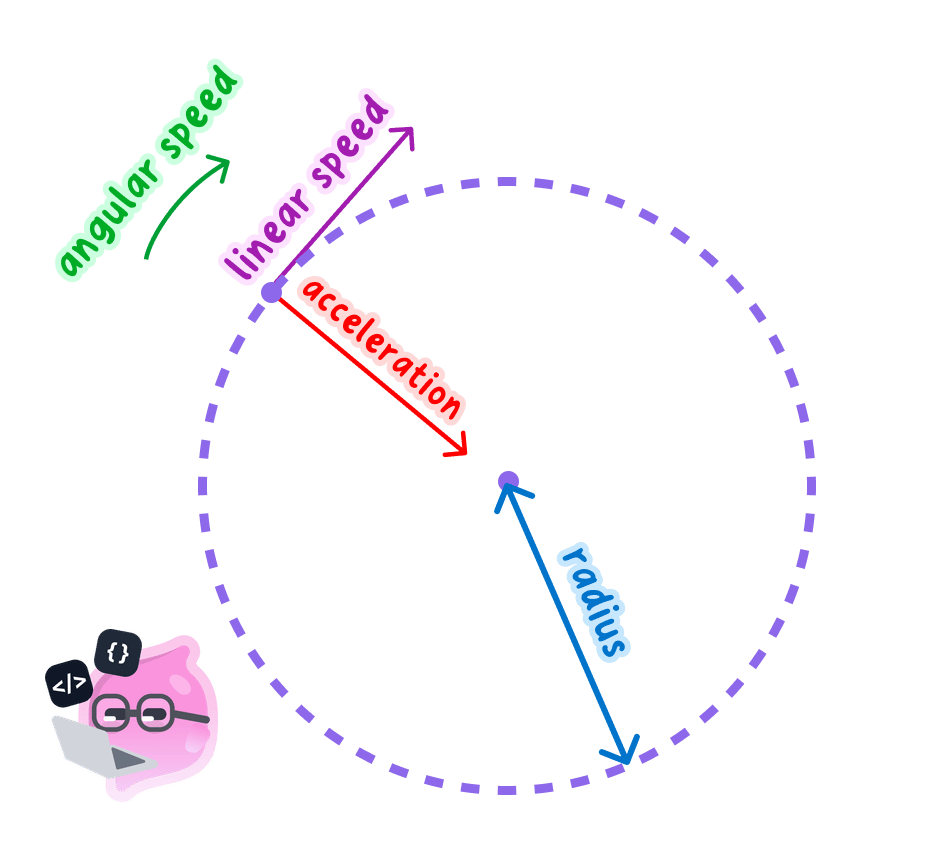
- A body moving in a circle travels along a tangent to the circle at every instant, so its direction of motion is different at every point of the path.
- Gravitational attraction supplies the centripetal force for a planet, a moon or a satellite, and it acts along the line joining the two bodies.
- That force therefore points towards the centre of the circle, while the velocity points along the tangent, so the two are always at right angles to each other.
Why the speed stays constant
- A force only changes the speed of a body when part of that force acts along the direction the body is already moving.
- In a circular orbit the gravitational pull is at right angles to the velocity, so it has no component along the direction of travel.
- Nothing speeds the body up and nothing slows it down, so the speed stays constant all the way round.
- What the force does instead is pull the body sideways out of the straight line it would otherwise follow, which continuously turns the direction of motion.
- Because the direction changes, the velocity changes even though the speed does not.
- A changing velocity is an acceleration, so a satellite in a steady circular orbit is accelerating towards the Earth at every moment while never getting any faster.
- Remove the gravitational force and the body would carry straight on along the tangent, which is what happens to a hammer thrower's hammer at the moment the wire is released.
Radius and orbital speed
Stable orbit
A stable orbit is one in which the orbital speed of a body matches its orbital radius, so the body keeps circling at the same distance instead of spiralling in or escaping.
- A stable orbit needs the gravitational pull at that distance to be exactly the centripetal force required to bend the path into a circle.
- Only one orbital speed satisfies that condition at any given radius, so the speed and the radius are locked together.
- Close to the central body the field is stronger, the inward pull is larger, and a greater speed is needed to hold the body on that tighter circle.
- Further out the field is weaker, so a smaller speed is enough to keep the body on that wider circle.
- If the orbital speed of a satellite increases and the orbit is to stay stable, the radius must decrease.
- If the orbital speed decreases and the orbit is to stay stable, the radius must increase.
- The same rule explains the Solar System, since Mercury is close in and races round at about 48 km/s48\ \text{km/s}48 km/s while Neptune is far out and crawls at about 5 km/s5\ \text{km/s}5 km/s.
- It also explains why a low satellite completes an orbit in about 909090 minutes while the far more distant Moon needs about 272727 days.
Comparing two satellite orbits
- Satellite A orbits at a radius of 7.0×10⁶ m7.0 \times 10^{6}\ \text{m}7.0×10⁶ m and satellite B orbits the Earth at 4.2×10⁷ m4.2 \times 10^{7}\ \text{m}4.2×10⁷ m.
- Satellite A is much closer to the Earth, so the gravitational field strength at its orbit is much larger.
- A larger inward force is needed to hold it on its tighter circle, and that is only provided at a higher orbital speed.
- Satellite A therefore travels faster and completes each orbit in far less time than satellite B.
Velocity change over half an orbit
- A satellite in a circular orbit travels at 7.5 km/s7.5\ \text{km/s}7.5 km/s due north as it crosses the equator.
- Half an orbit later it crosses the equator again, still at 7.5 km/s7.5\ \text{km/s}7.5 km/s but now travelling due south.
- The speed is unchanged because gravity never acted along the direction of motion.
- The velocity has reversed because the direction of motion has turned through 180∘180^{\circ}180∘, which is why the satellite counts as accelerating throughout.
Explaining constant speed in orbit
- Use the words speed and velocity precisely, because a question asking why one is constant while the other is not is testing exactly that distinction.
- Say that the gravitational force acts at right angles to the direction of motion, since that is the marking point that most answers miss.
- State that the force is directed towards the centre of the orbit, rather than writing only that gravity pulls the satellite down.
- For a stable orbit question, give the direction of both changes, so a faster orbit means a smaller radius and a slower orbit means a larger radius.
- Justify the change with the strength of the gravitational field at that distance instead of asserting the relationship on its own.
- Do not say that a satellite in a circular orbit is not accelerating, because its direction is changing all the time.
- Do not treat speed and velocity as the same word in this topic, since the whole explanation depends on the difference between them.
- Do not draw the gravitational force along the direction of travel, because it points towards the centre of the orbit.
- Do not claim that a satellite further from the Earth must travel faster, because a wider orbit needs a smaller orbital speed.
- State the difference between speed and velocity.
- Explain why the gravitational force on a satellite changes its velocity but not its speed.
- State the direction of the resultant force on a body in a circular orbit.
- Explain how the radius of a stable orbit must change if the orbital speed increases.
- Explain why Mercury travels around the Sun faster than Neptune does.
