Question 13
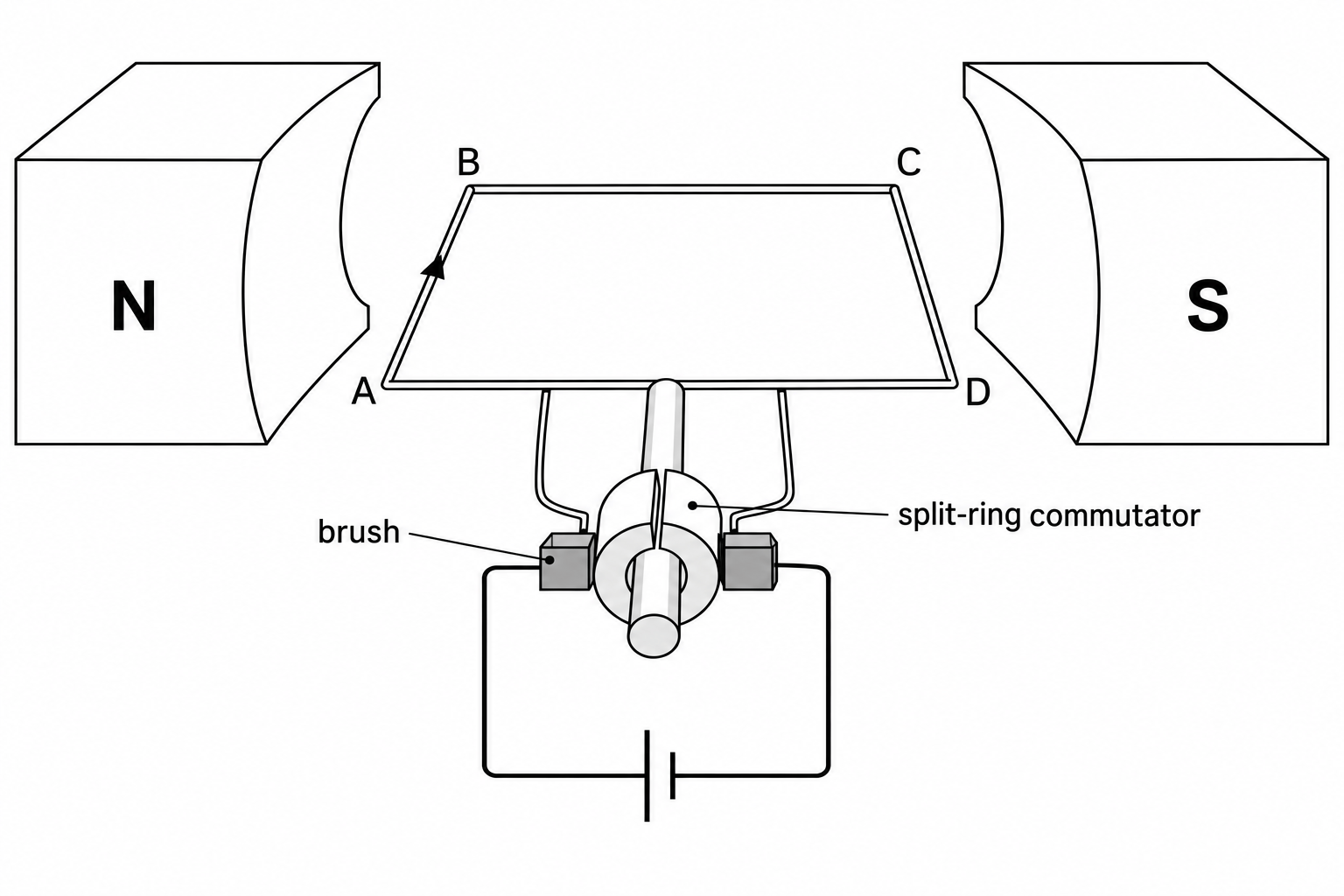
HThe Figure shows a simple d.c. electric motor.
The coil ABCD is horizontal at the instant shown. Side AB is next to the north pole and side CD is next to the south pole.
The arrow on side AB shows the direction of the current in that side.
Figure
a.[1]
State the direction of the force on side AB.
b.[1]
Explain why there is no force on side BC at the instant shown.
c.[2]
Determine whether the coil turns clockwise or anticlockwise when viewed from the front, where the commutator is.
Give a reason for your answer.
d.[3]
Explain how the split-ring commutator keeps the coil turning in the same direction.
12.3 The motor effect Questions
86 exam-style questions on Edexcel GCSE Physics 12.3 The motor effect, covering 12.3.1 The motor effect, 12.3.2 Fleming's left-hand rule, 12.3.3 Force on a conductor, and 12.3.4 Electric motors. Each one has a worked solution and a mark scheme showing where the marks go.