Question 13
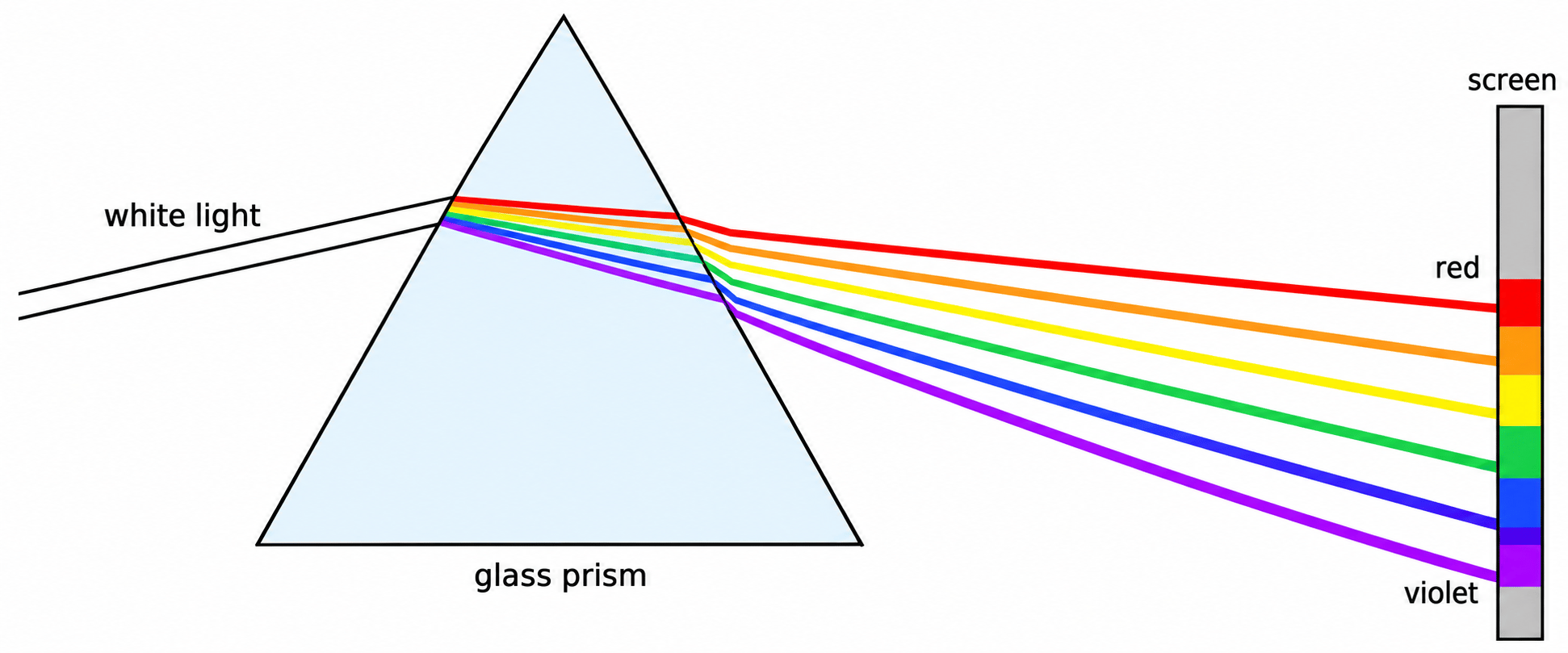
HA ray of white light passes through a triangular glass prism.
The Figure shows that the white light is split into a spectrum of colours on a screen.
Figure
The Table shows information about red light and violet light in the glass.
Table
| Colour | Frequency in Hz\text{Hz}Hz | Speed in glass in m/s\text{m/s}m/s |
|---|---|---|
| red | 4.3 × 10¹⁴ | 1.98 × 10⁸ |
| violet | 7.5 × 10¹⁴ | 1.94 × 10⁸ |
a.[3]
Explain why the white light is split into different colours by the prism.
b.[2]
Explain which colour of light travels most slowly in the glass.
c.[3]
Use the Table to calculate the difference between the wavelength of the red light and the wavelength of the violet light in the glass.
d.[2]
White light passing through a rectangular glass block is not split into a spectrum that can be seen.
Suggest why.
5.2 The electromagnetic spectrum Questions
84 exam-style questions on Edexcel GCSE Physics 5.2 The electromagnetic spectrum, covering 5.2.1 Electromagnetic waves and refraction in glass (core practical), 5.2.2 Groups of the electromagnetic spectrum, 5.2.3 Wavelength-dependent behaviour of EM waves, and 5.2.4 Velocities of EM waves in different substances. Each one has a worked solution and a mark scheme showing where the marks go.