Question 3
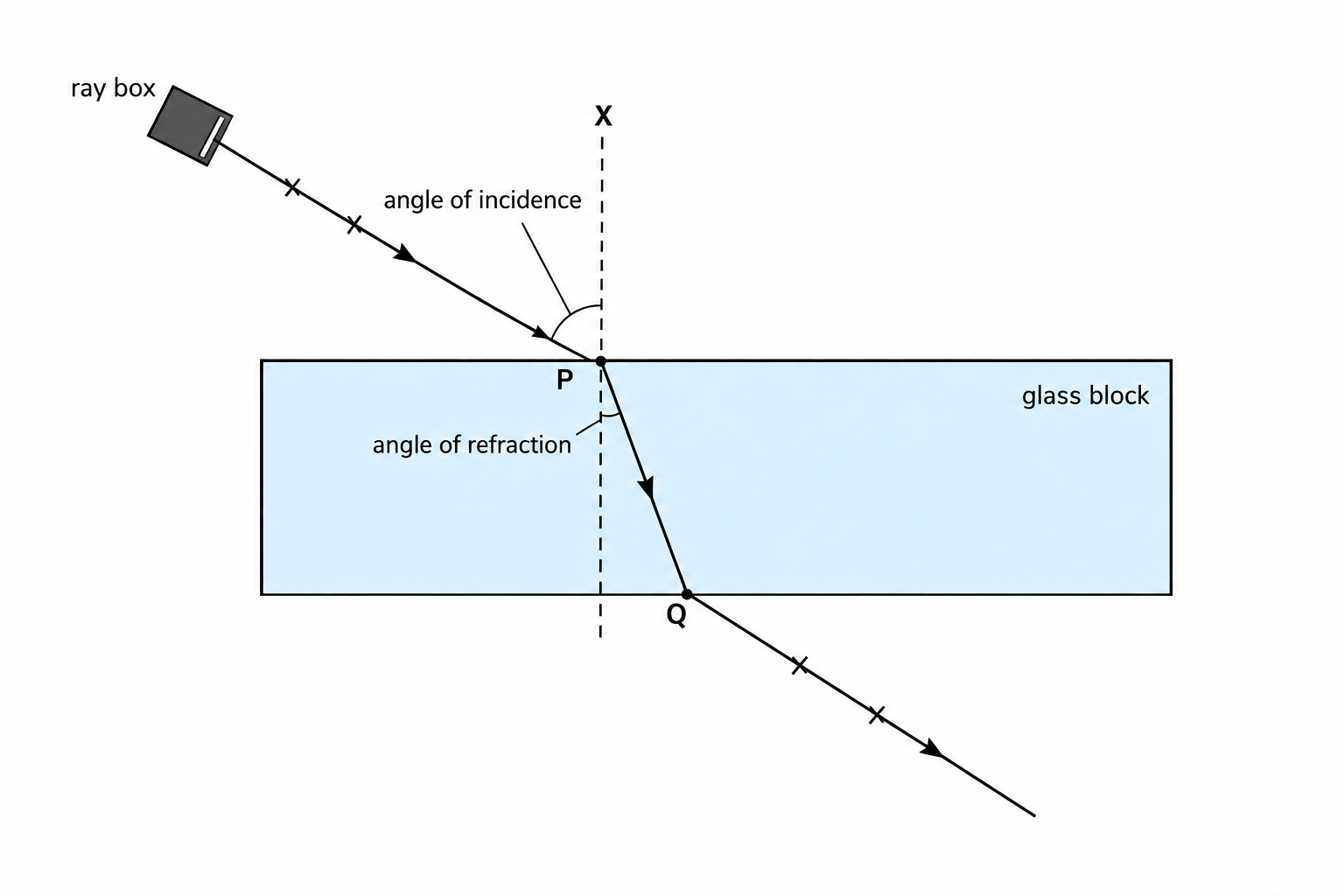
FA student investigates the refraction of light in a rectangular glass block.
The Figure shows the student's ray diagram.
Figure
The Table shows the student's results.
Table
| Angle of incidence | Angle of refraction |
|---|---|
| 20∘20^{\circ}20∘ | 13∘13^{\circ}13∘ |
| 30∘30^{\circ}30∘ | 20∘20^{\circ}20∘ |
| 40∘40^{\circ}40∘ | 25∘25^{\circ}25∘ |
| 50∘50^{\circ}50∘ | 31∘31^{\circ}31∘ |
| 60∘60^{\circ}60∘ | 35∘35^{\circ}35∘ |
a.[1]
Give the name of the line labelled X.
b.[2]
Describe how the student marks the path of the ray so that the ray can be drawn after the glass block is removed.
c.[2]
Use the Table to describe the relationship between the angle of incidence and the angle of refraction.
d.[2]
Suggest one way the student could make the measurements of the angles more accurate. Give a reason for your answer.
e.[1]
State what happens to a ray of light that enters the block with an angle of incidence of 0∘0^{\circ}0∘.
5.2 The electromagnetic spectrum Questions
84 exam-style questions on Edexcel GCSE Physics 5.2 The electromagnetic spectrum, covering 5.2.1 Electromagnetic waves and refraction in glass (core practical), 5.2.2 Groups of the electromagnetic spectrum, 5.2.3 Wavelength-dependent behaviour of EM waves, and 5.2.4 Velocities of EM waves in different substances. Each one has a worked solution and a mark scheme showing where the marks go.