7.2.1 Big Bang and Steady State theories
Two theories of the Universe
Universe
The Universe is all of space together with everything in it, including all of the galaxies, stars, planets and radiation.
Big Bang theory
The Big Bang theory states that the Universe began from a very small, extremely hot and dense region that has been expanding and cooling ever since.
Steady State theory
The Steady State theory states that the Universe has always existed and always looks much the same, because new matter is created continuously as it expands.
- Astronomers agree that the Universe is expanding, which means that the distances between distant galaxies are increasing.
- Two rival theories were built to explain that expansion, the Big Bang theory and the Steady State theory.
- Both were serious scientific theories, and both were taken seriously through the middle of the twentieth century because both accounted for the expansion that had been measured.
- They part company over one question, whether the Universe had a beginning or has simply always been here.
What the Big Bang theory says
- All of the matter and energy in the Universe began packed into a region that was extremely small, hot and dense.
- That region began to expand, and space itself has been growing ever since rather than matter flying outwards through empty space.
- The expansion has spread the same fixed amount of matter through a steadily larger volume, so the Universe has become less dense as it has aged.
- Expansion also spreads out the energy present at the start, so the Universe has cooled continuously from that first hot state.
- The theory therefore gives the Universe a finite age, currently taken as about 13.813.813.8 billion years.
- It also means the Universe looked very different in the past, since everything was closer together, hotter and more crowded.
What the Steady State theory says
- The Universe has always existed, so there was no starting event and there is no age to calculate.
- The Universe is still expanding, so this theory agrees with the Big Bang theory that galaxies are moving apart.
- To stop the expansion thinning everything out, new matter is created continuously in the gaps that open up between the galaxies.
- That new matter forms new galaxies at the same rate as old ones drift apart, so the average density stays constant.
- The overall appearance of the Universe is therefore unchanging, which is where the name of the theory comes from.
- An observer looking at the Universe billions of years ago, or billions of years in the future, would see much the same picture as one looking today.
Comparing the two theories
- Both theories accept that the Universe is expanding and that distant galaxies are moving away from us.
- Both also accept that the Earth holds no special place, so an observer in any galaxy would see the other galaxies receding.
- They differ on the beginning, because the Big Bang theory has a single starting event while the Steady State theory has none.
- They differ on age, because the Big Bang theory gives a finite age while the Steady State theory makes the Universe infinitely old.
- They differ on matter, because the Big Bang theory keeps the total amount fixed while the Steady State theory creates more of it as space grows.
- They differ on density, because the Big Bang theory has it falling with time while the Steady State theory holds it constant.
- They differ on how the Universe changes over time, because the Big Bang theory says the distant past looked hotter and more crowded while the Steady State theory says it looked the same.
- Those last differences are what make the two theories testable, since a theory that predicts a changing Universe can be separated from one that predicts an unchanging Universe by observation.
Running the expansion backwards
- Imagine playing a recording of the expanding Universe in reverse so that the galaxies move towards one another instead of apart.
- In the Big Bang theory the galaxies eventually crowd into one extremely small, hot, dense region, and that moment is the start of the Universe.
- In the Steady State theory the crowding never happens, because matter that was created along the way is removed again as the recording runs back.
- The reversed film keeps running for ever with the same average density on screen, which is exactly what an infinitely old Universe means.
Keeping the density constant
- Take a cube of space containing a fixed number of galaxies and let the expansion double the length of each side.
- The volume grows by a factor of 23=82^{3} = 823=8, so on the Big Bang theory the density of that cube falls to one eighth of its original value.
- On the Steady State theory enough new matter appears inside the cube to make eight times as many galaxies, so the density is unchanged.
- The creation rate this needs is far too small to detect in a laboratory, which is why the idea could not be ruled out directly.
Structuring a comparison answer
- A compare question wants both theories mentioned in the same sentence, so write what each one says about the same feature rather than describing one and then the other.
- Include at least one similarity, because answers that list only differences drop the mark for the shared expanding Universe.
- Use the feature words the examiners use, which are beginning, age, creation of matter and density.
- Keep the language precise by saying that space expands rather than that the Universe explodes into something.
- Do not describe the Big Bang as an explosion of matter into empty space, because it is an expansion of space itself.
- Do not write that the Steady State theory denies expansion, since both theories agree that the Universe is expanding.
- Do not say the Steady State theory has no evidence behind it, because it was built to fit the same expansion measurements.
- Do not place the Big Bang at a particular point in space, because it happened everywhere at once.
- State what the Big Bang theory says about how the Universe began.
- State what the Steady State theory says about the age of the Universe.
- Give one thing the two theories agree about.
- Explain why the Steady State theory needs matter to be created continuously.
- Describe how the density of the Universe changes with time according to each theory.
7.2.2 Evidence for the Big Bang
What counts as evidence
Big Bang theory
The Big Bang theory states that the Universe began from a very small, extremely hot and dense region that has been expanding and cooling ever since.
Galaxy
A galaxy is a very large collection of stars, gas and dust held together by gravity.
- A theory about the Universe cannot be tested in a laboratory, so it is judged by whether its predictions match what telescopes actually record.
- Two observations are treated as the supporting evidence for the Big Bang theory, the red-shift of light from distant galaxies and the cosmic microwave background radiation.
- Each of these is a measurement made with instruments rather than an argument, which is what makes them evidence rather than opinion.
- Both have been repeated by many independent teams using different telescopes, so neither depends on a single result that might be a fault in one instrument.
Red-shift of distant galaxies
Red-shift
Red-shift is the increase in the observed wavelength, and decrease in the observed frequency, of light from a source that is moving away from the observer.
- Light from a galaxy is split into a spectrum, and that spectrum carries a pattern of dark absorption lines produced by the elements in the outer layers of its stars.
- The same elements produce the same pattern in a laboratory on Earth, so the two spectra can be laid side by side and compared directly.
- In the light from a distant galaxy the whole pattern sits at longer wavelengths, which means it has moved towards the red end of the visible spectrum.
- The spacing and order of the lines are unchanged, so the elements in the galaxy are the same as those on Earth and only the wavelengths have shifted.
- Almost every galaxy shows this shift, and the more distant the galaxy the larger the shift measured.
- A red-shift is produced when a source of light moves away from the observer, so the measurement shows that these galaxies are receding from us.
The cosmic microwave background
Cosmic microwave background radiation
Cosmic microwave background radiation is faint microwave radiation of almost the same intensity that reaches the Earth from every direction in space.
- A faint signal in the microwave part of the electromagnetic spectrum arrives at the Earth from every direction in the sky.
- It does not come from any star, galaxy or other object that can be pointed at, and it is present even where the sky looks completely empty.
- Its intensity is almost exactly the same in every direction, with variations of only a tiny fraction of the total.
- The radiation matches what a body at a temperature just under 3 K3\ \text{K}3 K would emit, which is only a few kelvin above absolute zero.
- The Big Bang theory accounts for it as radiation released when the young Universe was extremely hot, stretched to microwave wavelengths by the expansion of space since then.
- On that account the microwave background is leftover heat radiation that has been cooling for the whole life of the Universe.
Why this evidence carries weight
- The microwave background was predicted before it was found, so the Big Bang theory was committed to it in advance rather than fitted to it afterwards.
- A prediction that is confirmed later is stronger support than an explanation invented once the measurement is already known.
- The two pieces of evidence are independent, since one uses visible light from individual galaxies and the other uses microwaves from empty sky.
- Agreement between independent measurements is what turns a plausible idea into an accepted theory.
- Neither observation counts as proof, because a scientific theory is always open to being replaced if a later measurement contradicts it.
Measuring a shift in a spectrum
- A hydrogen absorption line is measured in the laboratory at a wavelength of 656 nm656\ \text{nm}656 nm.
- The same line in the spectrum of a distant galaxy is recorded at 673 nm673\ \text{nm}673 nm.
- The change in wavelength is 673−656=17 nm673 - 656 = 17\ \text{nm}673−656=17 nm, and the wavelength has increased.
- As a fraction of the original wavelength this is 17656=0.026\dfrac{17}{656} = 0.02665617=0.026, so the line is red-shifted by about 2.6%2.6\%2.6%.
- A longer observed wavelength means the galaxy is moving away from the Earth.
Frequency of the background signal
- The microwave background is strongest at a wavelength of about 1.1 mm1.1\ \text{mm}1.1 mm, which is 1.1×10⁻³ m1.1 \times 10^{-3}\ \text{m}1.1×10⁻³ m.
- All electromagnetic waves travel through space at 3.0×10⁸ m/s3.0 \times 10^{8}\ \text{m/s}3.0×108 m/s.
- Rearranging v=f×λv = f \times \lambdav=f×λ gives f=vλf = \dfrac{v}{\lambda}f=λv.
- Substituting gives f=3.0×1081.1×10−3=2.7×10¹¹ Hzf = \dfrac{3.0 \times 10^{8}}{1.1 \times 10^{-3}} = 2.7 \times 10^{11}\ \text{Hz}f=1.1×10−33.0×108=2.7×10¹¹ Hz.
- That frequency sits in the microwave region, well below the frequency of the visible light that was released when the radiation was first produced.
Naming the evidence precisely
- Give both pieces of evidence when a question asks for evidence, because the two carry a mark each and only these two are examinable.
- Describe the observation and not just its name, so write that the absorption lines are shifted towards longer wavelengths rather than writing red-shift on its own.
- Use the full phrase cosmic microwave background radiation at least once before shortening it to CMB.
- Say that the microwave signal comes from all directions, since that detail separates it from radiation coming from a particular object.
- Subtract wavelengths in the order observed value minus laboratory value, and state that the wavelength has increased.
- Do not write that red-shift makes a galaxy look red, because the whole pattern of lines moves and the change is measured rather than seen by eye.
- Do not describe the microwave background as coming from one direction or one object, since it fills the whole sky.
- Do not offer evidence outside the two named observations, because the examiners credit only red-shift and the cosmic microwave background radiation.
- Do not call this evidence proof, because evidence supports a theory rather than settling it permanently.
- Name the two pieces of evidence that support the Big Bang theory.
- Describe what happens to the absorption lines in the spectrum of a distant galaxy.
- State how the size of the red-shift depends on the distance to the galaxy.
- Describe two features of the cosmic microwave background radiation.
- Explain why a confirmed prediction gives stronger support than an explanation offered afterwards.
7.2.3 The Doppler effect and red-shift
The Doppler effect
Doppler effect
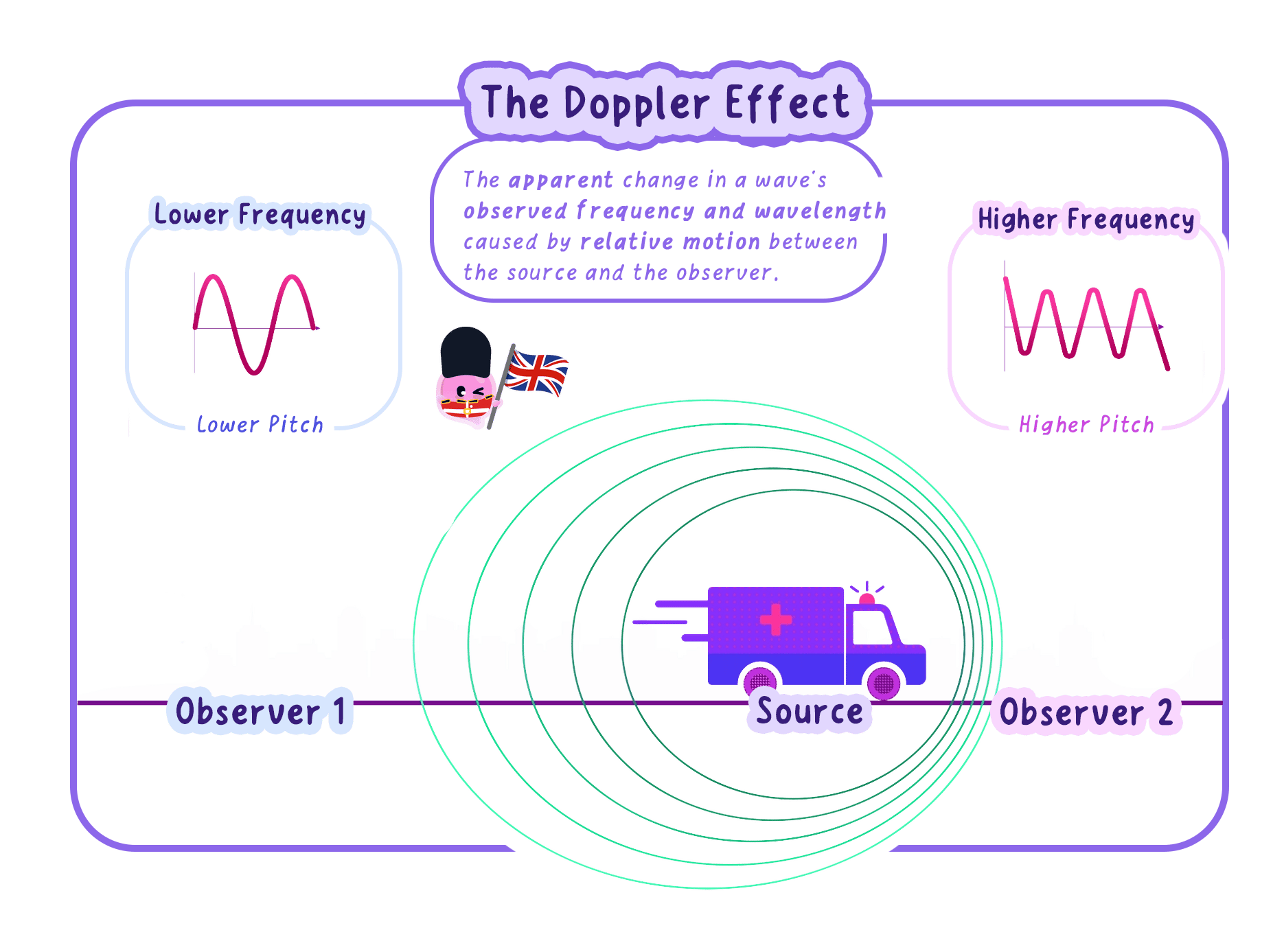
The Doppler effect is the change in the observed frequency and wavelength of a wave that occurs when the source is moving relative to the observer.
Frequency
The number of complete waves or oscillations passing a point each second.
Wavelength
The distance between consecutive points on a wave that are at the same stage of an oscillation.
- A stationary source sends out waves as a set of evenly spaced circles, so every observer around it measures the same wavelength and the same frequency.
- Once the source starts to move it travels a short distance between sending out one wave and sending out the next, so each new wave leaves from a slightly different place.
- Ahead of the moving source the waves are squashed together, so an observer in front measures a shorter wavelength and a higher frequency.
- Behind the moving source the waves are stretched apart, so an observer behind measures a longer wavelength and a lower frequency.
- Only the relative motion of source and observer matters, so the same change is measured whether the source approaches the observer or the observer approaches the source.
- The source itself never changes what it emits, since the change is created entirely by the motion and appears only in what the observer receives.
- Wavelength and frequency shift in opposite senses because the wave speed is set by the material the wave travels through, and v=f×λv = f \times \lambdav=f×λ must still hold.
Sound from a moving source
- The everyday example is an ambulance siren heard from the pavement as the ambulance drives past.
- While the ambulance approaches, the sound waves reaching you are compressed, the frequency you hear is higher than the siren produces, and the note sounds higher pitched.
- The moment the ambulance passes, the waves reaching you are stretched instead, and the note drops to a lower pitch even though the siren has been set to one steady note throughout.
- The driver hears no change at all, because the ambulance and the siren are not moving relative to each other.
- The speed of sound in the air stays at about 340 m/s340\ \text{m/s}340 m/s the whole time, so a shorter wavelength has to mean a higher frequency.
- The faster the source travels, the larger the change in the observed frequency, which is why a passing racing car produces a far more dramatic drop than a passing bicycle bell.
Light from a moving source
Red-shift
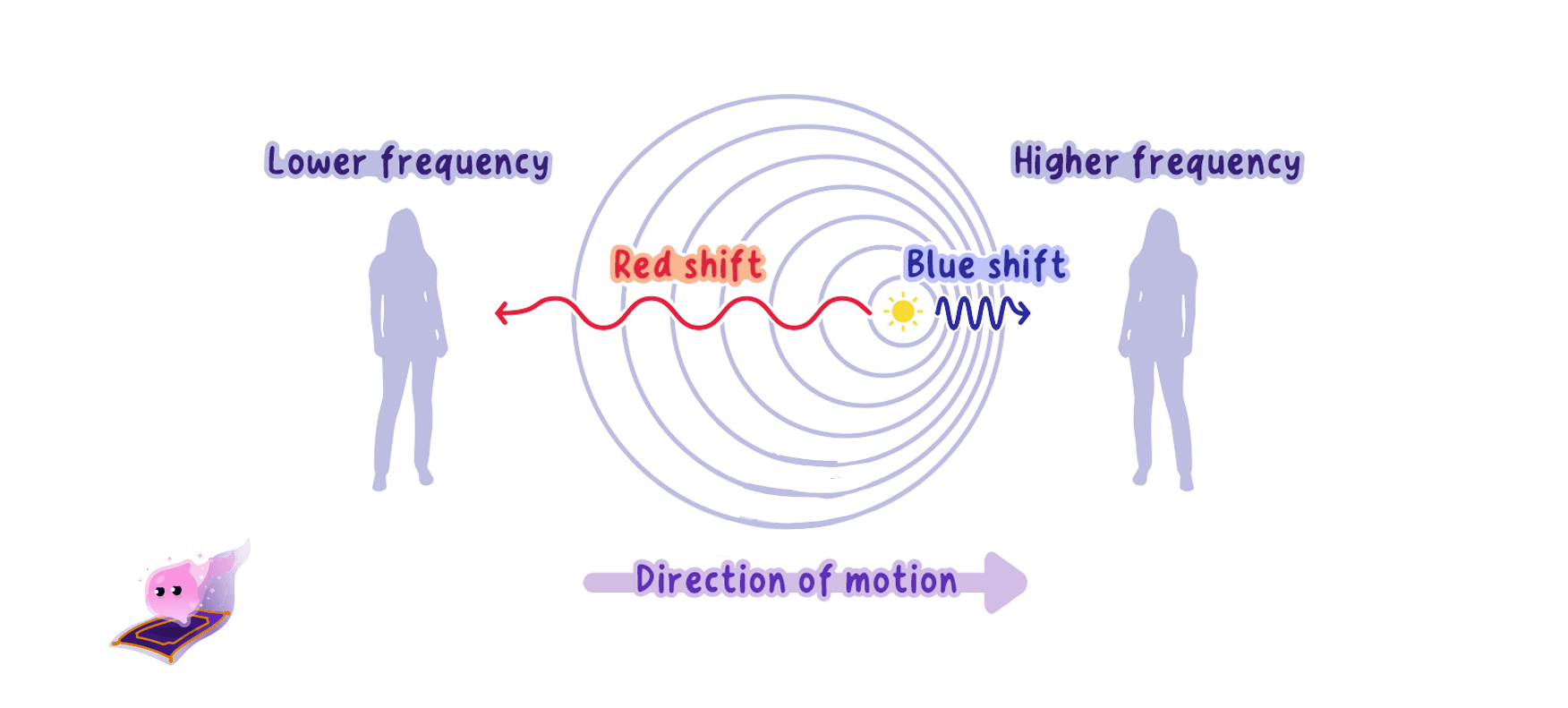
Red-shift is the increase in the observed wavelength, and decrease in the observed frequency, of light from a source that is moving away from the observer.
Blue-shift
Blue-shift is the decrease in the observed wavelength, and increase in the observed frequency, of light from a source that is moving towards the observer.
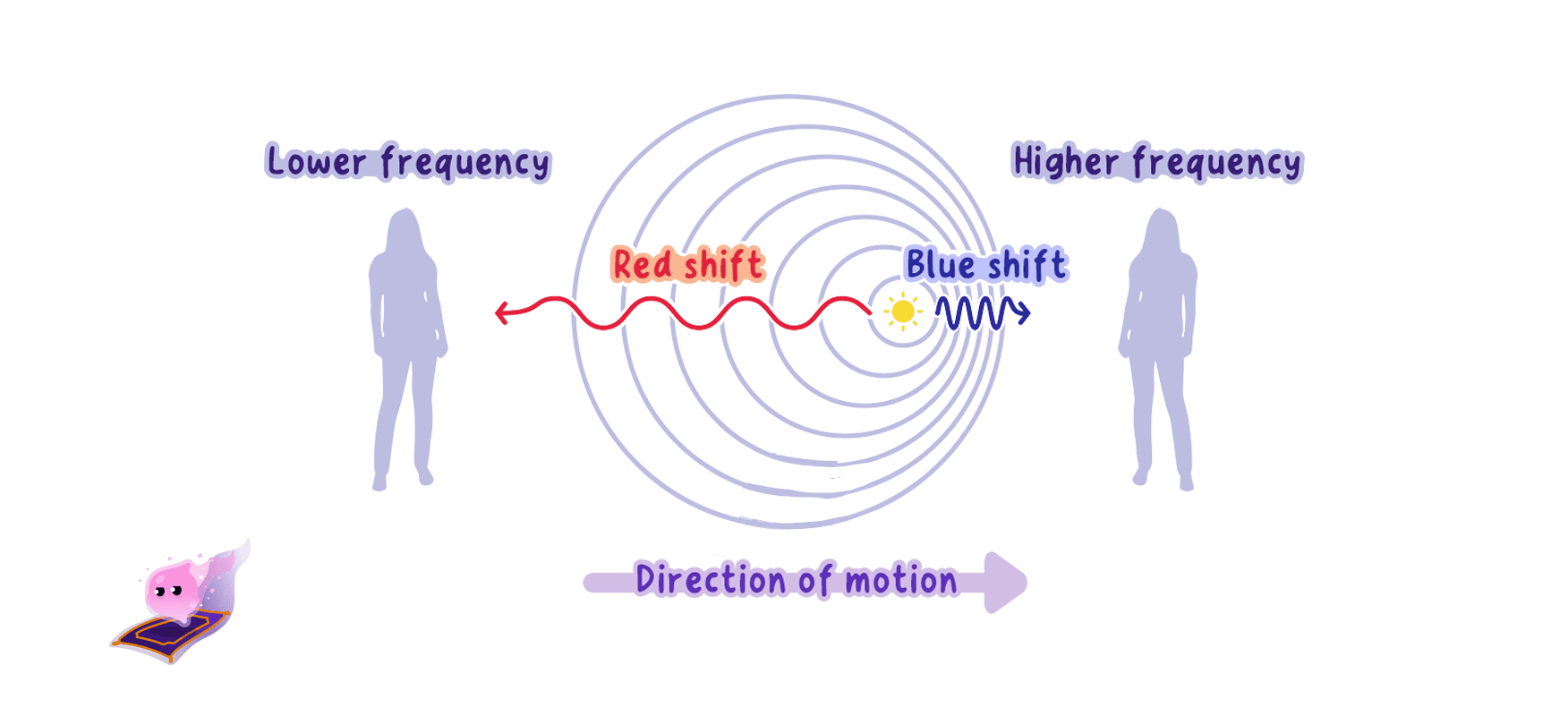
- Light is a wave, so a light source moving relative to an observer produces the same change in observed wavelength and frequency as a moving sound source does.
- A source moving away gives a longer observed wavelength and a lower observed frequency, and the light is described as red-shifted because red sits at the long wavelength end of the visible spectrum.
- A source moving towards the observer gives a shorter observed wavelength and a higher observed frequency, and the light is described as blue-shifted.
- The shift is detected by comparing the wavelengths of absorption lines from a star with the wavelengths the same elements produce in a laboratory.
- Everyday speeds give shifts far too small to notice, because light travels at 3.0×10⁸ m/s3.0 \times 10^{8}\ \text{m/s}3.0×108 m/s and a car is slower than that by a factor of many millions.
- The size of the shift depends on how fast the source is moving along the line of sight, so a larger shift means a larger speed of approach or recession.
Pitch of an approaching siren
- A siren produces a steady note of frequency 850 Hz850\ \text{Hz}850 Hz and the speed of sound in air is 340 m/s340\ \text{m/s}340 m/s.
- Rearranging v=f×λv = f \times \lambdav=f×λ gives λ=vf=340850=0.40 m\lambda = \dfrac{v}{f} = \dfrac{340}{850} = 0.40\ \text{m}λ=fv=850340=0.40 m for a stationary siren.
- As the source drives towards a listener the waves ahead of it are compressed and the observed wavelength falls to 0.36 m0.36\ \text{m}0.36 m.
- The speed of sound in the air is unchanged, so f=vλ=3400.36f = \dfrac{v}{\lambda} = \dfrac{340}{0.36}f=λv=0.36340.
- The observed frequency is about 940 Hz940\ \text{Hz}940 Hz, which is higher than the emitted frequency and is heard as a higher pitch.
A star moving towards the Earth
- A hydrogen line has a laboratory wavelength of 486 nm486\ \text{nm}486 nm and is recorded from a star at 480 nm480\ \text{nm}480 nm.
- The observed wavelength is shorter than the laboratory value, so the light is blue-shifted.
- Using f=vλf = \dfrac{v}{\lambda}f=λv the laboratory frequency is 3.0×108486×10−9=6.17×10¹⁴ Hz\dfrac{3.0 \times 10^{8}}{486 \times 10^{-9}} = 6.17 \times 10^{14}\ \text{Hz}486×10−93.0×108=6.17×10¹⁴ Hz.
- The observed frequency is 3.0×108480×10−9=6.25×10¹⁴ Hz\dfrac{3.0 \times 10^{8}}{480 \times 10^{-9}} = 6.25 \times 10^{14}\ \text{Hz}480×10−93.0×108=6.25×10¹⁴ Hz, which is higher.
- A shorter wavelength and a higher frequency together show that the star is moving towards the Earth.
Describing an observed change
- Say observed frequency and observed wavelength rather than just frequency and wavelength, because the emitted values never change.
- Give the change in both quantities, since a mark is usually available for the wavelength and another for the frequency.
- State the direction of motion clearly as towards or away from the observer, because approaching and receding give opposite answers.
- Keep the wave speed constant in any calculation, and use v=f×λv = f \times \lambdav=f×λ to convert between the two observed quantities.
- Convert nanometres to metres before substituting, since 486 nm486\ \text{nm}486 nm is 486×10−9 m486 \times 10^{-9}\ \text{m}486×10−9 m.
- Do not say that the source changes the frequency it emits, because the source is unchanged and only the observed value differs.
- Do not say the wave travels faster when the source approaches, since the wave speed depends on the material rather than the motion of the source.
- Do not let wavelength and frequency change in the same direction, because one rises exactly as the other falls.
- Do not confuse loudness with pitch, because a passing siren changes pitch while its loudness changes for a different reason.
- State what happens to the observed wavelength and frequency when a source moves towards an observer.
- Explain why the waves ahead of a moving source are closer together.
- Describe what the driver of an ambulance hears compared with a person on the pavement.
- Define red-shift and blue-shift in terms of observed wavelength.
- Calculate the observed frequency of a sound of wavelength 0.36 m0.36\ \text{m}0.36 m travelling at 340 m/s340\ \text{m/s}340 m/s.
7.2.4 Red-shift as evidence for an expanding Universe
Red-shift and distance
Galaxy
A galaxy is a very large collection of stars, gas and dust held together by gravity.
Red-shift
Red-shift is the increase in the observed wavelength, and decrease in the observed frequency, of light from a source that is moving away from the observer.
- When the light from a distant galaxy is compared with a laboratory spectrum, every absorption line is found at a longer wavelength than it should be.
- This red-shift is seen in almost every galaxy that has been measured, in whichever part of the sky the telescope is pointed.
- The size of the shift is not the same for every galaxy, and the further away a galaxy is, the larger its red-shift.
- The pattern is close to a proportional one, so a galaxy twice as far away shows roughly twice the shift.
- Since a larger shift means a faster speed along the line of sight, the more distant galaxies are moving away from us more quickly.
- A few of the nearest galaxies are blue-shifted instead, because their own motion within the local group of galaxies is larger than the general recession at such small distances.
Why this shows expansion
- The red-shift measurements show that the distance between our galaxy and almost every other galaxy is increasing.
- The same pattern would be measured from any galaxy, so there is no galaxy at the centre and our own position is nothing special.
- Galaxies flying outwards through fixed space from one point would put us at the centre of the motion, and the observations rule that picture out.
- What fits instead is that space itself is expanding, stretching the gaps between the galaxies and carrying them apart with it.
- Expanding space also stretches the light waves travelling through it, which is why the wavelength arriving at the telescope is longer than the wavelength that left the galaxy.
- Light from a more distant galaxy spends longer crossing the expanding space, so it is stretched more, which is exactly why distance and red-shift rise together.
- The expansion is a property of the whole Universe rather than of one region, so red-shift is evidence about the Universe as a whole.
How both theories explain it
Big Bang theory
The Big Bang theory states that the Universe began from a very small, extremely hot and dense region that has been expanding and cooling ever since.
Steady State theory
The Steady State theory states that the Universe has always existed and always looks much the same, because new matter is created continuously as it expands.
- Red-shift on its own does not decide between the two theories, because both of them include an expanding Universe.
- The Big Bang theory explains it as expansion that started at a single event, so the galaxies have been separating ever since and the light between them has been stretched throughout.
- On that account the red-shift is a record of an expansion with a beginning, which is why it can be traced back to a hot, dense start.
- The Steady State theory explains the same red-shift as expansion that has always been going on and always will, with no beginning to trace back to.
- New matter forms new galaxies in the widening gaps, so the galaxies still separate and still show red-shift while the Universe as a whole looks unchanged.
- Both theories therefore predict red-shift that increases with distance, and both match the measurements equally well.
- Separating them needs an observation the two theories disagree about, which is why red-shift is quoted as evidence for expansion rather than as evidence for the Big Bang alone.
Comparing two galaxy spectra
- A hydrogen line measured at 656 nm656\ \text{nm}656 nm in the laboratory is recorded at 666 nm666\ \text{nm}666 nm from galaxy A and at 696 nm696\ \text{nm}696 nm from galaxy B.
- The change for galaxy A is 666−656=10 nm666 - 656 = 10\ \text{nm}666−656=10 nm, giving a fractional shift of 10656=0.015\dfrac{10}{656} = 0.01565610=0.015.
- The change for galaxy B is 696−656=40 nm696 - 656 = 40\ \text{nm}696−656=40 nm, giving a fractional shift of 40656=0.061\dfrac{40}{656} = 0.06165640=0.061.
- Galaxy B has about four times the red-shift of galaxy A, so it is receding about four times as quickly.
- Because speed of recession rises with distance, galaxy B must also be roughly four times as far away.
Dots on an inflating balloon
- Draw dots on a deflated balloon to stand for galaxies, with one dot 2 cm2\ \text{cm}2 cm from a chosen dot and another 6 cm6\ \text{cm}6 cm away.
- Inflate the balloon until every distance has doubled, so the near dot is now 4 cm4\ \text{cm}4 cm away and the far dot is 12 cm12\ \text{cm}12 cm away.
- The near dot has moved 2 cm2\ \text{cm}2 cm and the far dot has moved 6 cm6\ \text{cm}6 cm in the same time, so the more distant dot has moved away faster.
- No dot was pushed and no dot is at the centre, because the rubber between them stretched, which is what expanding space does.
- Choosing any other dot as the starting point gives exactly the same result, which is why every galaxy sees the others receding.
Building the expansion argument
- Work through the chain in order, from lines shifted to longer wavelengths, to galaxies moving away, to more distant galaxies moving away faster, to an expanding Universe.
- Include the distance relationship, because an answer that only says galaxies are receding misses the step that shows the whole Universe is expanding.
- Add that the same view would be seen from any galaxy when a question asks why the Earth is not at the centre.
- For a question about both theories, give a separate sentence to each and state clearly that neither is ruled out by red-shift.
- Read data tables carefully, since the galaxy with the largest wavelength change is the one furthest away.
- Do not say that red-shift proves the Big Bang theory, because the Steady State theory explains red-shift too.
- Do not place the Earth at the centre of the expansion, since observers in every galaxy see the same recession.
- Do not describe galaxies as moving through space away from a central point, because the space between them is stretching.
- Do not claim every galaxy is red-shifted, since a few nearby galaxies are approaching and are blue-shifted.
- Describe how the red-shift of a galaxy depends on its distance from the Earth.
- Explain why red-shift shows that the Universe is expanding.
- Explain why the Earth is not at the centre of the expansion.
- State how the Steady State theory accounts for the red-shift of galaxies.
- Explain why red-shift alone cannot decide between the two theories.
7.2.5 The CMB and the accepted model
Predicting the microwave background
Cosmic microwave background radiation
Cosmic microwave background radiation is faint microwave radiation of almost the same intensity that reaches the Earth from every direction in space.
Electromagnetic spectrum
The continuous range of electromagnetic waves arranged according to wavelength or frequency.
- The Big Bang theory starts the Universe in an extremely hot state, and anything that hot emits intense electromagnetic radiation.
- That radiation was released in every direction at once, so it should still be crossing space in every direction today.
- Space has expanded enormously since then, and the expansion stretches the wavelength of any wave travelling through it.
- Radiation that left as visible and infrared light has therefore been stretched all the way into the microwave part of the electromagnetic spectrum.
- The theory therefore predicted a weak microwave signal filling the whole sky, corresponding to a temperature only a few degrees above absolute zero.
- The Steady State theory makes no such prediction, because it never has a hot dense early stage to leave any radiation behind.
Finding the background radiation
- In 196519651965 two radio astronomers, Penzias and Wilson, were testing a large horn shaped aerial and could not get rid of a faint hiss in their receiver.
- The signal did not fade when they pointed the aerial elsewhere, did not change with the time of day and did not change with the seasons.
- That behaviour ruled out any source on the Earth, in the atmosphere, in the Solar System or in our own galaxy, because each of those would appear in one direction or vary through the year.
- What was left was radiation coming uniformly from all of space, at microwave wavelengths and at a temperature close to 3 K3\ \text{K}3 K.
- A separate team of physicists recognised that this matched the signal the Big Bang theory had predicted years earlier.
- Later satellites mapped the radiation across the whole sky and confirmed both its temperature and its evenness far more precisely.
Why the Big Bang became accepted
Big Bang theory
The Big Bang theory states that the Universe began from a very small, extremely hot and dense region that has been expanding and cooling ever since.
Steady State theory
The Steady State theory states that the Universe has always existed and always looks much the same, because new matter is created continuously as it expands.
- Red-shift had never separated the two theories, since both of them describe an expanding Universe.
- The microwave background did separate them, because it was predicted by one theory and not by the other.
- Supporters of the Steady State theory could only account for the signal by adding extra assumptions that had no independent support of their own.
- The Big Bang theory now had two independent pieces of evidence behind it, the red-shift of galaxies and the microwave background, while the Steady State theory had one.
- Because there is more evidence supporting the Big Bang theory than the Steady State theory, the Big Bang is the currently accepted model for the origin of the Universe.
- The word currently matters, because a model is accepted only while it fits the evidence and would be replaced if a future observation contradicted it.
- Acceptance also took time rather than happening at once, since other groups first had to repeat the measurement with different equipment before the result was trusted.
Tracking down the aerial noise
- The first suspicion was equipment fault, so the receiver was rebuilt and retested, and the hiss stayed.
- The second suspicion was interference from nearby New York, so the aerial was pointed away from the city, and the hiss stayed.
- The third suspicion was contamination inside the horn, so the pigeon droppings were cleaned out, and the hiss stayed.
- Eliminating each local explanation in turn is what turned an annoying noise into a measurement of something real.
- Only then could the signal be matched against a prediction that had been published before it was found.
How far the radiation has stretched
- Take radiation that left the hot early Universe with a wavelength of 1.0×10⁻⁶ m1.0 \times 10^{-6}\ \text{m}1.0×10⁻⁶ m, which is in the infrared.
- It is detected today at a wavelength of about 1.1×10⁻³ m1.1 \times 10^{-3}\ \text{m}1.1×10⁻³ m, which is in the microwave region.
- The stretch factor is 1.1×10−31.0×10−6=1100\dfrac{1.1 \times 10^{-3}}{1.0 \times 10^{-6}} = 11001.0×10−61.1×10−3=1100.
- Space has expanded by roughly that same factor since the radiation was released, which is why the signal now sits so far from the visible part of the spectrum.
Explaining why the model changed
- State that the microwave background was predicted by the Big Bang theory but not by the Steady State theory, because that contrast is the answer to the question.
- Mention that the radiation arrives from all directions, since a question often awards a mark for that feature alone.
- Write currently accepted model rather than correct model, because the examiners expect you to leave room for the theory being replaced.
- Say that more evidence supports the Big Bang theory rather than saying the Steady State theory was disproved.
- In a longer answer, order it as prediction, discovery, then acceptance, so each stage earns its own credit.
- Do not write that the microwave background proves the Big Bang theory, because evidence supports a theory rather than proving it.
- Do not say the radiation comes from the edge of the Universe, since it arrives evenly from every direction.
- Do not claim the radiation was always microwaves, because it was released as much shorter wavelength radiation and has been stretched since.
- Do not treat the Steady State theory as unscientific, since it made testable predictions and was rejected because those predictions failed.
- Explain why the Big Bang theory predicts radiation filling the whole sky.
- Describe how the wavelength of that radiation has changed since it was released.
- State two observations that showed the signal found by Penzias and Wilson was not from a local source.
- Explain why the discovery of the microwave background counted against the Steady State theory.
- State which model of the origin of the Universe is currently accepted and give the reason.
