7.3.1 Evolution of stars similar to the Sun
Balance of gravity and pressure
Nuclear fusion
Nuclear fusion is the joining of small nuclei to create a larger nucleus, with a loss of mass that is accompanied by a release of energy.
Main sequence star
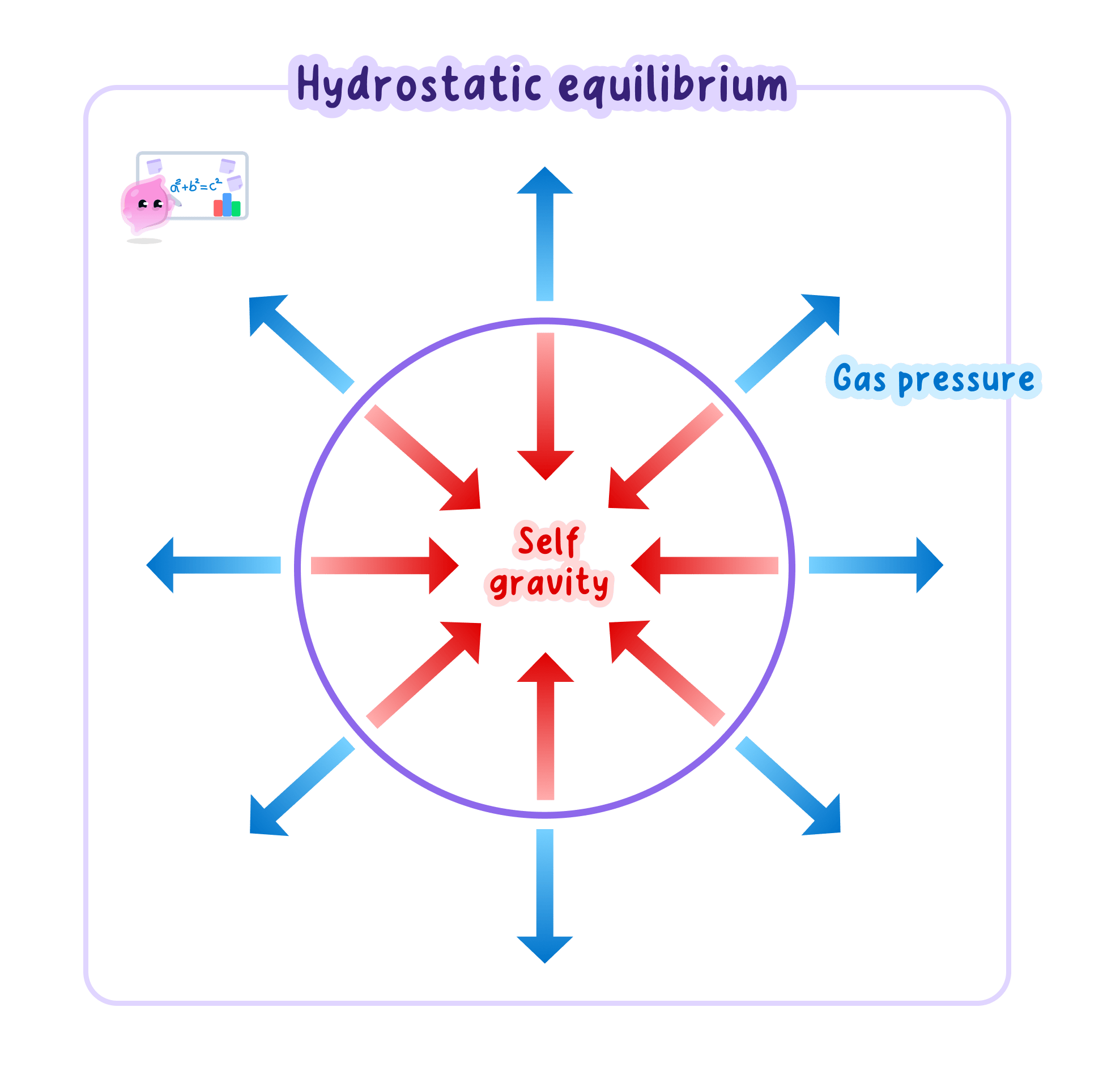
A main sequence star is a star in the long, stable stage of its life in which the outward pressure from hydrogen fusion balances the inward pull of gravity.
- Two opposing effects decide what a star does at every stage of its life, gravity pulling all of its material inwards and thermal expansion pushing it outwards.
- The outward push comes from the hot gas in the core, because nuclear fusion keeps the core at millions of degrees and hot gas exerts a very large pressure.
- When the two effects are balanced the star neither collapses nor swells, so its size stays steady for a very long time.
- When fusion slows the core cools, the outward push weakens, gravity wins and part of the star contracts.
- When fusion speeds up the core gets hotter, the outward push strengthens and the star expands.
- Every stage in the life of a star is one of these situations, so the whole life cycle can be read as the balance being made, held, lost and remade.
From nebula to main sequence
Nebula
A nebula is a cloud of dust and gas in space from which stars form.
Protostar
A protostar is the hot, dense ball of gas formed as a nebula collapses under gravity, before nuclear fusion begins in its core.
- A star begins as a nebula, a cold cloud of dust and hydrogen gas spread thinly through space.
- Gravity pulls the material of the cloud together, and the denser parts pull in more material still, so the collapse speeds up as it goes.
- As the material falls inwards its gravitational store is transferred to the thermal store of the gas, so the centre of the cloud gets steadily hotter.
- The hot dense ball at this stage is a protostar, which glows from that heating alone because no fusion has started yet.
- Once the core passes about 101010 million K\text{K}K the hydrogen nuclei move fast enough to fuse together into helium, and a star is born.
- Fusion releases energy, the core pressure rises, and the collapse stops when that outward push exactly balances gravity.
- The star is now a main sequence star, and it stays that way for as long as there is hydrogen in the core to fuse.
- This is by far the longest stage, lasting about 101010 billion years for a star the size of the Sun, which is currently about halfway through it.
The red giant stage
Red giant
A red giant is the much larger, cooler star that a star of similar mass to the Sun becomes once hydrogen fusion in its core stops.
- Eventually the hydrogen in the core is used up, fusion there slows and the outward push is no longer enough to hold gravity off.
- The core contracts under gravity, and that contraction raises its temperature high enough for helium nuclei to fuse into larger nuclei.
- The extra energy released heats the outer layers, and those layers expand enormously.
- Spreading the same energy over a far larger surface leaves that surface cooler, so the star glows red rather than yellow or white.
- The result is a red giant, a star with a small hot core and a huge cool outer envelope.
- When the Sun reaches this stage its surface will swell out past the orbit of the Earth, and the stage will last only a few hundred million years.
The white dwarf stage
White dwarf
A white dwarf is the small, hot, very dense core left behind when a red giant sheds its outer layers.
- Fusion in the core eventually stops for good, because the core is not massive enough to reach the temperature that heavier nuclei need.
- With no energy released there is nothing to hold the outer layers, and they drift gently away into space.
- Gravity pulls what is left of the core into a body roughly the size of the Earth, and this hot dense remnant is a white dwarf.
- A white dwarf shines only from the energy stored during its earlier life, so it slowly cools and fades over billions of years.
- The full order for a star of similar mass to the Sun is therefore nebula, main sequence star, red giant and white dwarf.
Following the balance through a life
- In the nebula there is no fusion and no outward push, so gravity acts alone and the cloud collapses.
- On the main sequence the push from the hot core exactly matches gravity, so the size holds steady for billions of years.
- When core hydrogen runs out the push drops below gravity, so the core is squeezed smaller and heats up.
- Helium fusion then raises the push above gravity in the outer layers, so those layers expand and the star becomes a red giant.
- Once fusion ends the push disappears for good, gravity wins completely and the core is crushed into a white dwarf.
How much a red giant swells
- A star like the Sun expands to roughly 100100100 times its main sequence radius when it becomes a red giant.
- Volume depends on the cube of the radius, so the volume increases by a factor of 1003=1×106100^{3} = 1 \times 10^{6}1003=1×10⁶.
- Almost none of the mass is lost during the expansion, and ρ=mV\rho = \dfrac{m}{V}ρ=Vm shows that the mean density falls by that same factor of a million.
- A red giant is therefore an extremely thin, spread out star despite being so large.
Describing a life cycle for marks
- Name each stage in the right order, since a describe question usually gives one mark for each correctly placed stage.
- Say what triggers each change as well as naming it, for example that core hydrogen running out is what ends the main sequence stage.
- Use the words gravity and outward pressure explicitly in any question about why a star changes size.
- State which force is winning at that moment, because saying the forces are unbalanced is not enough for the mark.
- Link a colour change to a surface temperature change, since red means a cooler surface than yellow or white.
- Do not write that a star runs out of fuel and instantly dies, because the core contracts and begins fusing helium first.
- Do not confuse the small hot core with the huge cool envelope of a red giant, since it is the outer layers that expand and cool.
- Do not say a white dwarf is still fusing, because it shines only from energy stored earlier.
- Do not describe nuclear fission in a star, since stars release energy by fusing small nuclei together.
- List the four stages in the life of a star of similar mass to the Sun, in order.
- Explain what keeps a main sequence star at a constant size.
- Describe how a nebula becomes hot enough for fusion to start.
- Explain why the surface of a red giant is cooler than the surface of a main sequence star.
- Describe what a white dwarf is and explain why it fades over time.
7.3.2 Evolution of massive stars
Why mass changes the outcome
Main sequence star
A main sequence star is a star in the long, stable stage of its life in which the outward pressure from hydrogen fusion balances the inward pull of gravity.
Nuclear fusion
Nuclear fusion is the joining of small nuclei to create a larger nucleus, with a loss of mass that is accompanied by a release of energy.
- A star with far more mass than the Sun has a far stronger inward pull of gravity acting on its core.
- Balancing that stronger pull needs a much greater outward push, which the star can only supply by running its core at a higher temperature and pressure.
- A hotter core fuses hydrogen far more rapidly, so a massive star gets through its fuel much faster even though it started with more of it.
- The main sequence stage of a massive star therefore lasts a few million years rather than the billions of years a star like the Sun manages.
- The high core temperature also lets fusion continue on to heavier elements that a smaller star can never reach.
- Mass is the single quantity that decides the whole later life of a star, which is why two stars formed in the same nebula can end so differently.
Life of a massive star
Red supergiant
A red supergiant is the extremely large, cool star formed when a star of much greater mass than the Sun expands after hydrogen fusion in its core stops.
- A massive star begins in exactly the same way as any other, with gravity pulling a nebula together until the core is hot enough for fusion.
- It then spends a short main sequence stage as a very hot, very bright star, burning blue or blue white rather than yellow.
- When the core hydrogen is gone the outward push drops, the core contracts under gravity, and the outer layers swell into a red supergiant.
- This is the same process that makes a red giant, but on a far larger scale, so a red supergiant can be hundreds of times wider than the Sun.
- Inside it the contracting core keeps reaching new temperatures, so helium fuses into carbon and then heavier nuclei form in a series of stages.
- Fusion stops once the core is made of iron, because fusing iron nuclei takes energy in rather than giving energy out.
- With no energy released the outward push collapses, and gravity is left completely unopposed.
The supernova explosion
Supernova
A supernova is the sudden explosion of a red supergiant that scatters its outer layers into space.
- The unsupported core collapses in a fraction of a second, and the outer layers fall inwards behind it.
- The infalling material rebounds off the collapsed core and is blasted back out in an enormous explosion called a supernova.
- For a few weeks a single supernova can shine more brightly than all of the other stars in its galaxy put together.
- The explosion supplies enough energy to build nuclei heavier than iron, including gold, lead and uranium.
- All of those elements are thrown out into space, where they enrich the gas and dust that later collapses into new nebulae.
- Every atom heavier than helium on Earth was made inside an earlier star or in a supernova, which is why the Solar System contains rocky planets at all.
Neutron star or black hole
Neutron star
A neutron star is the extremely small and dense remnant left when the core of a red supergiant collapses during a supernova.
Black hole
A black hole is a remnant of a very massive star whose gravitational field is so strong that not even light can escape from it.
- What is left behind after the supernova depends on how much mass the collapsed core still holds.
- A core of moderate mass is squeezed until its material is packed as tightly as the inside of a nucleus, forming a neutron star.
- A neutron star packs more mass than the Sun into a ball only about 20 km20\ \text{km}20 km across, so a teaspoon of it would have a mass of billions of tonnes.
- If the remaining core is more massive still, nothing can resist gravity and the collapse continues without limit.
- The result is a black hole, where the gravitational field is so strong that not even light travels fast enough to escape.
- A black hole emits no light of its own, so it is detected by its gravitational pull on nearby stars and gas rather than by being seen directly.
- The full order for a massive star is therefore nebula, main sequence star, red supergiant, supernova, and then either a neutron star or a black hole.
Comparing two main sequence lives
- The Sun holds enough hydrogen for a main sequence stage of about 101010 billion years.
- A star of 202020 times that mass starts with 202020 times as much hydrogen, so it might be expected to last far longer.
- Its far stronger gravity forces a much hotter core, and fusion in that core runs many thousands of times faster.
- The rate of use outweighs the extra supply, so its main sequence stage lasts only about 101010 million years.
- That is roughly one thousandth of the life of the Sun, reached with twenty times the fuel.
Density of a neutron star
- A neutron star has a mass of about 3.0×1030 kg3.0 \times 10^{30}\ \text{kg}3.0×1030 kg and a radius of about 1.0×10⁴ m1.0 \times 10^{4}\ \text{m}1.0×10⁴ m.
- Its volume is 43πr3=43π(1.0×10⁴)3=4.2×10¹² m3\dfrac{4}{3}\pi r^{3} = \dfrac{4}{3}\pi (1.0 \times 10^{4})^{3} = 4.2 \times 10^{12}\ \text{m}^{3}34πr3=34π(1.0×10⁴)3=4.2×10¹² m3.
- Using ρ=mV\rho = \dfrac{m}{V}ρ=Vm gives ρ=3.0×10304.2×1012\rho = \dfrac{3.0 \times 10^{30}}{4.2 \times 10^{12}}ρ=4.2×10123.0×1030.
- The density is about 7×10¹⁷ kg/m37 \times 10^{17}\ \text{kg/m}^{3}7×1017 kg/m3.
- Water has a density of 1000 kg/m31000\ \text{kg/m}^{3}1000 kg/m3, so this material is denser than water by a factor of about 101410^{14}1014.
Getting the massive star sequence right
- Start any comparison question by stating the mass of the star, because the whole answer follows from whether it is similar to the Sun or much larger.
- Use supergiant rather than giant for a massive star, since the two words mark two different routes and only one earns the mark.
- Give both possible endings when asked what a supernova leaves behind, and say that the more massive core becomes the black hole.
- Explain the short life of a massive star through its faster rate of fusion, not through it having less fuel.
- Mention the scattering of heavy elements when a question asks why a supernova matters for the formation of planets.
- Do not send a star like the Sun through a supernova, because it lacks the mass to reach that stage.
- Do not write that a massive star lives longer because it has more fuel, since it uses that fuel far more quickly.
- Do not put a white dwarf at the end of a massive star sequence, because that remnant belongs to a star of similar mass to the Sun.
- Do not describe a black hole as a hole in space, since it is an extremely concentrated mass with a very strong gravitational field.
- List the stages in the life of a star much more massive than the Sun, in order.
- Explain why a massive star spends less time on the main sequence than the Sun does.
- State why fusion stops once the core of a massive star is made of iron.
- Describe what happens during a supernova and name one thing it produces.
- State what decides whether a supernova leaves a neutron star or a black hole.
7.3.3 Observing the Universe
From naked eye to telescope
Telescope
A telescope is an instrument that collects electromagnetic radiation from distant objects in order to produce an image or a measurement of them.
- For most of history the only instrument available was the naked eye, so astronomers recorded the positions of bright stars and planets and how those positions changed.
- That method could reach only a few thousand objects, because the pupil of the eye collects very little light and cannot store it up.
- The optical telescope changed that from the early 160016001600s, first with lenses and later with curved mirrors.
- A telescope gathers light over a much larger area than the eye and brings it to a focus, so far fainter and more distant objects become visible.
- Mirrors can be built much larger than lenses, so telescope apertures grew from a few centimetres to the ten metre class instruments used today.
- From the nineteenth century photography replaced the eye at the eyepiece, and a long exposure builds up light from a faint object over hours instead of an instant.
- A photograph is also a permanent record that other astronomers can measure and check, which a personal sketch at the eyepiece never was.
Observing beyond visible light
Electromagnetic spectrum
The continuous range of electromagnetic waves arranged according to wavelength or frequency.
- Visible light is a narrow band of the electromagnetic spectrum, so an optical telescope reveals only a small part of what objects in space emit.
- From the 193019301930s radio telescopes began detecting radio waves from the Milky Way, which opened up objects that give out almost no visible light at all.
- Detectors were then developed for infrared, ultraviolet, X-rays and gamma rays, so the whole spectrum could be used.
- Each band reveals different physics, since cool dust clouds show up in the infrared while extremely hot gas and violent events show up in X-rays.
- The cosmic microwave background could only be found once microwave receivers existed, which is a direct example of new instruments producing new evidence.
- Modern telescopes use digital detectors rather than film, and computers combine, sharpen and store the images automatically.
- Signals from several telescopes spread across the world can also be combined, giving detail that no single dish could produce on its own.
Why telescopes are put in space
Space telescope
A space telescope is a telescope placed in orbit above the Earth's atmosphere so that its observations are not affected by absorption or distortion by the air.
- The atmosphere absorbs most of the electromagnetic spectrum before it reaches the ground, so those wavelengths simply never arrive at a ground based telescope.
- Gamma rays, X-rays and most ultraviolet are blocked completely, and much of the infrared is absorbed by water vapour in the air.
- Visible light and radio waves pass through reasonably well, which is why those two types of telescope still work from the ground.
- Moving air also bends light continuously, which blurs the image and makes stars appear to twinkle, so fine detail is lost even on a clear night.
- Cloud, rain and light pollution from towns and cities cut observing time further and swamp faint objects.
- A telescope placed in orbit sits above the whole atmosphere, so it receives every wavelength, produces far sharper images and can observe continuously.
- The price is that a space telescope costs far more to build and launch, and repairing one is difficult or impossible once it is in orbit.
- Ground based telescopes are therefore still built for visible and radio work, where the atmosphere causes least trouble and a much larger instrument can be afforded.
Light gathered by a larger mirror
- An amateur telescope has a mirror of diameter 0.10 m0.10\ \text{m}0.10 m and a space telescope has a mirror of diameter 2.4 m2.4\ \text{m}2.4 m.
- The light gathered depends on the area of the mirror, and area is proportional to the square of the diameter.
- The ratio of the diameters is 2.40.10=24\dfrac{2.4}{0.10} = 240.102.4=24.
- The ratio of the areas is therefore 242=57624^{2} = 576242=576.
- The larger mirror collects nearly 600600600 times as much light each second, which is why it reaches objects far too faint for the smaller one.
Siting an X-ray telescope
- A team wants to study X-rays given out by hot gas falling towards a black hole.
- A mountain top site would reduce cloud and light pollution, so it looks attractive at first.
- The atmosphere absorbs X-rays completely, however, so even the highest mountain still has enough air above it to stop the signal.
- The telescope must be launched into orbit, because only above the atmosphere do any X-rays reach the detector at all.
- A radio telescope studying the same object could stay on the ground, since radio waves pass through the atmosphere freely.
Answering questions on observation
- Give absorption by the atmosphere as the first reason for putting a telescope in space, and name the wavelengths that are blocked.
- Add blurring by moving air as a second reason, because most answers give only one and lose the second mark.
- Order any question about changing methods by time, from the naked eye through optical telescopes to detectors across the whole spectrum.
- Say what each new method allowed astronomers to see, since the mark is for the improvement rather than for the name of the instrument.
- Include one drawback of space telescopes when a question asks you to evaluate, such as the cost or the difficulty of repair.
- Do not say a space telescope is used because it is closer to the stars, since the extra few hundred kilometres makes no difference over such distances.
- Do not claim the atmosphere blocks all electromagnetic radiation, because visible light and radio waves pass through it.
- Do not write that telescopes make objects bigger, since the important gain is that a larger aperture collects more light.
- Do not treat all telescopes as optical, because radio, infrared and X-ray telescopes detect radiation your eyes cannot see.
- Describe two ways in which methods of observing the Universe have improved since naked eye astronomy.
- Explain why a larger telescope mirror allows fainter objects to be seen.
- Name three parts of the electromagnetic spectrum that the atmosphere largely blocks.
- Give two reasons why some telescopes are placed outside the atmosphere.
- State one disadvantage of a space telescope compared with a ground based one.
