Refraction and wave speed
Definition
Refraction
The change in direction of a wave caused by a change in speed as it passes from one medium into another.
- A wave changes speed when the properties of the medium that determine its propagation change.
- The source does not change at the boundary, so the wave frequency remains constant.
- Using v=fλv=f\lambdav=fλ, constant fff means that a lower speed gives a shorter wavelength and a higher speed gives a longer wavelength.
Direction of bending
- Draw a normal at 90∘90^\circ90∘ to the boundary where the wave arrives.
- If the wave slows down, it bends towards the normal, so the angle of refraction is smaller than the angle of incidence.
- If the wave speeds up, it bends away from the normal, so the angle of refraction is larger than the angle of incidence.
- The rule depends on the change in wave speed, not simply on which material is denser.
- If the wave travels along the normal, every part of the wavefront changes speed together, so the direction does not change.
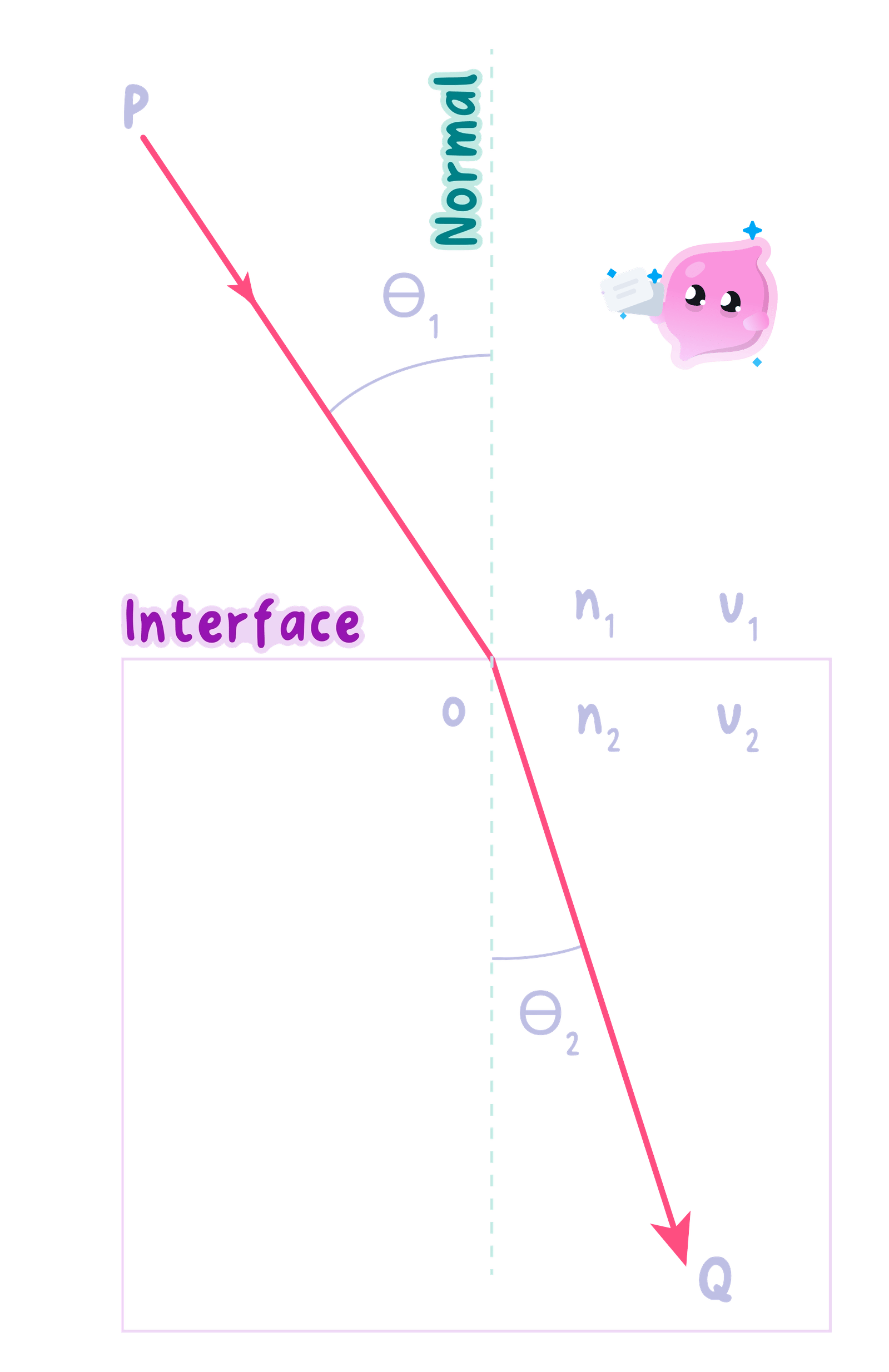
Why the wave turns
- A wavefront arriving at an angle reaches the new medium one side first.
- That side changes speed before the rest of the wavefront.
- The unequal distances travelled by the two sides during the change rotate the wavefront.
- The direction of travel, which is perpendicular to the wavefront, therefore changes.
Wave quantities at the boundary
- Frequency remains unchanged because each incoming oscillation produces one transmitted oscillation.
- Speed changes because the wave now travels through a different medium.
- Wavelength changes in the same ratio as speed because λ=vf\lambda=\dfrac{v}{f}λ=fv and fff is constant.
Example
Wavelength after refraction
- Water waves with frequency 5.0 Hz5.0\ \text{Hz}5.0 Hz move at 0.30 m s−10.30\ \text{m s}^{-1}0.30 m s−1 before entering shallow water, where their speed is 0.18 m s−10.18\ \text{m s}^{-1}0.18 m s−1.
- In deep water, λ=vf=0.305.0=0.060 m\lambda=\dfrac{v}{f}=\dfrac{0.30}{5.0}=0.060\ \text{m}λ=fv=5.00.30=0.060 m.
- In shallow water, λ=0.185.0=0.036 m\lambda=\dfrac{0.18}{5.0}=0.036\ \text{m}λ=5.00.18=0.036 m.
- The wave slows and its wavelength decreases, so an oblique wave bends towards the normal.
Exam technique
- Write a complete causal chain: the wave changes speed at the boundary, so one side of the wavefront changes speed first and the wave changes direction.
- On a ray diagram, draw the normal before measuring the angles from it.
Common Mistake
- Do not say that frequency changes when a wave crosses a boundary; the source fixes the frequency.
- A wave entering along the normal is still refracted in speed and wavelength, although its direction is unchanged.
Self review
- What causes refraction at a boundary?
- How does a wave bend when it slows down?
- Which wave quantity remains constant across a boundary?
- Why does wavelength change when speed changes?
- Why is there no change of direction at normal incidence?
