Reflection: angles are measured from the normal
Definition
Reflection
The change in direction of a wave at a boundary so that it remains in the original medium.
- A ray is a straight line with an arrow that shows the direction in which light travels.
- The normal is an imaginary line drawn at 90∘90^\circ90∘ to the surface at the point where the ray meets the boundary.
- The angle of incidence, iii, is the angle between the incident ray and the normal.
- The angle of reflection, rrr, is the angle between the reflected ray and the normal.
- The law of reflection is i=ri=ri=r, so the incident ray and reflected ray make equal angles with the normal.
- A ray travelling along the normal has i=0∘i=0^\circi=0∘ and is reflected back along the same path.
Example
Applying the law of reflection
- A ray strikes a plane mirror at 37∘37^\circ37∘ to the normal.
- The law of reflection gives r=i=37∘r=i=37^\circr=i=37∘.
- The angle between the incident and reflected rays is 37∘+37∘=74∘37^\circ+37^\circ=74^\circ37∘+37∘=74∘.
Refraction: speed changes at a boundary
Definition
Refraction
The change in direction of a wave caused by a change in speed as it passes from one medium into another.
- When light enters a more optically dense medium, such as glass from air, it slows down and bends towards the normal.
- When light enters a less optically dense medium, such as air from glass, it speeds up and bends away from the normal.
- Light travelling along the normal changes speed but does not change direction because its angle of incidence is 0∘0^\circ0∘.
- The frequency of the light is fixed by the source and does not change at the boundary.
- Since v=fλv=f\lambdav=fλ, a lower speed at unchanged frequency means a shorter wavelength in the more optically dense medium.
- At a glass boundary, part of the light can be refracted and part can be reflected.
Practical
Investigating refraction in a rectangular block
- Apparatus: ray box with a single slit or an approved low-power classroom laser, rectangular glass or acrylic block, plain paper, pencil, ruler, protractor and power supply.
- Independent variable: angle of incidence.
- Dependent variable: angle of refraction.
- Control variables: block material, light colour, entry face, entry point and angle-measuring method.
- Method:
- Place the block on the paper, trace its outline and draw a normal at the chosen entry point.
- Direct one narrow ray at the entry point and mark two points on the incident ray and two points on the emergent ray.
- Remove the block, join the marked points with a ruler and connect the entry and exit points to reconstruct the ray inside the block.
- Measure the angles of incidence and refraction from the normal, not from the block surface.
- Repeat for at least five angles of incidence, repeat each reading and calculate a mean angle of refraction.
- Record the results in a table and plot angle of refraction against angle of incidence if required.
- Expected pattern: light bends towards the normal on entering the block and away from the normal on leaving it, while the emergent ray is parallel to the incident ray because the block faces are parallel.
- Safety: never look into the beam or direct it at another person, keep leads tidy and avoid touching a hot ray-box lamp.
- Uncertainty: thick pencil lines, a broad ray, parallax, movement of the block and incorrect protractor alignment increase uncertainty.
- Improvements: use a narrow beam and sharp pencil, space ray marks widely apart, keep the block on its outline, measure from the centre of each ray and repeat readings.
Total internal reflection needs two conditions
Definition
Total internal reflection
The complete reflection of light back into an optically denser medium when it meets a boundary above the critical angle.
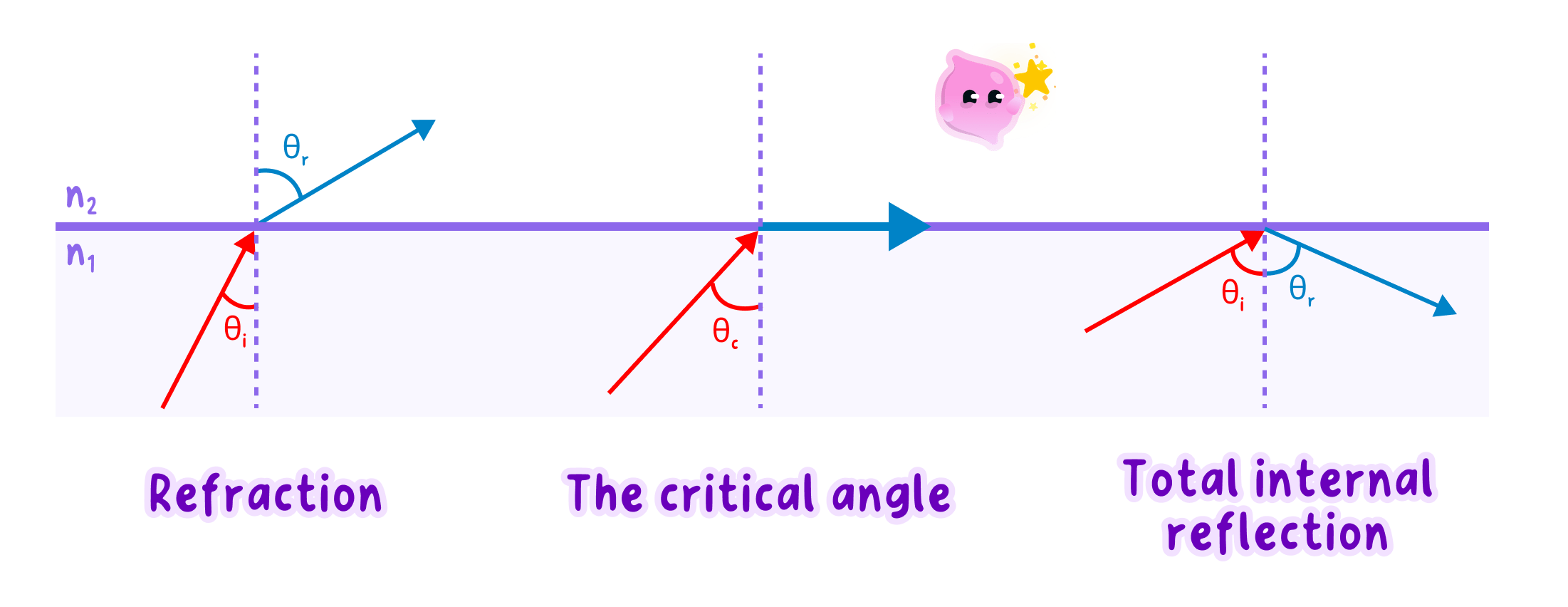
- The critical angle, ccc, is the angle of incidence in the optically denser medium that produces an angle of refraction of 90∘90^\circ90∘.
- At i<ci<ci<c, some light leaves the denser medium by refraction and some can be reflected.
- At i=ci=ci=c, the refracted ray travels along the boundary because its angle to the normal is 90∘90^\circ90∘.
- At i>ci>ci>c, total internal reflection occurs and no refracted ray leaves the medium.
- Total internal reflection can occur only when light travels from a more optically dense medium to a less optically dense medium, such as glass to air.
- Optical fibres use repeated total internal reflection to guide light along the transparent core, including around gentle bends.
Common Mistake
- Do not measure an angle from the surface; every incidence, reflection and refraction angle is measured from the normal.
- Do not state that light always bends at a boundary; a ray along the normal changes speed without changing direction.
- Do not claim that a large angle alone causes total internal reflection; the ray must also travel from a more optically dense medium to a less optically dense medium.
Exam technique
Drawing ray diagrams
- Draw the boundary and a dashed normal at 90∘90^\circ90∘ before adding the rays.
- Put arrowheads on every ray and show whether the ray is travelling towards or away from the boundary.
- For an explanation of refraction, link the change in speed to the change in direction and state whether the ray bends towards or away from the normal.
- For total internal reflection, state both required conditions and compare iii with ccc.
Self review
- State the law of reflection and identify the line from which both angles are measured.
- Explain why light bends towards the normal when it enters glass from air.
- State what happens to speed, frequency and wavelength when light enters glass from air.
- Define the critical angle.
- State both conditions required for total internal reflection.
