6.3.1 Beta-minus and beta-plus decay
Beta decay in unstable nuclei
Beta particle
A beta particle is an electron emitted from the nucleus of an unstable atom.
Positron
A positron is a particle with the same relative mass as an electron and a relative charge of +1.
- A nucleus is held together by the balance between the strong nuclear force pulling all the nucleons together and the electrostatic repulsion pushing the protons apart.
- When a nucleus holds too many neutrons or too many protons for that balance to hold, it is unstable and it will eventually decay.
- Beta decay is the route an unstable nucleus takes when its problem is the ratio of neutrons to protons rather than its total size, so no nucleons are thrown out of the nucleus at all.
- Instead, one nucleon changes identity inside the nucleus, and a small light particle is created and thrown out to carry away the charge.
- There are two versions of this, and which one happens depends on which nucleon the nucleus has too many of.
- A nucleus with too many neutrons turns a neutron into a proton and emits an electron, which is called beta-minus decay and written β−\beta^-β− decay.
- A nucleus with too many protons turns a proton into a neutron and emits a positron, which is called beta-plus decay and written β+\beta^+β+ decay.
- The two emitted particles are antiparticles of each other, so they have the same very small relative mass but opposite relative charge.
Beta-minus decay
Beta-minus decay
Beta-minus decay is the decay of an unstable nucleus in which a neutron becomes a proton and an electron, and the electron is emitted from the nucleus as a beta-minus particle.
- Inside a neutron-rich nucleus, a single neutron changes into a proton and an electron, and the electron is immediately expelled from the nucleus.
- In words, the change to the nucleon is neutron→proton+electron\text{neutron} \rightarrow \text{proton} + \text{electron}neutron→proton+electron.
- Using particle symbols, the same change is n→p+e−\text{n} \rightarrow \text{p} + \text{e}^-n→p+e−.
- Written with mass numbers and charges, so that both quantities can be seen to balance, the change is 01n→11p+−10e_{0}^{1}\text{n} \rightarrow _{1}^{1}\text{p} + _{-1}^{0}\text{e}01n→11p+−10e.
- The emitted electron is the beta-minus particle, and in a nuclear equation it is written as −10e_{-1}^{0}\text{e}−10e or −10β_{-1}^{0}\beta−10β.
- Both symbols carry the same information: a mass number of 000, because an electron contains no protons or neutrons, and a charge of −1-1−1, because it carries one electron charge.
- The electron that leaves is created in the nucleus at the moment of decay, and it is not one of the electrons that was orbiting the atom beforehand.
- Beta-minus emitters are common among the heavy nuclei produced in reactors and among the daughter products of long decay chains, because those nuclei are typically left neutron-rich.
Carbon-14 decaying by beta-minus emission
- Carbon-14 is written 614C_{6}^{14}\text{C}614C, so it has 666 protons and 14−6=814 - 6 = 814−6=8 neutrons.
- Eight neutrons to six protons is a neutron-rich mixture for such a light nucleus, so this nucleus decays by β−\beta^-β− emission.
- One neutron becomes a proton, so the proton count rises from 666 to 777 while the total nucleon count stays at 141414.
- An element with 777 protons is nitrogen, so the daughter nucleus is 714N_{7}^{14}\text{N}714N.
- The decay is written 614C→714N+−10e_{6}^{14}\text{C} \rightarrow _{7}^{14}\text{N} + _{-1}^{0}\text{e}614C→714N+−10e, with the emitted electron shown as a product.
- Nothing was ejected from the nucleus except that electron, so the same fourteen nucleons are present throughout.
Beta-plus decay
Beta-plus decay
Beta-plus decay is the decay of an unstable nucleus in which a proton becomes a neutron and a positron, and the positron is emitted from the nucleus.
- Inside a proton-rich nucleus, a single proton changes into a neutron and a positron, and the positron is immediately expelled from the nucleus.
- In words, the change to the nucleon is proton→neutron+positron\text{proton} \rightarrow \text{neutron} + \text{positron}proton→neutron+positron.
- Using particle symbols, the same change is p→n+e+\text{p} \rightarrow \text{n} + \text{e}^+p→n+e+.
- Written with mass numbers and charges, the change is 11p→01n++10e_{1}^{1}\text{p} \rightarrow _{0}^{1}\text{n} + _{+1}^{0}\text{e}11p→01n++10e.
- The emitted positron is written +10e_{+1}^{0}\text{e}+10e or +10β_{+1}^{0}\beta+10β, with a mass number of 000 and a charge of +1+1+1.
- A positron is a form of antimatter, so once it has left the nucleus it travels only a very short distance through matter before it meets an ordinary electron and the pair is annihilated.
- Because a positron is destroyed so quickly, beta-plus emitters are much harder to keep and store than beta-minus emitters, and they are usually made artificially.
Fluorine-18 decaying by beta-plus emission
- Fluorine-18 is written 918F_{9}^{18}\text{F}918F, so it has 999 protons and 18−9=918 - 9 = 918−9=9 neutrons.
- Nine protons to nine neutrons leaves this nucleus proton-rich compared with the stable isotope fluorine-19, so it decays by β+\beta^+β+ emission.
- One proton becomes a neutron, so the proton count falls from 999 to 888 while the total nucleon count stays at 181818.
- An element with 888 protons is oxygen, so the daughter nucleus is 818O_{8}^{18}\text{O}818O.
- The decay is written 918F→818O++10e_{9}^{18}\text{F} \rightarrow _{8}^{18}\text{O} + _{+1}^{0}\text{e}918F→818O++10e, with the emitted positron shown as a product.
- The positron leaves almost at once and is annihilated, so what remains in the sample is oxygen-18.
Comparing the two beta decays
- Both decays start with an unstable nucleus, change one nucleon into the other kind of nucleon, and emit one light particle from the nucleus.
- The differences all follow from which nucleon changes.
- In β−\beta^-β− decay a neutron is the nucleon that changes, so the neutron count falls by one and the proton count rises by one.
- In β+\beta^+β+ decay a proton is the nucleon that changes, so the proton count falls by one and the neutron count rises by one.
- The emitted particles differ only in the sign of their charge, which is what the minus and plus in the two names record.
- Neither decay ejects a nucleon from the nucleus, which is what separates beta decay from alpha decay and from neutron emission.
- Neither decay can be triggered or prevented, because which nucleus decays and when is settled by chance alone.
Describing a beta decay for full marks
- Name the nucleon that changes and the nucleon it becomes, because a description that only names the emitted particle has left out the change inside the nucleus.
- Say that the light particle is emitted from the nucleus, since the mark is for the emission and not just for the particle existing.
- Write β−\beta^-β− decay as a neutron changing into a proton with an electron emitted, and β+\beta^+β+ decay as a proton changing into a neutron with a positron emitted.
- Match the sign to the particle every time: minus goes with the electron, −10e_{-1}^{0}\text{e}−10e, and plus goes with the positron, +10e_{+1}^{0}\text{e}+10e.
- Use the word nucleus rather than atom or particle when you say where the emission comes from, because the looser word is not credited.
- Do not describe the beta-minus particle as an electron that has escaped from an orbit, because it is created inside the nucleus when a neutron changes.
- Do not write that a positron is an emitted proton, because the proton stays in the nucleus as a neutron and the positron is a separate new particle.
- Do not give a beta particle a mass number of 111, since its mass number is 000 and only protons and neutrons are counted in a mass number.
- Do not let the mass number change in a beta decay, because the total number of nucleons is unchanged by either process.
- Do not confuse a positron with a positive ion, because an ion is an atom that has lost or gained electrons and is far more massive.
- What happens to a neutron during β−\beta^-β− decay, and which particle is emitted?
- What happens to a proton during β+\beta^+β+ decay, and which particle is emitted?
- Give the mass number and the charge of a positron.
- Why does neither beta decay eject a nucleon from the nucleus?
- Write the particle equation for the nucleon change in β+\beta^+β+ decay.
- Explain why the electron emitted in β−\beta^-β− decay is not one of the atom's orbiting electrons.
6.3.2 Effects of decay on the nucleus
The two numbers that describe a nucleus
Atomic number
The number of protons in the nucleus of an atom.
Mass number
The total number of protons and neutrons in the nucleus of an atom.
Daughter nucleus
A daughter nucleus is the nucleus left behind after a parent nucleus has decayed.
- A nucleus is written in the form ZAX_{Z}^{A}\text{X}ZAX, where X\text{X}X is the chemical symbol, AAA is the mass number and ZZZ is the atomic number.
- The atomic number is the count of protons, and it alone decides which element the nucleus belongs to, so any decay that changes ZZZ changes the element.
- The mass number is the count of protons plus neutrons, so the neutron count of a nucleus is always A−ZA - ZA−Z.
- Every radioactive decay removes something from the nucleus or converts one nucleon into another, so every decay leaves AAA and ZZZ changed in a way fixed by what was emitted.
- The nucleus that is left behind after a decay is the daughter nucleus, and the nucleus that decayed is called the parent nucleus.
- Because both numbers are conserved across a decay, working out the daughter is a matter of subtracting the mass number and the charge of the emitted particle from the parent.
Alpha decay
Alpha particle
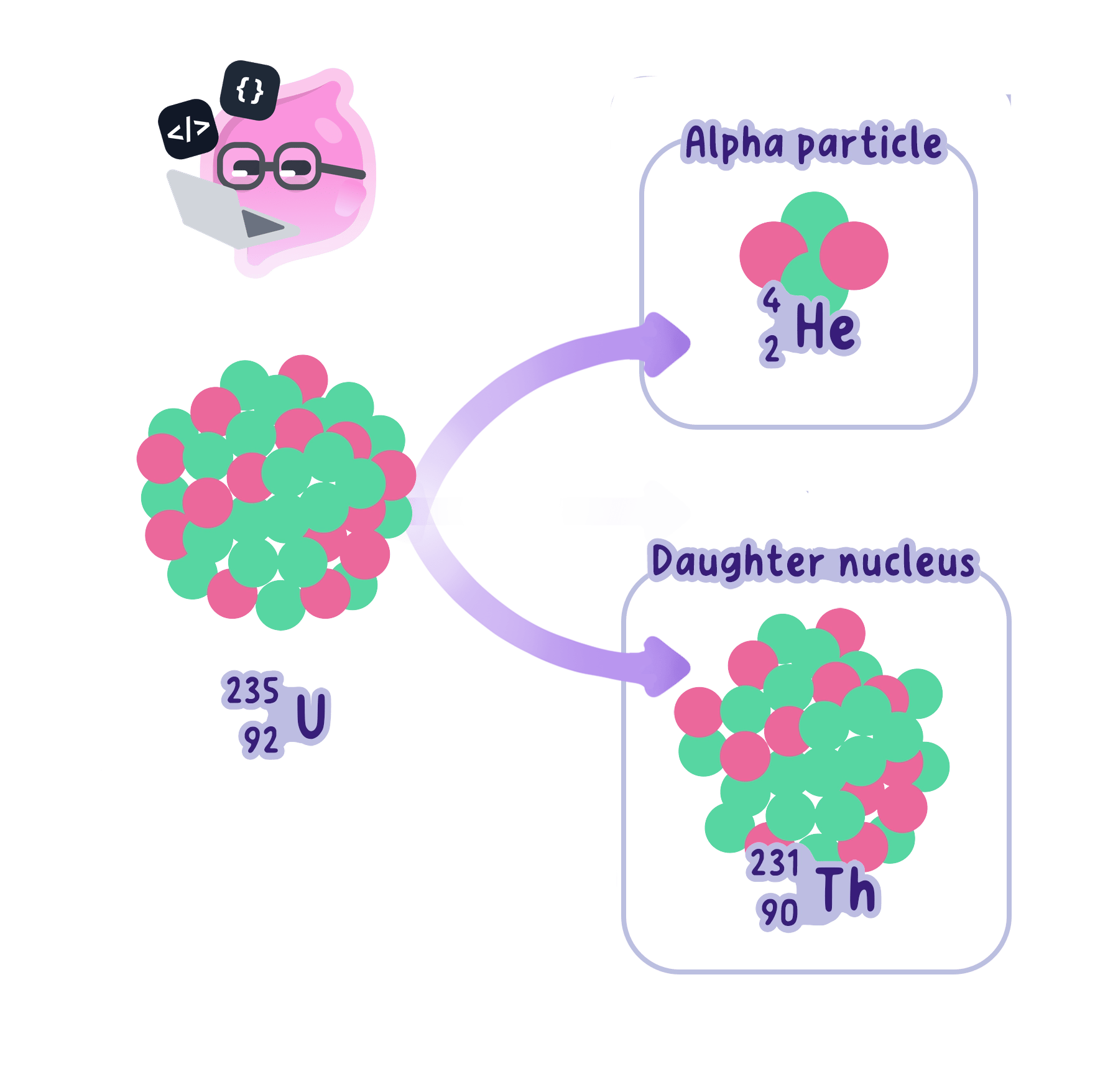
An alpha particle is a particle made of two protons and two neutrons emitted from an unstable nucleus, and is equivalent to a helium nucleus.
- An alpha particle is a tightly bound group of two protons and two neutrons, identical to a helium nucleus, and it is written 24α_{2}^{4}\alpha24α or 24He_{2}^{4}\text{He}24He.
- Alpha decay happens in very heavy nuclei, where the electrostatic repulsion between a large number of protons makes the whole nucleus too large to hold together.
- Ejecting an alpha particle removes four nucleons at once, which is the fastest way for such a nucleus to shed both size and positive charge.
- The alpha particle carries away a mass number of 444, so the mass number of the nucleus falls by 444.
- It also carries away a charge of +2+2+2, so the atomic number falls by 222.
- Since the atomic number has changed, the daughter nucleus is a different element, two places back in the periodic table.
- In general form, alpha decay is ZAX→Z−2A−4Y+24α_{Z}^{A}\text{X} \rightarrow _{Z-2}^{A-4}\text{Y} + _{2}^{4}\alphaZAX→Z−2A−4Y+24α.
Finding the daughter of an alpha emitter
- Radium-226 is written 88226Ra_{88}^{226}\text{Ra}88226Ra, so it has 888888 protons and 226−88=138226 - 88 = 138226−88=138 neutrons.
- The mass number of the daughter is 226−4=222226 - 4 = 222226−4=222.
- The atomic number of the daughter is 88−2=8688 - 2 = 8688−2=86.
- The element with 868686 protons is radon, so the daughter nucleus is 86222Rn_{86}^{222}\text{Rn}86222Rn.
- The complete equation is 88226Ra→86222Rn+24α_{88}^{226}\text{Ra} \rightarrow _{86}^{222}\text{Rn} + _{2}^{4}\alpha88226Ra→86222Rn+24α.
- The neutron count has fallen from 138138138 to 222−86=136222 - 86 = 136222−86=136, which confirms that two protons and two neutrons left together.
Beta-minus and beta-plus decay
- In beta-minus decay a neutron becomes a proton and an electron is emitted, and the electron is written −10e_{-1}^{0}\text{e}−10e.
- Because the electron has a mass number of 000, the total nucleon count is unchanged, so the mass number stays the same.
- Because a neutron has been replaced by a proton, the atomic number rises by 111, and the daughter is the next element up.
- In general form, beta-minus decay is ZAX→Z+1AY+−10e_{Z}^{A}\text{X} \rightarrow _{Z+1}^{A}\text{Y} + _{-1}^{0}\text{e}ZAX→Z+1AY+−10e, as in 614C→714N+−10e_{6}^{14}\text{C} \rightarrow _{7}^{14}\text{N} + _{-1}^{0}\text{e}614C→714N+−10e.
- In beta-plus decay a proton becomes a neutron and a positron is emitted, and the positron is written +10e_{+1}^{0}\text{e}+10e.
- The mass number again stays the same, for the same reason, but the atomic number falls by 111, so the daughter is the previous element.
- In general form, beta-plus decay is ZAX→Z−1AY++10e_{Z}^{A}\text{X} \rightarrow _{Z-1}^{A}\text{Y} + _{+1}^{0}\text{e}ZAX→Z−1AY++10e, as in 1122Na→1022Ne++10e_{11}^{22}\text{Na} \rightarrow _{10}^{22}\text{Ne} + _{+1}^{0}\text{e}1122Na→1022Ne++10e.
- Both beta decays therefore change the element without changing the mass of the nucleus in any measurable way, because the neutron count and proton count trade places.
Gamma emission and nuclear rearrangement
Gamma radiation
Gamma radiation is electromagnetic radiation emitted from the nucleus of an unstable atom when that nucleus loses energy.
Nuclear rearrangement
Nuclear rearrangement is the movement of the protons and neutrons of a nucleus into a lower energy arrangement after a decay, with the surplus energy released as gamma radiation.
- Gamma radiation is not a particle at all; it is a very high frequency electromagnetic wave carrying energy away from the nucleus.
- A gamma ray has no mass number and no charge, so it is written 00γ_{0}^{0}\gamma00γ.
- The direct consequence is that after gamma emission the mass number stays the same, the atomic number stays the same, and the element does not change.
- What does change is the energy of the nucleus, which is left lower than it was before.
- Gamma emission normally follows another decay rather than happening on its own, because an alpha or beta decay usually leaves the daughter nucleus with its nucleons in a high energy arrangement.
- That high energy state is described as an excited nucleus, and it settles by nuclear rearrangement: the protons and neutrons shift into a lower energy arrangement and the surplus energy leaves as a gamma ray.
- Because gamma emission needs no nucleon to leave and no nucleon to change, it is the only one of these processes that leaves the identity of the nucleus completely untouched.
- In general form, gamma emission is ZAX∗→ZAX+00γ_{Z}^{A}\text{X}^{*} \rightarrow _{Z}^{A}\text{X} + _{0}^{0}\gammaZAX∗→ZAX+00γ, where the asterisk marks the excited nucleus.
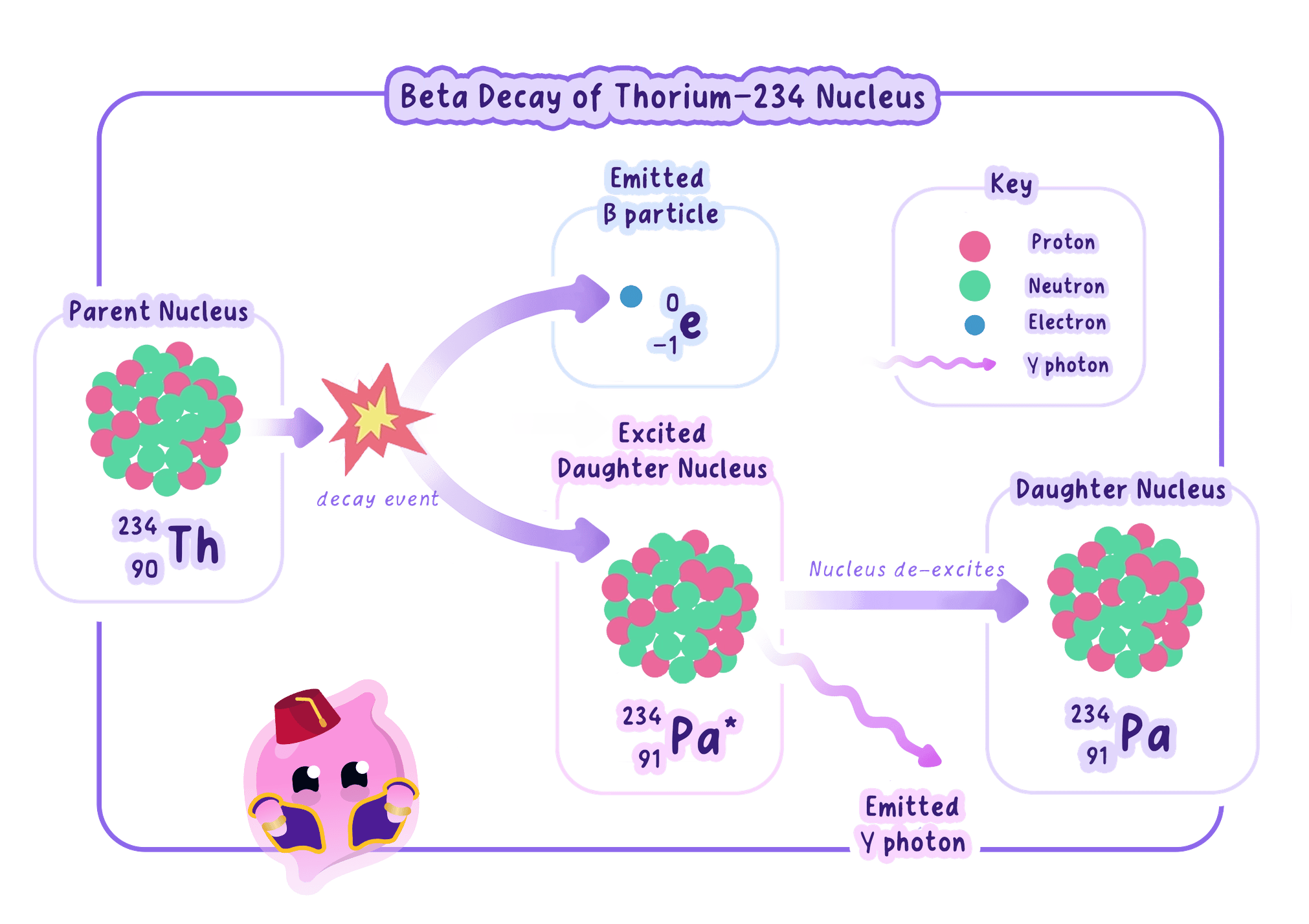
A beta decay followed by gamma emission
- Thorium-234, written 90234Th_{90}^{234}\text{Th}90234Th, is neutron-rich and decays by beta-minus emission.
- The mass number stays at 234234234 and the atomic number rises from 909090 to 919191, giving protactinium-234.
- The equation for the first stage is 90234Th→91234Pa+−10e_{90}^{234}\text{Th} \rightarrow _{91}^{234}\text{Pa} + _{-1}^{0}\text{e}90234Th→91234Pa+−10e.
- The protactinium nucleus is left excited, so its nucleons rearrange and it emits a gamma ray.
- The equation for the second stage is 91234Pa∗→91234Pa+00γ_{91}^{234}\text{Pa}^{*} \rightarrow _{91}^{234}\text{Pa} + _{0}^{0}\gamma91234Pa∗→91234Pa+00γ.
- Across both stages the mass number never changed, the atomic number changed only once, and only the beta stage produced a new element.
Neutron emission
Neutron emission
Neutron emission is the release of a neutron from an unstable nucleus.
- A neutron released from a nucleus is written 01n_{0}^{1}\text{n}01n, giving it a mass number of 111 and a charge of 000.
- The nucleus therefore loses one nucleon, so its mass number falls by 111.
- The neutron carries no charge, so the proton count is untouched and the atomic number stays the same.
- Since the atomic number is unchanged, the daughter is the same element as the parent, but a different isotope of it, with one fewer neutron.
- In general form, neutron emission is ZAX→ZA−1X+01n_{Z}^{A}\text{X} \rightarrow _{Z}^{A-1}\text{X} + _{0}^{1}\text{n}ZAX→ZA−1X+01n, so oxygen-17 emitting a neutron gives 817O→816O+01n_{8}^{17}\text{O} \rightarrow _{8}^{16}\text{O} + _{0}^{1}\text{n}817O→816O+01n.
- Neutron emission is the one decay in this set that changes the isotope without changing the element, which makes it easy to tell apart from a beta decay in an equation.
Working out the effect of a decay
- Write the emitted particle in the form chargemass numbersymbol_{\text{charge}}^{\text{mass number}}\text{symbol}chargemass numbersymbol first, then subtract those two numbers from the parent.
- Subtract the numbers separately: the top numbers form one total and the bottom numbers form another, and they are never added together.
- Use the atomic number, not the mass number, to decide whether the element has changed, because only the proton count identifies an element.
- Give both numbers in your answer when a question asks for the effect on the nucleus, since one mark is usually for each.
- Say stays the same rather than leaving a number out, because a blank is not credited as an unchanged value.
- For a gamma question, name the energy change: the nucleus loses energy, and neither the mass number nor the atomic number changes.
- Keep to the word nucleus when describing where the emission comes from, because atom and particle are not credited in place of it.
- Do not let gamma emission change the element, because a gamma ray removes energy and carries away neither protons nor neutrons.
- Do not reduce the mass number in a beta decay, because a nucleon changes type but no nucleon leaves the nucleus.
- Do not reduce the atomic number in neutron emission, since a neutron carries no charge and the proton count is unaffected.
- Do not apply two decays at once in a chain, because each step changes the numbers separately and must be worked through in order.
- Do not treat an excited nucleus as a different element from the nucleus it settles into, because rearrangement changes only its energy.
- Do not assume every decay produces a new element, because gamma emission and neutron emission both leave the atomic number unchanged.
- State the change in mass number and atomic number when a nucleus emits an alpha particle.
- Why does the mass number stay the same in a beta-minus decay?
- A nucleus emits a positron. What happens to its atomic number?
- Explain why gamma emission does not change the element.
- What happens to the mass number and the atomic number when a neutron is emitted?
- Which of these decays leaves the nucleus as a different isotope of the same element?
- Write the general equation for the alpha decay of ZAX_{Z}^{A}\text{X}ZAX.
6.3.3 Balancing nuclear equations
What a nuclear equation records
Nuclear equation
A nuclear equation is a way of writing a nuclear change that shows the mass number and the charge of every nucleus and particle taking part.
Mass number
The total number of protons and neutrons in the nucleus of an atom.
Charge number
The charge number is the number written at the bottom left of a symbol in a nuclear equation, giving the charge of that nucleus or particle relative to the charge of one proton.
- Every nucleus and particle in a nuclear equation is written as ZAX_{Z}^{A}\text{X}ZAX, with the mass number AAA on top and the charge number ZZZ below.
- For a nucleus the charge number is simply the proton number, because each proton carries one unit of positive charge and the neutrons carry none.
- For an emitted particle the charge number is that particle's own charge, so a beta particle takes Z=−1Z = -1Z=−1 and a gamma ray takes Z=0Z = 0Z=0.
- Two quantities are conserved across the arrow, which is what makes the equation solvable.
- The total mass number on the left equals the total mass number on the right, because nucleons are neither created nor destroyed.
- The total charge on the left equals the total charge on the right, because charge cannot be created or destroyed.
- Balancing a nuclear equation therefore means finding the missing numbers that make both of those totals agree.
- The two totals are kept completely separate: the top numbers are added only to other top numbers, and the bottom numbers only to other bottom numbers.
- This is not the same task as balancing a chemical equation, where whole atoms are counted and no atom ever changes into another element.
The symbols you need
Atomic number
The number of protons in the nucleus of an atom.
- An alpha particle is 24α_{2}^{4}\alpha24α, sometimes written 24He_{2}^{4}\text{He}24He, because it is two protons and two neutrons.
- A beta-minus particle is −10e_{-1}^{0}\text{e}−10e, sometimes written −10β_{-1}^{0}\beta−10β, because it is an electron with no nucleons and one unit of negative charge.
- A positron is +10e_{+1}^{0}\text{e}+10e, sometimes written +10β_{+1}^{0}\beta+10β, because it has no nucleons and one unit of positive charge.
- A gamma ray is 00γ_{0}^{0}\gamma00γ, because it carries energy but neither nucleons nor charge.
- A neutron is 01n_{0}^{1}\text{n}01n, because it is one nucleon with no charge.
- A proton is 11p_{1}^{1}\text{p}11p, because it is one nucleon carrying one unit of positive charge.
- Once these six symbols are known, every balancing task reduces to two subtractions.
The method for balancing
- Write the equation out with the unknown labelled, using AAA for the missing top number and ZZZ for the missing bottom number.
- Add the top numbers on the left, then add the top numbers on the right.
- Set those two totals equal to each other and solve for the missing mass number.
- Add the bottom numbers on the left, then add the bottom numbers on the right, remembering that a negative charge number reduces the total.
- Set those two totals equal to each other and solve for the missing charge number.
- Use the data supplied with the question, such as a section of the periodic table, to turn the charge number into an element symbol if a symbol is wanted.
- Substitute both answers back in and check that each total still agrees, since this catches a sign slip in seconds.
Balancing an alpha decay
- The equation to balance is 92238U→ZATh+24α_{92}^{238}\text{U} \rightarrow _{Z}^{A}\text{Th} + _{2}^{4}\alpha92238U→ZATh+24α.
- Top numbers give 238=A+4238 = A + 4238=A+4.
- Rearranging gives A=238−4=234A = 238 - 4 = 234A=238−4=234.
- Bottom numbers give 92=Z+292 = Z + 292=Z+2.
- Rearranging gives Z=92−2=90Z = 92 - 2 = 90Z=92−2=90.
- The balanced equation is 92238U→90234Th+24α_{92}^{238}\text{U} \rightarrow _{90}^{234}\text{Th} + _{2}^{4}\alpha92238U→90234Th+24α.
- Checking gives 238=234+4238 = 234 + 4238=234+4 and 92=90+292 = 90 + 292=90+2, so both totals agree.
Finding the daughter after beta-minus emission
- The equation to balance is 1940K→ZAX+−10e_{19}^{40}\text{K} \rightarrow _{Z}^{A}\text{X} + _{-1}^{0}\text{e}1940K→ZAX+−10e.
- Top numbers give 40=A+040 = A + 040=A+0, so A=40A = 40A=40.
- Bottom numbers give 19=Z+(−1)19 = Z + (-1)19=Z+(−1), which rearranges to Z=19+1=20Z = 19 + 1 = 20Z=19+1=20.
- The negative charge number on the electron is what makes the daughter's charge number larger than the parent's.
- An element with 202020 protons is calcium, so the daughter is 2040Ca_{20}^{40}\text{Ca}2040Ca.
- The balanced equation is 1940K→2040Ca+−10e_{19}^{40}\text{K} \rightarrow _{20}^{40}\text{Ca} + _{-1}^{0}\text{e}1940K→2040Ca+−10e.
Identifying an unknown emitted particle
- The equation to balance is 1327Al→1227Mg+ZAX_{13}^{27}\text{Al} \rightarrow _{12}^{27}\text{Mg} + _{Z}^{A}\text{X}1327Al→1227Mg+ZAX.
- Top numbers give 27=27+A27 = 27 + A27=27+A, so A=0A = 0A=0 and the emitted particle contains no nucleons.
- Bottom numbers give 13=12+Z13 = 12 + Z13=12+Z, so Z=1Z = 1Z=1 and the emitted particle carries one unit of positive charge.
- A particle with mass number 000 and charge +1+1+1 is a positron, written +10e_{+1}^{0}\text{e}+10e.
- The balanced equation is 1327Al→1227Mg++10e_{13}^{27}\text{Al} \rightarrow _{12}^{27}\text{Mg} + _{+1}^{0}\text{e}1327Al→1227Mg++10e.
- Reading off the two numbers first, then naming the particle, is what keeps this kind of question quick.
Balancing a decay chain of two steps
- The chain to complete is 90232Th→Z1A1Ra+24α_{90}^{232}\text{Th} \rightarrow _{Z_1}^{A_1}\text{Ra} + _{2}^{4}\alpha90232Th→Z1A1Ra+24α followed by Z1A1Ra→Z2A2Ac+−10e_{Z_1}^{A_1}\text{Ra} \rightarrow _{Z_2}^{A_2}\text{Ac} + _{-1}^{0}\text{e}Z1A1Ra→Z2A2Ac+−10e.
- For the first step, top numbers give A1=232−4=228A_1 = 232 - 4 = 228A1=232−4=228 and bottom numbers give Z1=90−2=88Z_1 = 90 - 2 = 88Z1=90−2=88.
- The first daughter is therefore 88228Ra_{88}^{228}\text{Ra}88228Ra.
- For the second step, top numbers give A2=228−0=228A_2 = 228 - 0 = 228A2=228−0=228.
- Bottom numbers give Z2=88+1=89Z_2 = 88 + 1 = 89Z2=88+1=89, because the electron carries away −1-1−1.
- The second daughter is 89228Ac_{89}^{228}\text{Ac}89228Ac, so the chain runs 90232Th→88228Ra→89228Ac_{90}^{232}\text{Th} \rightarrow _{88}^{228}\text{Ra} \rightarrow _{89}^{228}\text{Ac}90232Th→88228Ra→89228Ac.
- Each step is balanced on its own, which is always safer than trying to balance a whole chain in one line.
Presenting a balanced equation
- Write both totals as a short line of working, such as 238=A+4238 = A + 4238=A+4, because the marks are usually split between the mass number and the charge number.
- Fill in every box a question gives you, including any number that is unchanged, since a blank box scores nothing.
- Keep the minus sign on a beta particle's charge number, because dropping it sends the daughter's charge number the wrong way by two.
- Give the element symbol only when the question or its data allow you to identify it, and give the numbers regardless.
- Check both totals before moving on, because a single arithmetic slip loses both marks in a two-mark part.
- If a question supplies a periodic table extract, use it rather than recalling the symbol, since the extract is there to be read.
- For an unknown particle, state the mass number and charge first and then name it, because that order is what the working needs to show.
- Do not add a top number to a bottom number, because mass number and charge are conserved separately.
- Do not subtract 111 from the parent's charge number for a beta-minus particle, because a charge of −1-1−1 on the right means the daughter must be +1+1+1 higher.
- Do not give a gamma ray a mass number or a charge, since 00γ_{0}^{0}\gamma00γ leaves both totals untouched.
- Do not change an element symbol without changing its charge number to match, because the two must always agree.
- Do not treat this like a chemical equation by putting a large number in front of a symbol, because nuclear equations are balanced through the top and bottom numbers only.
- State the two quantities that must balance on both sides of a nuclear equation.
- Give the mass number and charge number of an alpha particle, a beta-minus particle, a positron and a gamma ray.
- Find AAA and ZZZ in 88226Ra→ZARn+24α_{88}^{226}\text{Ra} \rightarrow _{Z}^{A}\text{Rn} + _{2}^{4}\alpha88226Ra→ZARn+24α.
- Find AAA and ZZZ in 614C→ZAN+−10e_{6}^{14}\text{C} \rightarrow _{Z}^{A}\text{N} + _{-1}^{0}\text{e}614C→ZAN+−10e.
- A nucleus loses a particle of mass number 000 and charge −1-1−1. Which particle is it?
- Why does the charge number of the daughter rise when an electron is emitted?
