15.2.1 Atmospheric pressure and height
Air particles create atmospheric pressure
Atmospheric pressure
Atmospheric pressure is the normal force exerted per unit area by air particles colliding with a surface.
- Earth is surrounded by an atmosphere, which is a layer of gases held around the planet by gravity.
- Air particles are in constant random motion and repeatedly collide with exposed surfaces.
- Each collision changes a particle's momentum, so the particle exerts a small force on the surface.
- The combined normal force from many collisions acting on each unit area is atmospheric pressure.
- Atmospheric pressure acts in all directions because air particles move and collide in all directions.
Atmospheric pressure is produced by air-particle collisions, while its variation with height is explained by gravity and the changing density and weight of the atmosphere.
Gravity creates a pressure gradient
- Gravity pulls every air particle towards Earth, so the particles have weight.
- Air near Earth's surface supports the weight of the air above it.
- This weight compresses the lower layers of the atmosphere, pushing their particles closer together.
- The lower atmosphere therefore contains more particles in each cubic metre and has a greater density.
- A denser layer produces more particle collisions with each square metre of surface each second.
- More frequent collisions produce a greater total force per unit area, so atmospheric pressure is greatest near Earth's surface.
Pressure decreases as height increases
- At a greater height, there is a shorter column of atmosphere above a surface.
- The shorter column contains less air, so the weight of air pressing on the layers below is smaller.
- With less compression, the air particles are farther apart and the air density is lower.
- Fewer particles are available to strike each unit area, so collisions occur less frequently.
- The total force per unit area is therefore smaller, which means atmospheric pressure decreases with height.
- The decrease is not uniform because air density also changes continuously with height.
Comparing sea level and a mountain
- At sea level, the column of air above a person is taller and contains more air than the column above the same person on a mountain.
- The greater weight of overlying air compresses the lower atmosphere, giving it a greater density.
- The denser air produces more collisions with a surface each second, so atmospheric pressure is greater at sea level.
The atmosphere thins gradually
- The atmosphere has no sharp upper edge at which pressure suddenly becomes zero.
- Air becomes progressively less dense with height because the weight and compression from overlying air progressively decrease.
- Although gravity becomes slightly weaker with height, it still acts strongly enough over ordinary mountain and aircraft heights to keep pulling air towards Earth.
Do not write that atmospheric pressure is lower at altitude because there is no gravity; gravity remains, but there is less overlying air and the air is less dense.
Pressure changes have visible effects
- A sealed flexible packet taken to a high altitude can expand because the external atmospheric pressure decreases while its internal pressure initially remains higher.
- A flexible container moved to lower altitude can be compressed because the external atmospheric pressure increases.
- A barometer gives a lower reading at greater height because the atmosphere exerts a smaller pressure.
- Aircraft cabins are pressurised so the pressure inside does not fall to the much lower atmospheric pressure outside at cruising height.
Writing a complete explanation
- Begin with height: at greater height there is less air above the point.
- Link this to a smaller weight of overlying air and less compression of the atmosphere.
- State that the air is less dense, so fewer particles collide with each unit area each second.
- Finish with the consequence: the force per unit area is smaller, so atmospheric pressure is lower.
- What produces atmospheric pressure at a surface?
- Why is air denser near Earth's surface?
- Why does the weight of overlying air decrease with height?
- How does lower air density lead to lower atmospheric pressure?
- Why can a sealed flexible packet expand when taken to a high altitude?
15.2.2 Pressure in fluids
Fluids exert pressure in every direction
Fluid
A substance that can flow, so liquids and gases are fluids.
- Liquids and gases are fluids because their particles can move past one another and the substance can flow.
- Within a fluid, moving particles and the weight of fluid above create pressure.
- At a point in an open fluid, the total pressure includes both the fluid's pressure and the atmospheric pressure acting on its surface.
Pressure produces a normal force
Pressure
The normal force acting per unit area of a surface.
- Fluid pressure exerts a force normal to a surface, meaning perpendicular to that surface.
- The force acts on every surface in contact with the fluid, including horizontal, vertical and curved surfaces.
- Because the force is normal locally, its direction changes around a curved object.
Forces on a submerged object
- Water pushes down on the top, sideways on the vertical faces and up on the bottom of a submerged block.
- Each force acts at right angles to the surface where it is applied.
Open and sealed fluids differ
- For an open container, atmospheric pressure is transmitted through the liquid as part of the total pressure.
- A pressure gauge may show gauge pressure, which is the amount above atmospheric pressure, rather than total pressure.
Do not draw fluid-pressure forces parallel to a surface; each force must be perpendicular to the surface.
- What is a fluid?
- What contributes to the total pressure in an open liquid?
- In what direction does pressure exert force on a surface?
- How do pressure-force directions vary around a curved object?
15.2.3 Pressure, force and area
Pressure depends on normal force and area
Pressure
The normal force acting per unit area of a surface.
- Pressure is calculated using P=FAP=\dfrac{F}{A}P=AF.
- Here, PPP is pressure in pascals, FFF is the force normal to the surface in newtons, and AAA is the contact area in square metres.
- One pascal is one newton per square metre: 1 Pa=1 N m−21\,\text{Pa}=1\,\text{N m}^{-2}1Pa=1N m−2.
Force and area have opposite effects
- At constant area, a larger normal force produces a larger pressure, so P∝FP\propto FP∝F.
- At constant force, a larger contact area spreads the force and produces a smaller pressure, so P∝1AP\propto\dfrac{1}{A}P∝A1.
- A sharp blade creates high pressure through a small area, while wide tyres reduce pressure on soft ground by increasing area.
Calculating pressure
- A crate exerts a normal force of 720 N720\,\text{N}720N over an area of 0.24 m20.24\,\text{m}^20.24m2.
- P=FA=7200.24=3000 PaP=\dfrac{F}{A}=\dfrac{720}{0.24}=3000\,\text{Pa}P=AF=0.24720=3000Pa.
Rearrange and convert areas correctly
- Use F=PAF=PAF=PA to find force and A=FPA=\dfrac{F}{P}A=PF to find area.
- For areas, square the length conversion: 1 cm2=1×10⁻⁴ m21\,\text{cm}^2=1\times10^{-4}\,\text{m}^21cm2=1×10⁻⁴m2 and 1 mm2=1×10⁻⁶ m21\,\text{mm}^2=1\times10^{-6}\,\text{m}^21mm2=1×10⁻⁶m2.
Do not divide by a length when the equation requires an area, and do not convert square units using the unsquared conversion factor.
Comparisons must control one variable
- When comparing designs, identify whether force or area is unchanged, then link the changed quantity to pressure.
- Show the equation, conversion, substitution and unit because a correct numerical value without Pa\text{Pa}Pa can lose a unit mark.
- What equation links pressure, force and area?
- What is one pascal?
- How does doubling area affect pressure at constant force?
- How is 1 cm21\,\text{cm}^21cm2 converted to square metres?
15.2.4 Pressure and depth
Fluid pressure increases with depth and density
Liquid pressure
The pressure caused by the weight of liquid above a point.
- A deeper point has a taller column of fluid above it, so a greater weight of fluid presses down.
- This produces a larger pressure and therefore a larger normal force on the same area.
- At the same depth, a denser fluid has more mass and weight in the same volume, so it produces greater pressure.
- At the same horizontal level in one stationary connected liquid, the pressure is the same.
Jet distance provides qualitative evidence
- Water from a lower hole leaves faster and travels farther because the pressure difference between the inside and outside is greater.
- A fair comparison uses holes of equal size in the same container and measures their horizontal jet distances under the same conditions.
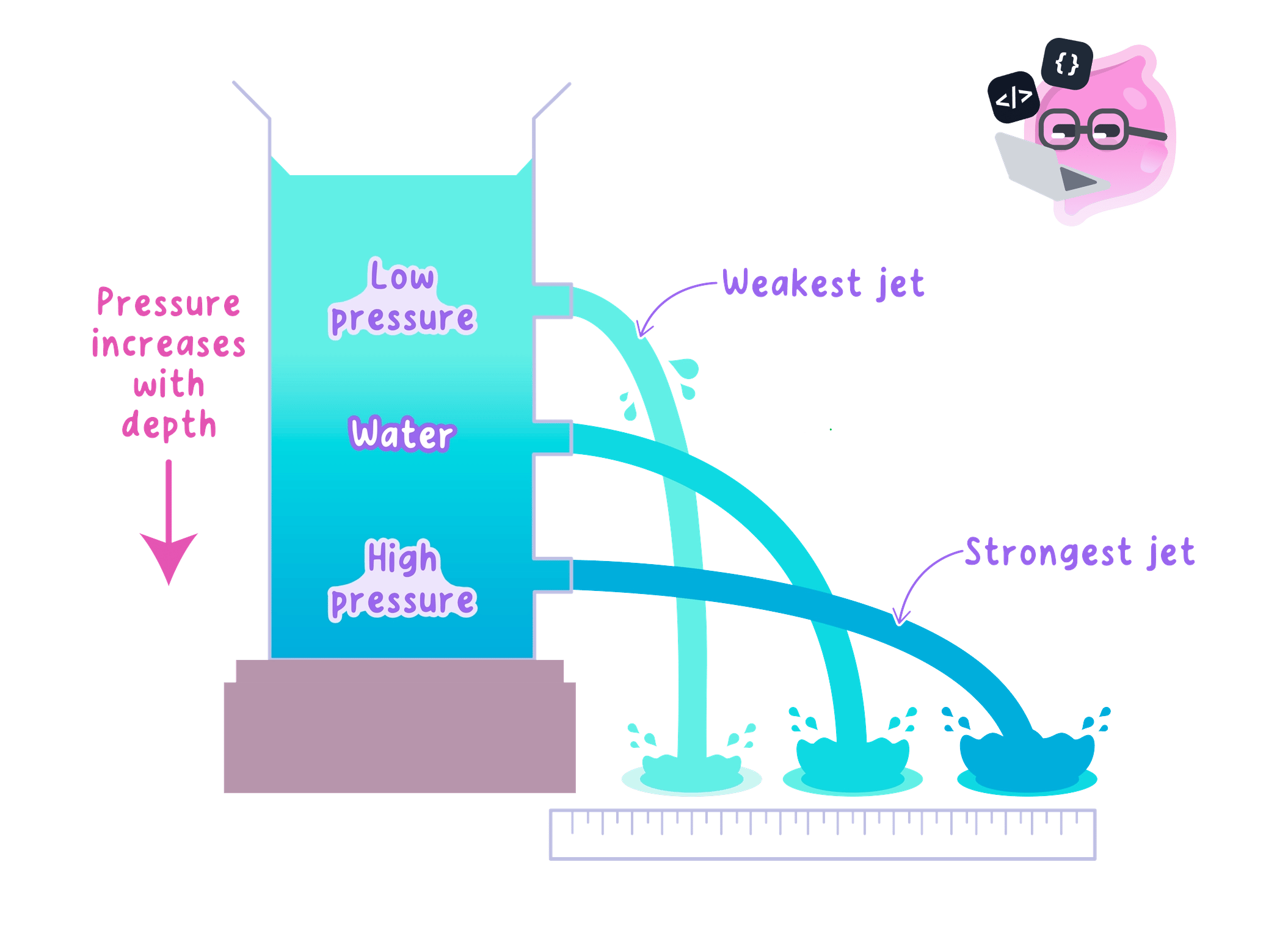
Comparing points in a liquid
- Point B is twice as deep as point A in the same liquid, so the pressure due to the liquid at B is twice that at A.
- A point at the same depth in a denser liquid experiences greater pressure because the overlying liquid column weighs more.
Pressure difference drives motion
- A fluid moves from higher pressure towards lower pressure when a path is available.
- The quantitative equation and pressure differences are developed in the next article.
Do not say that pressure increases because particles move faster at greater depth; the increase is caused by the greater weight of fluid above.
- Why does liquid pressure increase with depth?
- Why does a denser liquid produce greater pressure at the same depth?
- What does the three-hole water-jet demonstration show?
- At what locations in a stationary connected liquid is pressure equal?
15.2.5 Pressure in liquids: depth and density
A liquid column produces calculable pressure
Liquid pressure
The pressure caused by the weight of liquid above a point.
- The pressure due to a liquid column is P=hρgP=h\rho gP=hρg.
- Here, PPP is pressure in pascals, hhh is the vertical height of liquid above the point in metres, ρ\rhoρ is density in kilograms per cubic metre, and ggg is gravitational field strength in newtons per kilogram.
- The equation gives the pressure caused by the liquid column, not automatically the total pressure including the atmosphere.
The equation follows from weight per area
- For a column with area AAA and height hhh, its volume is V=AhV=AhV=Ah.
- Its mass is m=ρV=ρAhm=\rho V=\rho Ahm=ρV=ρAh, so its weight is F=mg=ρAhgF=mg=\rho AhgF=mg=ρAhg.
- Using P=F/AP=F/AP=F/A gives P=ρAhg/A=hρgP=\rho Ahg/A=h\rho gP=ρAhg/A=hρg.
Pressure differences use changes in depth
- Between two depths in the same liquid, ΔP=Δhρg\Delta P=\Delta h\rho gΔP=Δhρg.
- Use the vertical difference in depth, even if the container is sloping or irregularly shaped.
- At fixed density and gravitational field strength, pressure due to the liquid is directly proportional to depth.
Pressure at one depth
- For water, ρ=1000 kg m−3\rho=1000\,\text{kg m}^{-3}ρ=1000kg m−3 at a depth of 3.0 m3.0\,\text{m}3.0m with g=10 N kg−1g=10\,\text{N kg}^{-1}g=10N kg−1.
- P=hρg=3.0×1000×10=3.0×10⁴ PaP=h\rho g=3.0\times1000\times10=3.0\times10^4\,\text{Pa}P=hρg=3.0×1000×10=3.0×10⁴Pa.
Density changes the pressure gradient
Density
Density is the mass per unit volume of a substance.
- On a pressure against depth graph, the gradient is ρg\rho gρg.
- A denser liquid gives a steeper graph because pressure rises more rapidly with depth.
Difference between two depths
- In oil of density 800 kg m−3800\,\text{kg m}^{-3}800kg m−3, two points differ in depth by 0.75 m0.75\,\text{m}0.75m.
- ΔP=0.75×800×10=6000 Pa\Delta P=0.75\times800\times10=6000\,\text{Pa}ΔP=0.75×800×10=6000Pa.
Do not use the container's total liquid depth when the required hhh is the depth of the stated point below the surface.
- What does each symbol in P=hρgP=h\rho gP=hρg represent?
- Why does the area cancel when the equation is derived?
- How do you calculate the pressure difference between two depths?
- What does the gradient of a pressure-depth graph represent?
- When must atmospheric pressure be added?
15.2.6 Upthrust
A pressure difference produces upthrust
Upthrust
The resultant upward force that a fluid exerts on an object within it.
- Fluid pressure acts normal to every surface of an immersed object.
- Because pressure increases with depth, the upward force on the lower surface is greater than the downward force on the upper surface.
- The resultant of the fluid-pressure forces is an upward force called upthrust.
- Sideways pressure forces cancel for a symmetrical object in a stationary fluid.
Upthrust equals displaced-fluid weight
- The magnitude of upthrust equals the weight of fluid displaced by the immersed part of the object.
- For fluid density ρ\rhoρ, displaced volume VVV and gravitational field strength ggg, this can be written as U=ρVgU=\rho VgU=ρVg.
- A fully immersed object with fixed volume displaces the same volume wherever it is in an incompressible liquid, so its upthrust is unchanged with depth.
- A partially immersed object displaces only the volume below the surface.
Finding upthrust
- An object displaces 2.5×10⁻³ m32.5\times10^{-3}\,\text{m}^32.5×10⁻³m3 of water with ρ=1000 kg m−3\rho=1000\,\text{kg m}^{-3}ρ=1000kg m−3 and g=10 N kg−1g=10\,\text{N kg}^{-1}g=10N kg−1.
- U=ρVg=1000×2.5×10−3×10=25 NU=\rho Vg=1000\times2.5\times10^{-3}\times10=25\,\text{N}U=ρVg=1000×2.5×10−3×10=25N.
Gases also provide upthrust
- A balloon displaces air, so the surrounding air exerts upthrust equal to the weight of the displaced air.
- Upthrust increases when more fluid is displaced or when the fluid is denser.
Do not state that upthrust is caused simply by water pushing upwards; explain the pressure difference between the lower and upper surfaces.
- Why is the pressure force larger on the bottom of an immersed object?
- What is upthrust equal to?
- How can upthrust be calculated from displaced volume?
- Why can a balloon experience upthrust in air?
15.2.7 Floating and sinking
Floating depends on upthrust and weight
Upthrust
The resultant upward force that a fluid exerts on an object within it.
- An object initially accelerates upward when upthrust is greater than weight and downward when weight is greater than upthrust.
- A floating object at rest is in equilibrium, so upthrust equals its weight and the resultant force is zero.
- As a floating object sinks farther into a liquid, it displaces more liquid and upthrust increases until it balances weight.
Density predicts floating and sinking
Density
Density is the mass per unit volume of a substance.
- An object with a lower average density than the fluid can float because it can displace its own weight of fluid before becoming fully submerged.
- An object with a greater average density than the fluid sinks because even when fully submerged, the maximum upthrust is less than its weight.
- If the object and fluid have equal densities, a fully immersed object can remain suspended when upthrust equals weight.
- A hollow steel ship floats because its large air-filled volume makes its overall average density less than that of water.
Fraction submerged
- For a floating object, ρfluidVsubmergedg=ρobjectVobjectg\rho_{\text{fluid}}V_{\text{submerged}}g=\rho_{\text{object}}V_{\text{object}}gρfluidVsubmergedg=ρobjectVobjectg.
- Therefore VsubmergedVobject=ρobjectρfluid\dfrac{V_{\text{submerged}}}{V_{\text{object}}}=\dfrac{\rho_{\text{object}}}{\rho_{\text{fluid}}}VobjectVsubmerged=ρfluidρobject.
- An object of average density 750 kg m−3750\,\text{kg m}^{-3}750kg m−3 floating in water of density 1000 kg m−31000\,\text{kg m}^{-3}1000kg m−3 has 75%75\%75% of its volume submerged.
Comparing upthrust
- Apparatus: force meter, clamp stand, object, measuring cylinder, water, salt solution, cooking oil, balance, spill tray and paper towels.
- Set-up: zero the force meter and suspend the object so it hangs freely without touching the container.
- Method:
- record the object's weight WWW in air using a balance
- lower the object until it is fully immersed without touching the sides or bottom, then record the apparent weight WappW_{\text{app}}Wapp.
- calculate upthrust from U=W−WappU=W-W_{\text{app}}U=W−Wapp.
- repeat at the same immersed volume in each liquid and measure each liquid's density using ρ=m/V\rho=m/Vρ=m/V if it is not supplied.
- repeat readings, identify anomalies and calculate a mean upthrust for each liquid.
- Controls: keep the same object, immersed volume, force meter and gravitational field strength.
- Expected result: the denser liquid produces greater upthrust because the same displaced volume has greater mass and weight.
- Safety: use small stable containers, wipe spills immediately and keep the electrical balance dry.
Do not claim that every object less dense than water floats in every liquid; compare the object's average density with the density of the particular fluid.
- What force condition is required for an object to float at rest?
- Why does an object denser than the fluid sink?
- Why can a hollow steel ship float?
- How is upthrust measured using apparent weight?
- How does increasing fluid density affect upthrust for the same displaced volume?
