Question 19
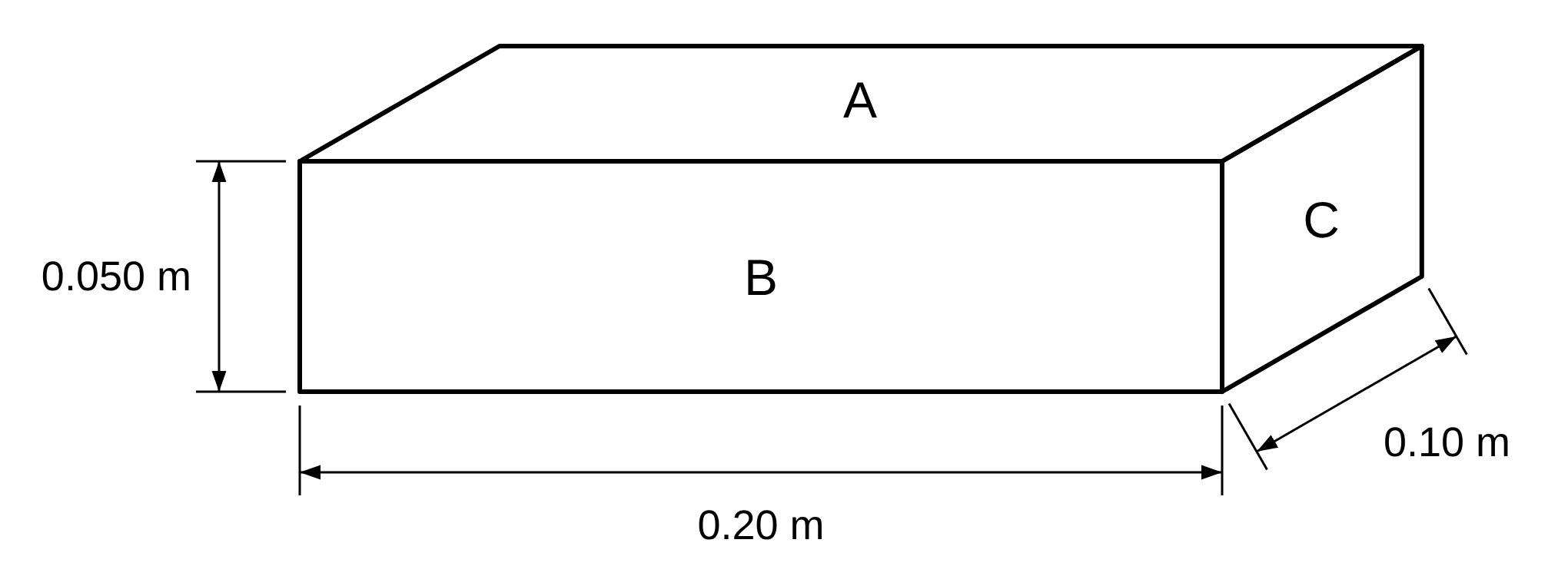
FThe Figure shows a solid rectangular block. The block has a weight of 80 N.
The block can rest on the floor on face A, face B or face C.
Figure
a.[2]
Calculate the pressure exerted on the floor when the block rests on face A.
b.[3]
Calculate the greatest pressure the block can exert on the floor.
c.[2]
The block is placed on soft sand, on each face in turn.
Explain which face makes the deepest dent in the sand.
d.[2]
The block rests on face A. A second identical block is placed on top of the first block.
Calculate the new pressure exerted on the floor.
15.2 Pressure in fluids Questions
132 exam-style questions on Edexcel GCSE Physics 15.2 Pressure in fluids, covering 15.2.1 Atmospheric pressure and height, 15.2.2 Pressure in fluids, 15.2.3 Pressure, force and area, 15.2.4 Pressure and depth, 15.2.5 Pressure in liquids: depth and density, 15.2.6 Upthrust, and 15.2.7 Floating and sinking. Each one has a worked solution and a mark scheme showing where the marks go.