8.3.1 Power
Power as a rate of transfer
Definition
Power
Power is the rate at which energy is transferred, which is the same as the rate at which work is done.
Definition
Watt
The watt is the unit of power, equal to an energy transfer of one joule each second.
- Power is the rate at which energy is transferred, and because work done and energy transferred are the same quantity it is also the rate of doing work.
- Power answers how many joules each second, not how many joules altogether.
- Two machines that transfer the same energy have different powers if they take different times, and the quicker one is the more powerful.
- The unit of power is the watt, W\text{W}W, and 1 W=1 J/s1\ \text{W} = 1\ \text{J/s}1 W=1 J/s.
- A device rated at 60 W60\ \text{W}60 W transfers 60 J60\ \text{J}60 J every second it is switched on.
- Larger powers are quoted in kilowatts and megawatts, where 1 kW=1000 W1\ \text{kW} = 1000\ \text{W}1 kW=1000 W and 1 MW=1 000 000 W1\ \text{MW} = 1\,000\,000\ \text{W}1 MW=1000000 W.
- A large power does not guarantee a large total energy transfer, because a small power running for a long time can transfer more.
The power equation
- Power is calculated from P=EtP = \dfrac{E}{t}P=tE.
- Here PPP is the power in watts, EEE is the work done or energy transferred in joules and ttt is the time taken in seconds.
- Rearranging gives E=P×tE = P \times tE=P×t for the energy transferred and t=EPt = \dfrac{E}{P}t=PE for the time taken.
- Convert every time into seconds first, so 2.5 minutes=150 s2.5\ \text{minutes} = 150\ \text{s}2.5 minutes=150 s and 1 hour=3600 s1\ \text{hour} = 3600\ \text{s}1 hour=3600 s.
- Convert kilowatts into watts before substituting, so 2.4 kW=2400 W2.4\ \text{kW} = 2400\ \text{W}2.4 kW=2400 W.
- For a lift or a hoist, work out E=m×g×ΔhE = m \times g \times \Delta hE=m×g×Δh first and then divide by the time.
- For a machine pulling against a steady force, work out E=F×dE = F \times dE=F×d first and then divide by the time.
Example
Power of an electric motor
- A motor does 3600 J3600\ \text{J}3600 J of work in 30 s30\ \text{s}30 s.
- The equation is P=EtP = \dfrac{E}{t}P=tE.
- Substituting gives P=360030P = \dfrac{3600}{30}P=303600.
- The power is P=120 WP = 120\ \text{W}P=120 W, which means the motor transfers 120 J120\ \text{J}120 J every second.
Example
Power of a lift raising a load
- A lift raises a load of mass 500 kg500\ \text{kg}500 kg through a vertical height of 12 m12\ \text{m}12 m in 20 s20\ \text{s}20 s, with g=10 N/kgg = 10\ \text{N/kg}g=10 N/kg.
- The useful energy transferred is E=m×g×Δh=500×10×12E = m \times g \times \Delta h = 500 \times 10 \times 12E=m×g×Δh=500×10×12.
- This gives E=60 000 JE = 60\,000\ \text{J}E=60000 J.
- The power is P=Et=60 00020P = \dfrac{E}{t} = \dfrac{60\,000}{20}P=tE=2060000.
- The useful power output of the lift is P=3000 WP = 3000\ \text{W}P=3000 W, which is 3.0 kW3.0\ \text{kW}3.0 kW.
Example
Energy transferred by a rated appliance
- A 2.4 kW2.4\ \text{kW}2.4 kW shower runs for 8.0 minutes8.0\ \text{minutes}8.0 minutes.
- Converting the values gives P=2400 WP = 2400\ \text{W}P=2400 W and t=8.0×60=480 st = 8.0 \times 60 = 480\ \text{s}t=8.0×60=480 s.
- Rearranging gives E=P×t=2400×480E = P \times t = 2400 \times 480E=P×t=2400×480.
- The energy transferred is E=1 152 000 JE = 1\,152\,000\ \text{J}E=1152000 J, which is 1152 kJ1152\ \text{kJ}1152 kJ.
Practical
Measuring your own power output
- Aim: to measure the useful power output of a student climbing a flight of stairs.
- Apparatus: bathroom scales or a balance, metre rule, stopwatch reading to 0.01 s0.01\ \text{s}0.01 s, a staircase with a countable number of steps, and a calculator.
- Variables: the time taken is the measured variable, the power output is the calculated variable, and the student, the staircase and the vertical height climbed are kept the same for every run.
- Method, set-up:
- Measure the student's mass in kilograms on the scales and record it.
- Measure the vertical height of one step with the metre rule, then multiply by the number of steps to get the vertical height of the whole flight.
- Mark a clear start line at the bottom step and a finish line at the top step so every run covers the same vertical height.
- Method, measurements:
- Start the stopwatch as the student's foot leaves the start line and stop it as the foot lands on the finish line.
- Climb at a brisk but safe walking pace, keeping one hand free for the handrail.
- Record the time in seconds.
- Repeat three times with a rest between runs, then calculate the mean time.
- Repeat with a second student so two power outputs can be compared.
- Results: the student who climbs the same flight in the shorter time has the greater power output, and a heavier student climbing in the same time has a greater power output still.
- Maths: calculate the useful energy transferred from E=m×g×ΔhE = m \times g \times \Delta hE=m×g×Δh with g=10 N/kgg = 10\ \text{N/kg}g=10 N/kg, then calculate the power from P=EtP = \dfrac{E}{t}P=tE; a student of mass 60 kg60\ \text{kg}60 kg climbing 3.0 m3.0\ \text{m}3.0 m in 5.0 s5.0\ \text{s}5.0 s transfers 1800 J1800\ \text{J}1800 J and has a power output of 360 W360\ \text{W}360 W.
- Watch out: reaction time in starting and stopping the stopwatch is the largest source of uncertainty, so use a longer flight and repeat every run; the height must be the vertical rise of the flight rather than the length of the staircase; the figure found is the useful power only, because the body also dissipates energy by heating.
- Safety: keep the staircase clear, do not run, use the handrail, and let anyone who feels unwell sit the activity out.
Comparing power in real machines
- Two cranes raising identical loads to the same height do the same work, so the crane that finishes sooner has the greater power.
- A 2.0 kW2.0\ \text{kW}2.0 kW kettle and a 10 W10\ \text{W}10 W phone charger differ by a factor of 200200200 in the joules they transfer each second.
- The charger left plugged in overnight can still transfer more energy in total than the kettle used for two minutes.
- The power rating printed on an appliance gives the energy it transfers each second while it is working normally.
- A car engine quoted in kilowatts is being described by how quickly it can do work, not by how far the car can travel.
- Comparing powers fairly means comparing the energy transferred over the same time, or the time taken to transfer the same energy.
Exam technique
Answering power questions
- Write P=EtP = \dfrac{E}{t}P=tE before substituting, and show any conversion of minutes into seconds on its own line.
- Work out the energy first when the question gives a mass and a height, or a force and a distance, then divide by the time.
- Give the unit as W\text{W}W, or as kW\text{kW}kW only when the question asks for kilowatts.
- When comparing two devices, say which quantity is the same and which differs, such as the same energy is transferred in a shorter time, so the power is greater.
- Use the word rate in the definition, because an answer that says only that power is energy does not gain the mark.
Common Mistake
- Do not give a power in joules, because joules measure the energy transferred while watts measure the rate of transfer.
- Do not substitute a time in minutes or hours, because the equation needs seconds.
- Do not assume the more powerful device always transfers more energy, because that holds only for equal times.
- Do not confuse kW\text{kW}kW with kJ\text{kJ}kJ, because one is a power and the other is an energy.
Self review
- Define power and give its unit.
- Write the equation linking power, energy transferred and time.
- Complete the statement 1 W=… J/s1\ \text{W} = \ldots\ \text{J/s}1 W=… J/s.
- Describe how to measure your own power output on a flight of stairs.
- Explain how a 10 W10\ \text{W}10 W charger can transfer more energy than a 2 kW2\ \text{kW}2 kW kettle.
8.3.2 Efficiency
Efficiency of a device
Definition
Efficiency
Efficiency is the ratio of useful energy transferred by a device to the total energy supplied to it.
- Efficiency compares the energy a device transfers usefully with the total energy supplied to it.
- The useful transfer is the one the device is designed for, so it is the gravitational store for a hoist and the light for a lamp.
- Every other transfer is unwanted, and it is dissipated into the thermal energy stores of the device and its surroundings.
- Efficiency is a ratio of two energies measured in the same unit, so it has no unit.
- It can be written either as a decimal between 000 and 111 or as a percentage between 0%0\%0% and 100%100\%100%.
- No real device reaches an efficiency of 111, because some energy is always dissipated.
- A higher efficiency means a larger share of the joules supplied is doing the job you wanted.
The efficiency equation
- Efficiency is calculated from efficiency=useful energy transferred by the devicetotal energy supplied to the device\text{efficiency} = \dfrac{\text{useful energy transferred by the device}}{\text{total energy supplied to the device}}efficiency=total energy supplied to the deviceuseful energy transferred by the device.
- Multiply a decimal by 100100100 to turn it into a percentage, so 0.750.750.75 becomes 75%75\%75%.
- Divide a percentage by 100100100 to turn it into a decimal, so 40%40\%40% becomes 0.400.400.40.
- Rearranging gives useful energy transferred=efficiency×total energy supplied\text{useful energy transferred} = \text{efficiency} \times \text{total energy supplied}useful energy transferred=efficiency×total energy supplied.
- Rearranging again gives total energy supplied=useful energy transferredefficiency\text{total energy supplied} = \dfrac{\text{useful energy transferred}}{\text{efficiency}}total energy supplied=efficiencyuseful energy transferred.
- The total energy supplied is shared between the useful transfer and the unwanted transfers, so the total equals the useful energy plus the wasted energy.
- Because both energies are measured over the same time, the same ratio can be found from powers using useful power outputtotal power input\dfrac{\text{useful power output}}{\text{total power input}}total power inputuseful power output.
- Put both quantities into the same unit before dividing, so convert kilojoules into joules first.
Efficiency from a Sankey diagram
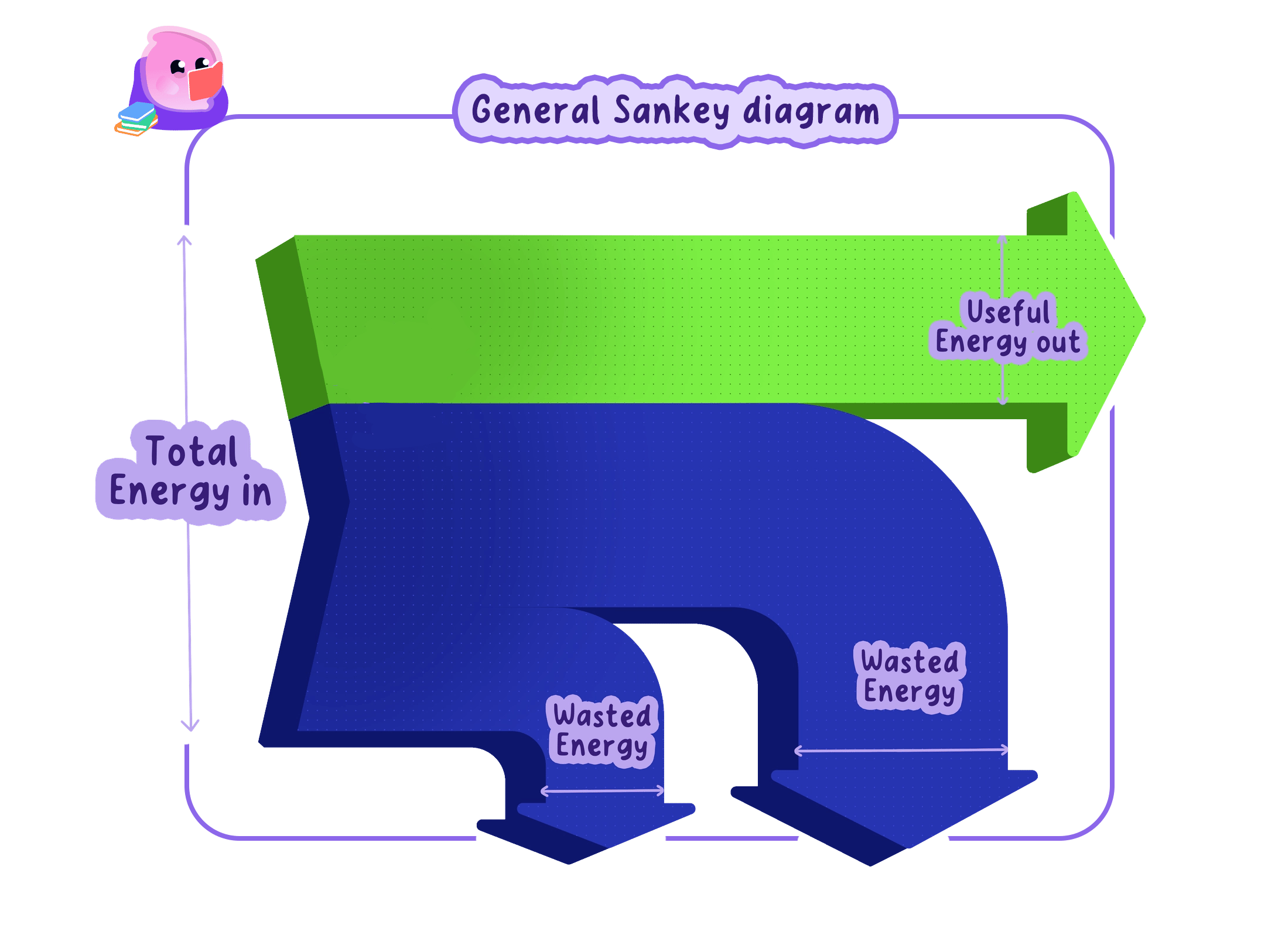
- The arrow entering a Sankey diagram on the left has a width set by the total energy supplied.
- The branch drawn straight on is normally the useful transfer, while the branches that turn away are the unwanted ones.
- Reading the two widths and dividing the useful one by the total gives the efficiency straight away.
- A diagram with 500 J500\ \text{J}500 J entering and a useful branch of width 125 J125\ \text{J}125 J shows an efficiency of 125500=0.25\dfrac{125}{500} = 0.25500125=0.25.
- Adding the widths of every branch leaving a point checks the reading, because they must equal the width of the arrow entering.
Increasing the efficiency of a device
- Efficiency rises when the unwanted transfers are made smaller, because fewer joules are then dissipated.
- Lubricating moving parts with oil or grease lowers the friction between surfaces, so less energy is transferred by heating.
- Streamlining a shape lowers air resistance, so less energy is dissipated into the air.
- Fitting thermal insulation slows the unwanted transfer by heating out of a device, so more of the energy stays where it is useful.
- Replacing a filament lamp with a light emitting diode raises efficiency, because a smaller share of the energy supplied warms the surroundings.
- Replacing worn bearings and gears lowers the friction inside a machine, so less of the energy supplied is dissipated.
Example
Efficiency of an electric motor
- A motor is supplied with 500 J500\ \text{J}500 J and transfers 125 J125\ \text{J}125 J usefully to raise a load.
- The equation is efficiency=useful energy transferredtotal energy supplied\text{efficiency} = \dfrac{\text{useful energy transferred}}{\text{total energy supplied}}efficiency=total energy supplieduseful energy transferred.
- Substituting gives efficiency=125500\text{efficiency} = \dfrac{125}{500}efficiency=500125.
- The efficiency is 0.250.250.25, which is 0.25×100=25%0.25 \times 100 = 25\%0.25×100=25%.
- The remaining 375 J375\ \text{J}375 J is dissipated, mostly into the thermal energy stores of the motor and the air around it.
Example
Finding the wasted energy
- A hair dryer has an efficiency of 0.850.850.85 and is supplied with 60 000 J60\,000\ \text{J}60000 J during one drying session.
- Rearranging gives useful energy transferred=efficiency×total energy supplied=0.85×60 000\text{useful energy transferred} = \text{efficiency} \times \text{total energy supplied} = 0.85 \times 60\,000useful energy transferred=efficiency×total energy supplied=0.85×60000.
- The useful transfer is 51 000 J51\,000\ \text{J}51000 J.
- The energy dissipated in unwanted ways is 60 000−51 000=9000 J60\,000 - 51\,000 = 9000\ \text{J}60000−51000=9000 J.
Example
Efficiency from power ratings
- An electric winch is rated at 1.5 kW1.5\ \text{kW}1.5 kW and its useful power output while lifting is 1.2 kW1.2\ \text{kW}1.2 kW.
- Both values are powers measured over the same time, so efficiency=1.21.5\text{efficiency} = \dfrac{1.2}{1.5}efficiency=1.51.2.
- The efficiency is 0.800.800.80, which is 80%80\%80%.
- The remaining 0.3 kW0.3\ \text{kW}0.3 kW is dissipated, mostly by heating the motor windings and the gears.
Practical
Measuring the efficiency of a motor lifting a load
- Aim: to measure the efficiency of a small electric motor as it raises a known load through a measured height.
- Apparatus: low-voltage electric motor with a cotton reel or pulley on its shaft, low-voltage power supply, joulemeter, light string, slotted masses on a hanger, balance, metre rule, clamp stand and boss, and a soft landing mat.
- Variables: the mass raised is the independent variable, the efficiency is the calculated variable, and the motor, the supply setting, the string and the vertical height raised are controlled.
- Method, set-up:
- Clamp the motor to the stand so the string winds onto the shaft and the load hangs freely, with the mat underneath it.
- Measure the mass of the hanger and masses in kilograms on the balance.
- Fix a metre rule beside the load and mark a start line and a finish line so every run raises the load through the same vertical height.
- Connect the joulemeter between the supply and the motor so that it reads the total energy supplied to the motor.
- Method, measurements:
- Zero the joulemeter, then switch on and raise the load from the start line to the finish line.
- Switch off the moment the load reaches the finish line and record the total energy supplied in joules.
- Record the mass raised in kilograms and the vertical height in metres.
- Repeat each load three times and calculate the mean energy supplied.
- Repeat for at least five different masses, keeping the height and the supply setting unchanged.
- Results: the measured efficiency rises as the load increases, because the energy dissipated inside the motor stays roughly the same while the useful transfer grows.
- Maths: calculate the useful energy transferred from E=m×g×ΔhE = m \times g \times \Delta hE=m×g×Δh with g=10 N/kgg = 10\ \text{N/kg}g=10 N/kg, then calculate efficiency=m×g×Δhtotal energy supplied\text{efficiency} = \dfrac{m \times g \times \Delta h}{\text{total energy supplied}}efficiency=total energy suppliedm×g×Δh, and plot efficiency against the mass raised.
- Watch out: the string must wind on without slipping and the load must not swing, switching off late adds joules that did no useful lifting, and friction in the shaft together with the mass of the string both lower the measured efficiency.
- Safety: keep fingers and long hair clear of the turning shaft, place a soft mat under the load, work at low voltage only, and clamp the stand to the bench so it cannot topple.
Exam technique
Setting out an efficiency answer
- Decide which energy is useful by asking what the device is for, then put that value on the top of the fraction.
- Put the total energy supplied on the bottom of the fraction, and never the wasted energy.
- Check the answer lies between 000 and 111, or between 0%0\%0% and 100%100\%100%, before writing it down.
- Write no unit after an efficiency, because it is a ratio of two energies.
- When an improvement is asked for, name the change and the transfer it reduces, such as oiling the bearings to reduce the energy dissipated by heating.
Common Mistake
- Do not divide the total energy supplied by the useful energy transferred, because that gives a value greater than 111.
- Do not write J\text{J}J or W\text{W}W after an efficiency, because a ratio has no unit.
- Do not treat the wasted energy as the total supplied, because the total is the useful energy and the wasted energy added together.
- Do not claim that a device can be 100%100\%100% efficient, because some energy is always dissipated.
Self review
- Define efficiency and state its unit.
- Write the efficiency equation and say which energy goes on the top.
- Convert an efficiency of 0.350.350.35 into a percentage.
- Calculate the efficiency of a lamp supplied with 200 J200\ \text{J}200 J that transfers 24 J24\ \text{J}24 J by light.
- Name two changes that raise the efficiency of a machine and state the transfer each one reduces.
