Question 16
FA student investigates how the acceleration of a trolley depends on its mass.
The Figure shows the apparatus.
Figure
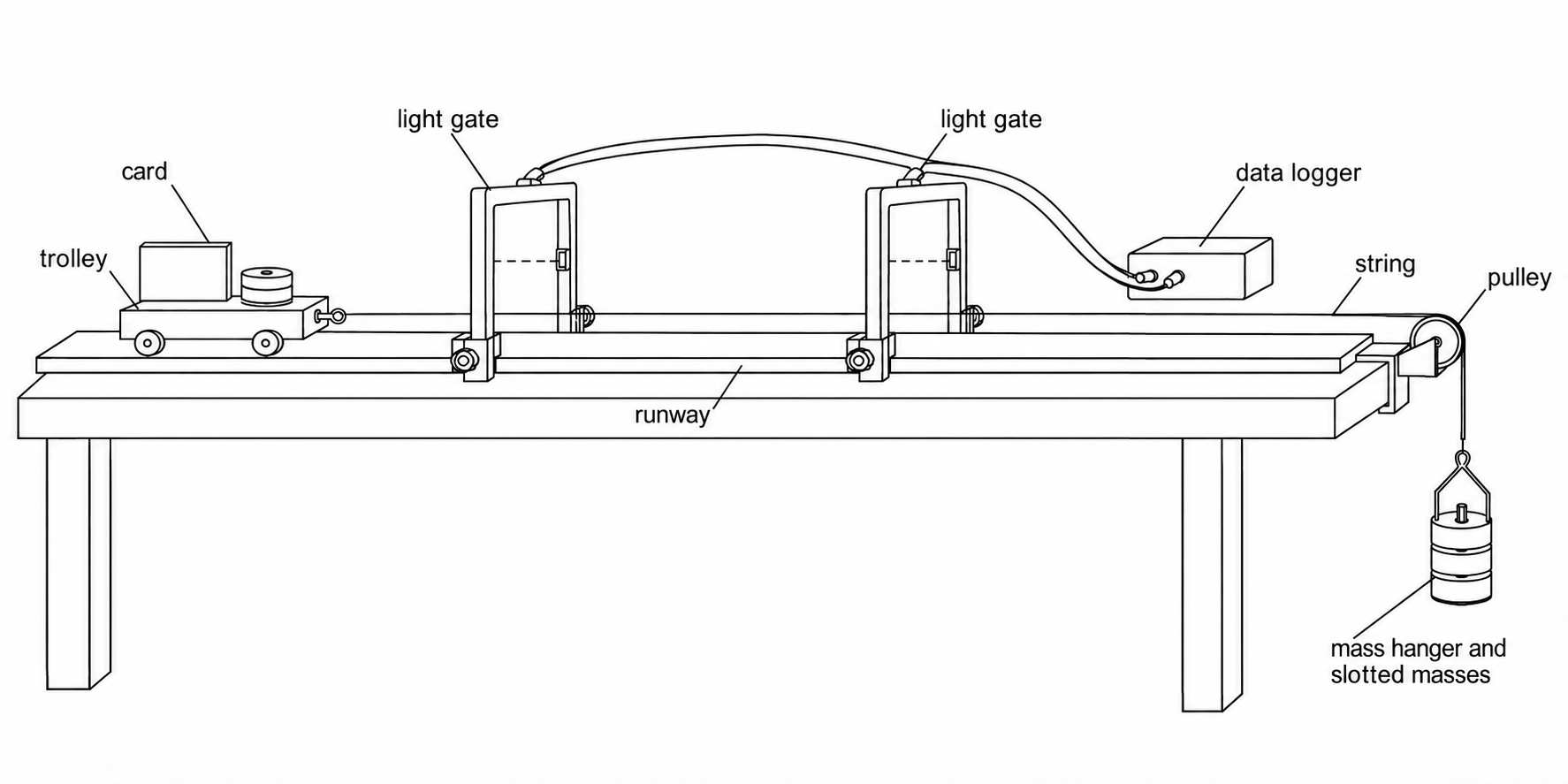
The student keeps the masses on the mass hanger the same. She adds masses to the trolley.
The Table shows the student's results.
Table
| Total mass in kg\text{kg}kg | Acceleration in m/s2\text{m/s}^{2}m/s2 |
|---|---|
| 0.40 | 2.00 |
| 0.50 | 1.60 |
| 0.80 | 1.00 |
| 1.00 | 0.80 |
a.[1]
State the independent variable in this investigation.
b.[2]
Give two control variables in this investigation.
c.[2]
Describe the relationship between total mass and acceleration shown by the results in the Table.
d.[2]
Calculate the resultant force on the trolley system.
Use data from the Table.
e.[2]
Explain one advantage of using light gates instead of a stopwatch to measure the motion of the trolley.
2.3 Forces and Newton's laws Questions
103 exam-style questions on Edexcel GCSE Physics 2.3 Forces and Newton's laws, covering 2.3.1 Newton's first law, 2.3.2 Newton's second law, and 2.3.3 Weight and gravitational field strength. Each one has a worked solution and a mark scheme showing where the marks go.