Magnets and magnetic poles
Definition
Magnet
A magnet is an object that produces a magnetic field around itself and exerts non-contact forces on other magnets and on magnetic materials.
Definition
Magnetic pole
A magnetic pole is one of the two regions of a magnet, called north and south, where the magnetic field is most concentrated and the magnetic force is strongest.
Definition
Non-contact force
A non-contact force is a force that one object exerts on another without the two objects touching.
- A magnet produces a magnetic field in the space around it, and any other magnet placed in that space feels a push or a pull.
- Every magnet has exactly two poles, and they always come as a pair: one north-seeking pole, labelled N, and one south-seeking pole, labelled S.
- The full names come from what a freely suspended magnet does. Left to hang on a thread, it turns until one particular end points towards the Earth's geographic north, and that end is the north-seeking pole.
- In diagrams and written answers the shortened names north pole and south pole are used, and both spellings of the idea earn credit.
- The poles are the two regions where the magnetic field is most concentrated, so the magnetic force produced by a bar magnet is strongest at its ends and weakest around its middle.
- A bar magnet is usually drawn with the north pole shaded blue and the south pole shaded red, and the letters N and S printed on the correct ends.
- The forces between magnets are non-contact forces. Two magnets do not need to touch, and the push or pull acts straight across the air gap between them.
- Because magnetic force is a non-contact force, it still acts through thin non-magnetic barriers such as paper, a plastic ruler or a glass sheet.
- A single pole on its own does not exist. Snapping a bar magnet in half gives two shorter bar magnets, each with a full north pole and a full south pole at its ends.
- Magnetism is a property of the object, not something stored up and used. A magnet keeps exerting forces indefinitely without running down like a battery.
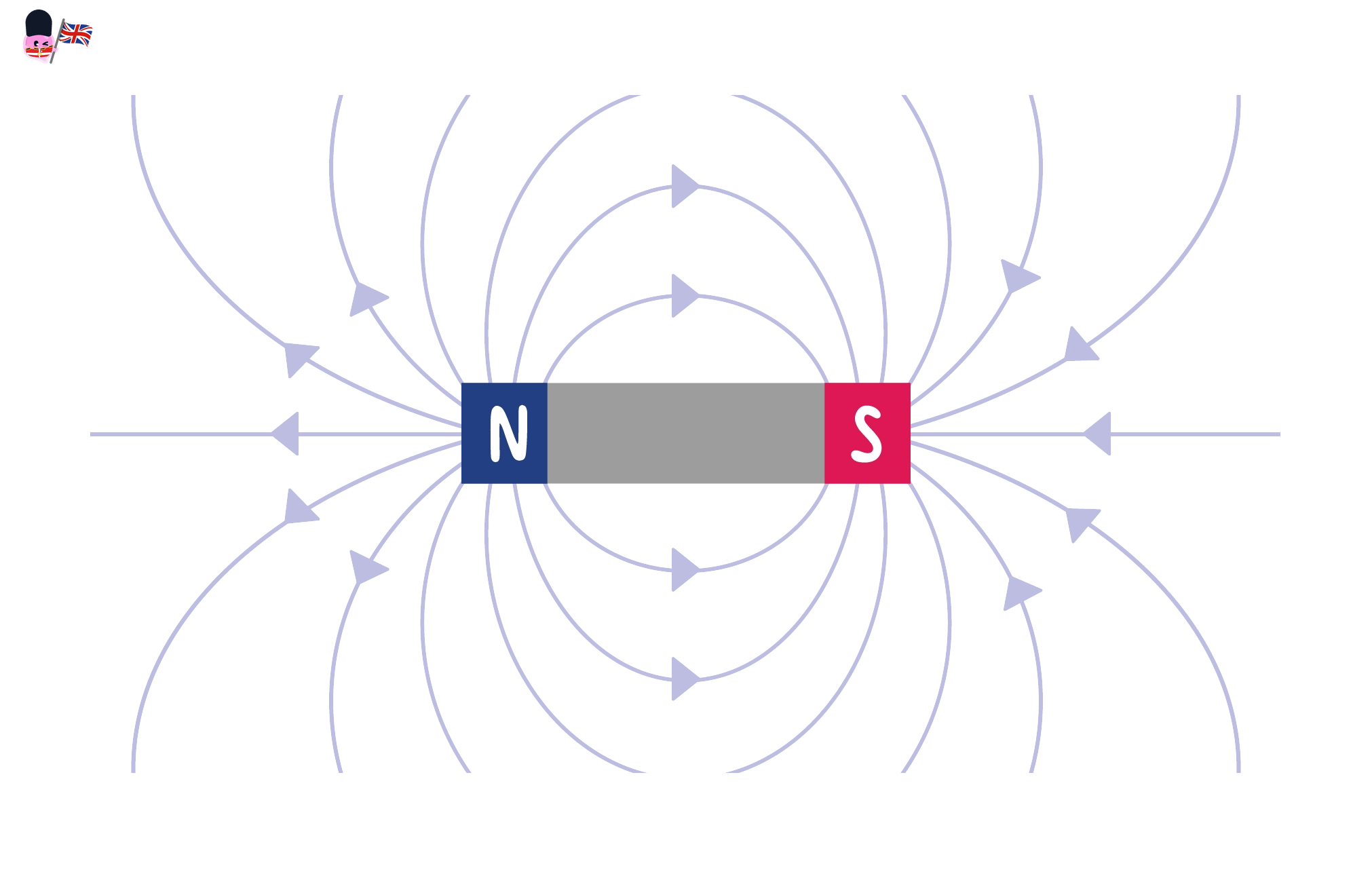
Key Idea
Magnetic poles always exist in pairs, and the magnetic force between them acts across a gap without the magnets touching.
Attraction and repulsion
- Whether two magnets pull together or push apart is decided by which pair of poles is facing across the gap.
- Unlike poles attract. A north pole facing a south pole gives a pull, so each magnet is pushed towards the other.
- Like poles repel. A north pole facing a north pole gives a push apart, and so does a south pole facing a south pole.
- There are only four possible pairings, and the rule sorts all of them:
- north facing south gives attraction
- south facing north gives attraction
- north facing north gives repulsion
- south facing south gives repulsion
- The two magnets always experience forces of the same size acting in opposite directions, so when they attract, each one is pulled towards the other rather than one magnet doing all the work.
- Turning one magnet through 180∘180^\circ180∘ swaps which of its poles faces the other magnet, so attraction becomes repulsion and repulsion becomes attraction without moving the second magnet at all.
- The size of the magnetic force grows sharply as the gap between the poles is reduced, and falls away quickly as the magnets are separated. Doubling the separation reduces the force by much more than half.
- Repulsion is the only certain test that an object is a magnet. Attraction alone is not enough, because a magnet also attracts an unmagnetised piece of iron or steel.
- Two identical bar magnets pushed north pole to north pole will spring apart if one is released, because the repulsive force acts along the line joining the poles.
Example
Predicting attraction or repulsion
- Two bar magnets lie end to end on a bench with a 2 cm2\ \text{cm}2 cm gap. The left magnet has its south pole facing the gap and the right magnet has its north pole facing the gap.
- Identify the pair of poles facing each other across the gap: a south pole and a north pole.
- These are unlike poles, because one is north and one is south.
- Unlike poles attract, so each magnet experiences a force pulling it towards the other and the gap closes.
- If the right magnet is now turned end for end, a south pole faces the gap instead. The poles are then alike, so the magnets repel and the gap widens.
Practical
Investigating the force between two magnets
- Aim: to compare the forces produced by like and unlike poles and to find how the force between two magnets changes with the separation of the poles.
- Apparatus: two identical bar magnets, a digital top-pan balance reading to 0.01 g0.01\ \text{g}0.01 g, a non-magnetic clamp stand and boss, a wooden or plastic block, a set square, a millimetre ruler or vernier callipers, and adhesive putty.
- Variables: the separation of the two poles is the independent variable, the reading change on the balance is the dependent variable, and the pair of magnets, the pole combination, the alignment of the magnets and the balance zero are all kept the same.
- Method, setting up:
- Stand the balance on a level bench well away from iron or steel objects, since a nearby radiator or table leg can attract the magnets sideways and spoil the reading.
- Fix one bar magnet flat on the balance pan with a small piece of adhesive putty so that one pole points vertically upwards, then press the tare or zero button so the balance reads 0.00 g0.00\ \text{g}0.00 g.
- Clamp the second bar magnet in the non-magnetic clamp directly above the first, with its lower pole pointing straight down at the pole below it and the two magnets in line.
- Check the alignment with a set square, because a tilted upper magnet gives a sideways force component that the balance cannot detect.
- Method, taking readings:
- Set the vertical gap between the two facing poles to 10 mm10\ \text{mm}10 mm, measured with the ruler or callipers held against the sides of the magnets.
- Read the balance and record whether the reading is positive or negative. A negative reading means the upper magnet is pulling the lower magnet upwards, so the poles are attracting. A positive reading means the upper magnet is pushing down, so the poles are repelling.
- Raise the clamp, lower it again to the same gap and take a second and third reading, then calculate a mean so that a single misplaced measurement does not decide the result.
- Repeat for gaps of 20 mm20\ \text{mm}20 mm, 30 mm30\ \text{mm}30 mm, 40 mm40\ \text{mm}40 mm and 50 mm50\ \text{mm}50 mm, re-zeroing the balance between sets.
- Turn the upper magnet over so the opposite pole now faces down, and repeat the whole set of gaps. The pole combination has changed from like to unlike, or from unlike to like.
- Processing: convert each mean balance reading in grams to a force in newtons using F=mgF=mgF=mg with g=10 N/kgg=10\ \text{N/kg}g=10 N/kg, remembering to convert grams to kilograms first, so a reading of 4.0 g4.0\ \text{g}4.0 g corresponds to F=0.0040×10=0.040 NF=0.0040\times10=0.040\ \text{N}F=0.0040×10=0.040 N.
- Expected pattern: like poles give a downward push and unlike poles give an upward pull, and for both combinations the size of the force rises steeply as the gap is reduced, so a graph of force against separation is a curve that falls away rather than a straight line.
- Watch out: stray iron near the bench, a tilted upper magnet, forgetting to re-zero the balance, reading the gap between the magnet edges rather than the pole faces, and pressing the clamp so far down that the two magnets snap together and damage the pan.
- Safety: keep the strong magnets away from phones, bank cards and laptops, warn anyone with a heart pacemaker to stay clear, and support the clamp stand so it cannot topple onto fingers.
Exam technique
Answering questions on poles
- For a state or give command word, one word is enough: write attract or repel.
- For an explain command word, name the pair of poles first and then quote the rule, for example that the magnets repel because two north poles are like poles and like poles repel.
- Use the technical words magnetic poles, attract and repel rather than everyday phrases such as stick together or push away, which examiners often refuse to credit.
- If a diagram shows unlabelled magnets, mark the poles on the diagram yourself before writing anything, so that the pairing across the gap is obvious.
- When asked how to prove that an object is a magnet, the mark is for repulsion, so describe bringing a known pole up to it and looking for a push.
Common Mistake
- Do not write that north poles attract. A north pole attracts a south pole and repels another north pole.
- Do not say that the magnets touch to produce the force. Magnetic force is a non-contact force that acts across a gap.
- Do not use attraction on its own to prove that something is a magnet, because an unmagnetised iron nail is also attracted.
- Do not claim that cutting a magnet in half separates a north pole from a south pole. Each half is a complete magnet with two poles.
Self review
- Name the two poles of a magnet and state which end of a freely suspended magnet points towards geographic north.
- State what happens when a north pole is brought close to a south pole, and when a south pole is brought close to a south pole.
- Explain why the force between two magnets is described as a non-contact force.
- Describe how the force between two magnets changes as the gap between their poles is made smaller.
- Explain why repulsion, and not attraction, is the reliable test for whether an object is a magnet.
