Heating transfers energy
Definition
Heating
Heating is the transfer of energy from a region at a higher temperature to a region at a lower temperature.
Definition
Internal energy
Internal energy is the total kinetic energy and potential energy of all the particles in a system.
- A system is the object or group of objects being studied, such as the water inside a kettle.
- Heating is an energy transfer pathway and not an energy store, so an object never contains heat.
- Energy transferred into a system by heating increases the internal energy of that system.
- Internal energy has two parts: the kinetic energy of the moving particles and the potential energy associated with the forces between them.
- Increasing the internal energy of a system produces one of two outcomes: a rise in temperature or a change of state.
- Which outcome happens depends on whether the substance is below a change of state temperature or already at one.
- Energy is conserved, so the energy supplied by a heater equals the energy gained by the system plus the energy transferred wastefully to the surroundings.
- Cooling is the same process running backwards, so a cooling system loses internal energy to its surroundings.
Raising the temperature
Definition
Temperature
Temperature is a measure of the average kinetic energy of the particles in a substance.
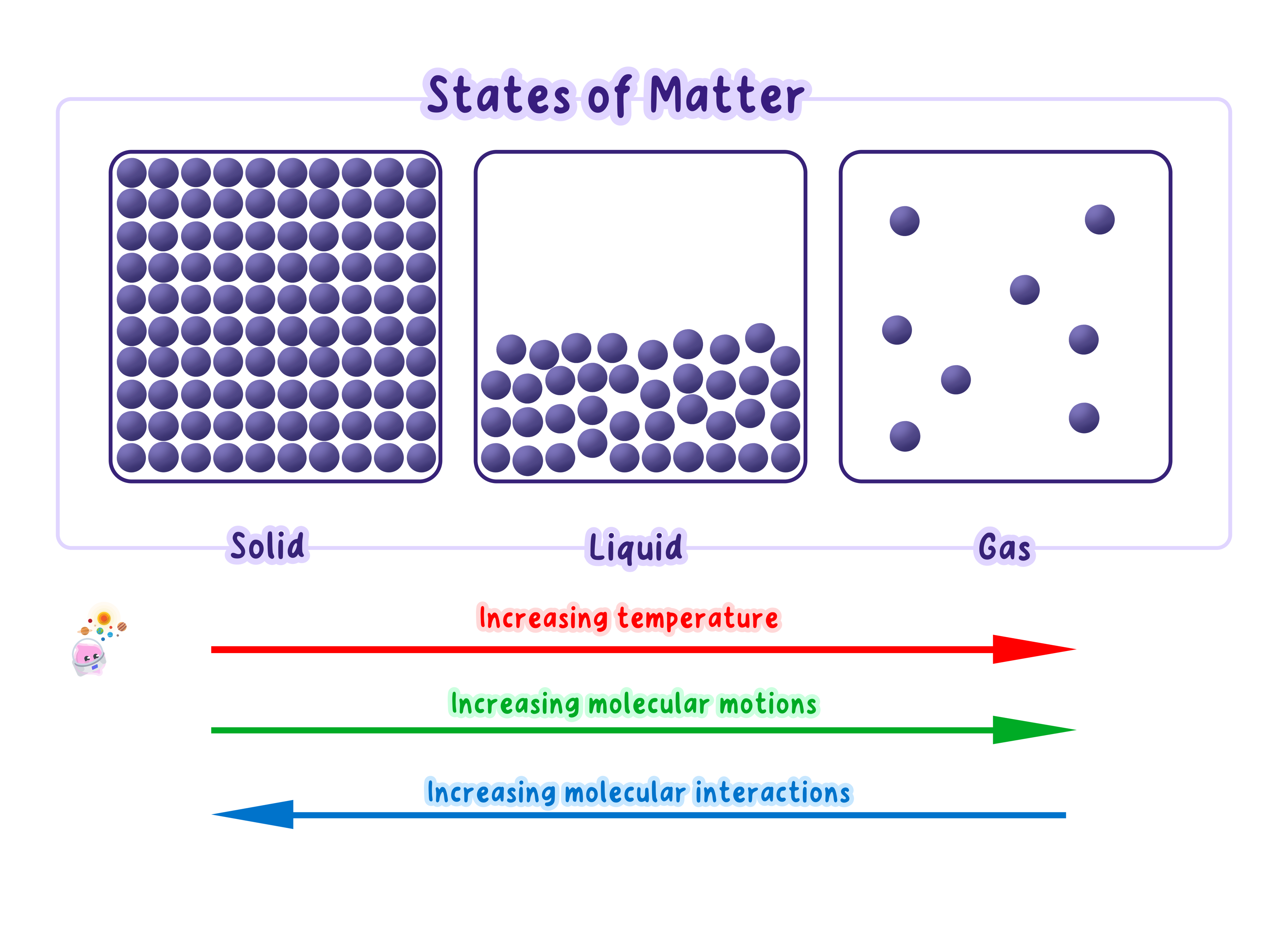
- When a substance is heated and stays in the same state, the transferred energy increases the average kinetic energy of its particles.
- Particles in a solid vibrate more rapidly about their fixed positions.
- Particles in a liquid or a gas move more rapidly from place to place.
- Because temperature is a measure of the average kinetic energy of the particles, the temperature of the substance rises.
- The arrangement of the particles does not change during this stage, so the substance stays in the same state throughout.
- Temperature is not the same as internal energy, because a small mass at a high temperature can hold less internal energy than a large mass at a low temperature.
- Cooling a substance in a single state slows its particles down, so the average kinetic energy and the temperature both fall.
Producing a change of state
Definition
Change of state
A change of state is a physical change in which a substance changes between the solid, liquid and gas states without becoming a different substance.
Definition
Melting point
The melting point is the temperature at which a solid changes into a liquid, and at which the liquid freezes back into a solid.
- Once a substance has reached its melting point or its boiling point, continued heating produces a change of state instead of a temperature rise.
- The transferred energy is used to break up the existing arrangement of the particles and to overcome the forces of attraction holding them to their neighbours.
- This increases the potential energy part of the internal energy, so the internal energy of the system still rises.
- The average kinetic energy of the particles does not increase during the change, so the temperature stays constant.
- The temperature only begins to rise again after the last particle has changed state.
- A mixture of ice and water therefore stays at 0 ∘C0\,^\circ\text{C}0∘C while any ice remains, however hard it is heated.
- Melting and boiling need energy to be transferred into the substance, so they cannot happen without a supply of energy.
Cooling and releasing energy
- Freezing and condensing transfer energy out of the substance and into the surroundings.
- The temperature stays constant while a substance freezes or condenses, for the same reason that it stays constant while it melts or boils.
- The energy released when a given mass condenses is equal to the energy needed to boil the same mass.
- Steam at 100 ∘C100\,^\circ\text{C}100∘C therefore scalds far more severely than liquid water at 100 ∘C100\,^\circ\text{C}100∘C, because it releases a large amount of energy as it condenses on the skin.
- Evaporation works the other way and takes energy from its surroundings, which is why sweat cools the skin as it dries.
- A substance in a fridge freezer keeps losing internal energy while it freezes, even though a thermometer in it shows no change.
Example
Heating ice through to steam
- Ice at −10 ∘C-10\,^\circ\text{C}−10∘C is heated steadily in an insulated container.
- The molecules vibrate faster about their fixed positions, their average kinetic energy rises, and the temperature climbs to 0 ∘C0\,^\circ\text{C}0∘C.
- At 0 ∘C0\,^\circ\text{C}0∘C the energy now separates the molecules from their fixed positions and overcomes the forces of attraction between them.
- The average kinetic energy does not increase during this stage, so the thermometer holds at 0 ∘C0\,^\circ\text{C}0∘C until the last of the ice has melted.
- Further heating then raises the average kinetic energy of the water molecules, so the temperature rises from 0 ∘C0\,^\circ\text{C}0∘C towards 100 ∘C100\,^\circ\text{C}100∘C.
- At 100 ∘C100\,^\circ\text{C}100∘C the temperature stops rising again, because the energy is being used to pull the molecules apart into a gas.
- The internal energy of the water has increased at every stage, including the two stages where the temperature did not change.
Exam technique
Writing a heating explanation
- Say that energy is transferred by heating and that the internal energy of the system increases, because that opening statement is usually worth a mark on its own.
- Use the words average kinetic energy when the temperature changes, since the mark scheme looks for that phrase rather than the word speed alone.
- Use the words arrangement and forces of attraction when the state changes.
- Add the consequence in the same sentence, so a rise in average kinetic energy is followed by so the temperature rises.
- Deal with each stage separately when a question covers both a temperature rise and a change of state, because each stage carries its own marks.
- State that internal energy still increases during a change of state, which is the point that separates a top answer from a middling one.
Common Mistake
- Do not write that an object contains heat, because heating is a way of transferring energy and not a store.
- Do not assume that heating always raises temperature, because the temperature holds steady throughout a change of state.
- Do not write that the internal energy is constant while ice melts, because it rises even though the temperature does not.
- Do not use temperature and internal energy as though they mean the same quantity, because internal energy also depends on the mass and the state of the substance.
- Do not write that particles gain kinetic energy while a substance boils, because the extra energy goes into separating them instead.
Self review
- State the two possible effects of heating a system.
- Name the two parts that make up the internal energy of a system.
- Explain why the temperature stays constant while ice is melting.
- Explain what happens to the particles of a solid when its temperature rises.
- Explain why steam causes a worse scald than boiling water at the same temperature.
- State why heating is not an energy store.
