14.2.1 Heating, temperature and changes of state
Heating transfers energy
Heating
Heating is the transfer of energy from a region at a higher temperature to a region at a lower temperature.
Internal energy
Internal energy is the total kinetic energy and potential energy of all the particles in a system.
- A system is the object or group of objects being studied, such as the water inside a kettle.
- Heating is an energy transfer pathway and not an energy store, so an object never contains heat.
- Energy transferred into a system by heating increases the internal energy of that system.
- Internal energy has two parts: the kinetic energy of the moving particles and the potential energy associated with the forces between them.
- Increasing the internal energy of a system produces one of two outcomes: a rise in temperature or a change of state.
- Which outcome happens depends on whether the substance is below a change of state temperature or already at one.
- Energy is conserved, so the energy supplied by a heater equals the energy gained by the system plus the energy transferred wastefully to the surroundings.
- Cooling is the same process running backwards, so a cooling system loses internal energy to its surroundings.
Raising the temperature
Temperature
Temperature is a measure of the average kinetic energy of the particles in a substance.
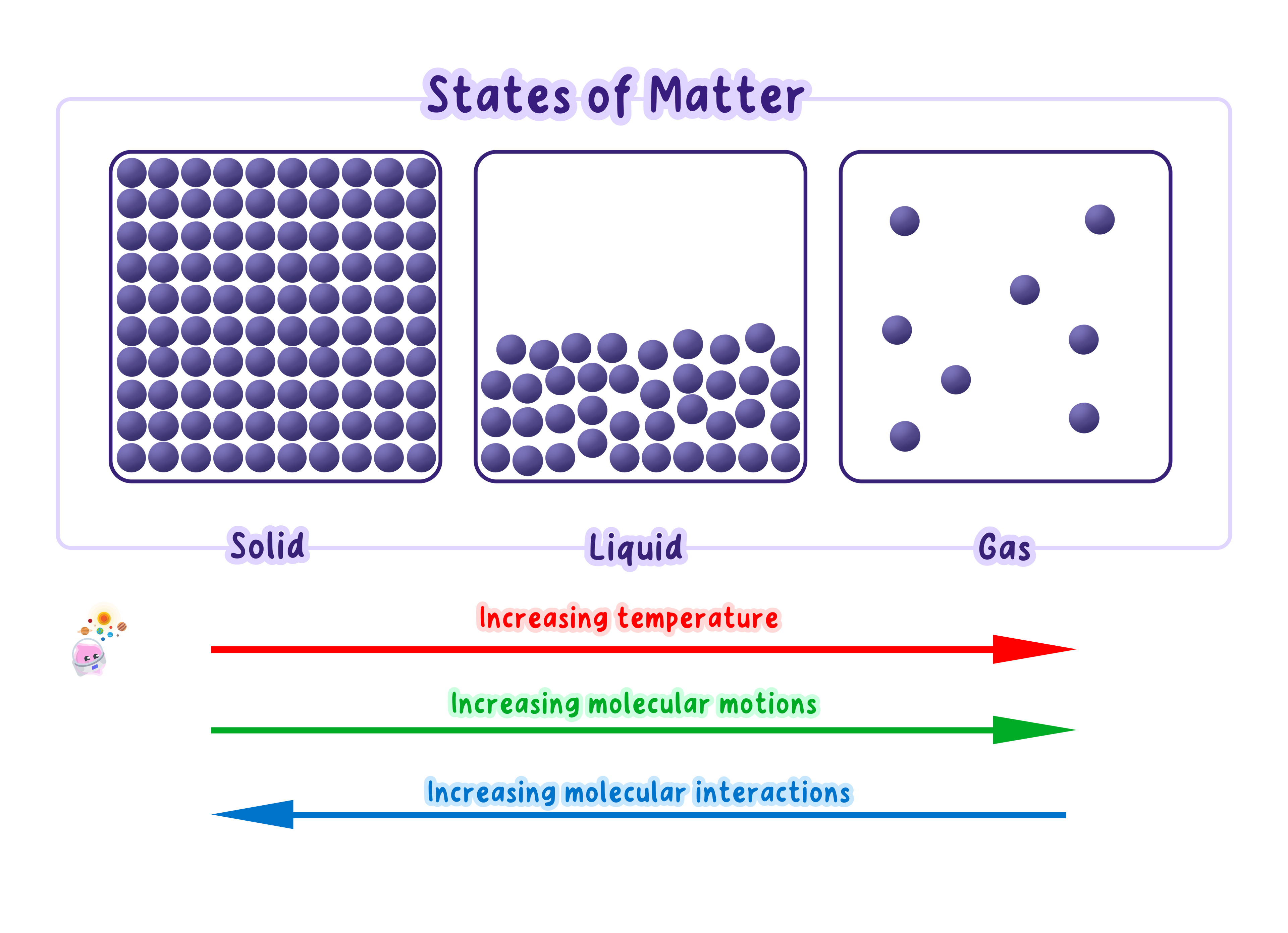
- When a substance is heated and stays in the same state, the transferred energy increases the average kinetic energy of its particles.
- Particles in a solid vibrate more rapidly about their fixed positions.
- Particles in a liquid or a gas move more rapidly from place to place.
- Because temperature is a measure of the average kinetic energy of the particles, the temperature of the substance rises.
- The arrangement of the particles does not change during this stage, so the substance stays in the same state throughout.
- Temperature is not the same as internal energy, because a small mass at a high temperature can hold less internal energy than a large mass at a low temperature.
- Cooling a substance in a single state slows its particles down, so the average kinetic energy and the temperature both fall.
Producing a change of state
Change of state
A change of state is a physical change in which a substance changes between the solid, liquid and gas states without becoming a different substance.
Melting point
The melting point is the temperature at which a solid changes into a liquid, and at which the liquid freezes back into a solid.
- Once a substance has reached its melting point or its boiling point, continued heating produces a change of state instead of a temperature rise.
- The transferred energy is used to break up the existing arrangement of the particles and to overcome the forces of attraction holding them to their neighbours.
- This increases the potential energy part of the internal energy, so the internal energy of the system still rises.
- The average kinetic energy of the particles does not increase during the change, so the temperature stays constant.
- The temperature only begins to rise again after the last particle has changed state.
- A mixture of ice and water therefore stays at 0 ∘C0\,^\circ\text{C}0∘C while any ice remains, however hard it is heated.
- Melting and boiling need energy to be transferred into the substance, so they cannot happen without a supply of energy.
Cooling and releasing energy
- Freezing and condensing transfer energy out of the substance and into the surroundings.
- The temperature stays constant while a substance freezes or condenses, for the same reason that it stays constant while it melts or boils.
- The energy released when a given mass condenses is equal to the energy needed to boil the same mass.
- Steam at 100 ∘C100\,^\circ\text{C}100∘C therefore scalds far more severely than liquid water at 100 ∘C100\,^\circ\text{C}100∘C, because it releases a large amount of energy as it condenses on the skin.
- Evaporation works the other way and takes energy from its surroundings, which is why sweat cools the skin as it dries.
- A substance in a fridge freezer keeps losing internal energy while it freezes, even though a thermometer in it shows no change.
Heating ice through to steam
- Ice at −10 ∘C-10\,^\circ\text{C}−10∘C is heated steadily in an insulated container.
- The molecules vibrate faster about their fixed positions, their average kinetic energy rises, and the temperature climbs to 0 ∘C0\,^\circ\text{C}0∘C.
- At 0 ∘C0\,^\circ\text{C}0∘C the energy now separates the molecules from their fixed positions and overcomes the forces of attraction between them.
- The average kinetic energy does not increase during this stage, so the thermometer holds at 0 ∘C0\,^\circ\text{C}0∘C until the last of the ice has melted.
- Further heating then raises the average kinetic energy of the water molecules, so the temperature rises from 0 ∘C0\,^\circ\text{C}0∘C towards 100 ∘C100\,^\circ\text{C}100∘C.
- At 100 ∘C100\,^\circ\text{C}100∘C the temperature stops rising again, because the energy is being used to pull the molecules apart into a gas.
- The internal energy of the water has increased at every stage, including the two stages where the temperature did not change.
Writing a heating explanation
- Say that energy is transferred by heating and that the internal energy of the system increases, because that opening statement is usually worth a mark on its own.
- Use the words average kinetic energy when the temperature changes, since the mark scheme looks for that phrase rather than the word speed alone.
- Use the words arrangement and forces of attraction when the state changes.
- Add the consequence in the same sentence, so a rise in average kinetic energy is followed by so the temperature rises.
- Deal with each stage separately when a question covers both a temperature rise and a change of state, because each stage carries its own marks.
- State that internal energy still increases during a change of state, which is the point that separates a top answer from a middling one.
- Do not write that an object contains heat, because heating is a way of transferring energy and not a store.
- Do not assume that heating always raises temperature, because the temperature holds steady throughout a change of state.
- Do not write that the internal energy is constant while ice melts, because it rises even though the temperature does not.
- Do not use temperature and internal energy as though they mean the same quantity, because internal energy also depends on the mass and the state of the substance.
- Do not write that particles gain kinetic energy while a substance boils, because the extra energy goes into separating them instead.
- State the two possible effects of heating a system.
- Name the two parts that make up the internal energy of a system.
- Explain why the temperature stays constant while ice is melting.
- Explain what happens to the particles of a solid when its temperature rises.
- Explain why steam causes a worse scald than boiling water at the same temperature.
- State why heating is not an energy store.
14.2.2 Specific heat capacity and specific latent heat
Specific heat capacity
Specific heat capacity
Specific heat capacity is the energy needed to raise the temperature of one kilogram of a substance by one degree Celsius.
- Different materials need different amounts of energy to warm up by the same number of degrees, and specific heat capacity is the quantity that measures that difference.
- Its symbol is ccc and its unit is joules per kilogram per degree Celsius, written J/kg ∘C\text{J/kg}\,^\circ\text{C}J/kg∘C.
- The word specific means the value is quoted for one kilogram, so the mass has already been divided out and the value belongs to the material rather than to a particular object.
- Water has an unusually high value of about 4200 J/kg ∘C4200\ \text{J/kg}\,^\circ\text{C}4200 J/kg∘C, while aluminium is about 900 J/kg ∘C900\ \text{J/kg}\,^\circ\text{C}900 J/kg∘C and copper about 385 J/kg ∘C385\ \text{J/kg}\,^\circ\text{C}385 J/kg∘C.
- A high specific heat capacity means the material warms up slowly for a given energy input, and it also cools down slowly.
- A low specific heat capacity means the material heats up quickly, which is why a copper pan base reaches cooking temperature much faster than the water inside it.
- Water is used to carry energy around a central heating system because its high value lets each kilogram carry a large amount of energy for a modest temperature change.
- The same property explains why the sea warms up and cools down far more slowly than the land around it.
- Ice, liquid water and steam each have their own specific heat capacity, because the arrangement of the molecules is different in each state.
Specific latent heat
Specific latent heat
Specific latent heat is the energy needed to change the state of one kilogram of a substance without changing its temperature.
Specific latent heat of fusion
Specific latent heat of fusion is the energy needed to melt one kilogram of a substance at its melting point without changing its temperature.
Specific latent heat of vaporisation
Specific latent heat of vaporisation is the energy needed to boil one kilogram of a substance at its boiling point without changing its temperature.
- Energy is still needed to change the state of a substance even though its temperature does not change, and specific latent heat measures how much energy each kilogram needs.
- Its symbol is LLL and its unit is joules per kilogram, written J/kg\text{J/kg}J/kg.
- There is no temperature in the unit, because the temperature is constant throughout the change of state.
- Fusion refers to the change between solid and liquid, so it covers both melting and freezing.
- Vaporisation refers to the change between liquid and gas, so it covers both boiling and condensing.
- For water the specific latent heat of fusion is about 3.34×10⁵ J/kg3.34\times10^{5}\ \text{J/kg}3.34×105 J/kg and the specific latent heat of vaporisation is about 2.26×10⁶ J/kg2.26\times10^{6}\ \text{J/kg}2.26×106 J/kg.
- Vaporisation always needs more energy than fusion for the same substance, because melting only frees the particles from their fixed positions while boiling separates them completely.
- The value works in both directions, so freezing one kilogram of water releases the same energy that melting one kilogram of ice absorbs.
Comparing the two quantities
- Both quantities are quoted per kilogram, so both tell you the energy involved for a 1 kg1\ \text{kg}1 kg sample of the substance.
- Specific heat capacity applies while the substance stays in one state and its temperature is changing.
- Specific latent heat applies while the substance is changing state and its temperature is constant.
- The energy in the specific heat capacity case changes the average kinetic energy of the particles, so the temperature moves.
- The energy in the specific latent heat case changes the arrangement of the particles and overcomes the forces between them, so the temperature holds still.
- The units separate the two: a temperature appears in J/kg ∘C\text{J/kg}\,^\circ\text{C}J/kg∘C but not in J/kg\text{J/kg}J/kg.
- One substance has a specific heat capacity for each of its states, but only two specific latent heats, one for fusion and one for vaporisation.
- Specific latent heat values are usually far larger than the energy needed to warm the same mass by a few degrees, which is why melting and boiling stages dominate the energy needed to take a substance through a wide temperature range.
Choosing the right quantity at each stage
- Ice at −5 ∘C-5\,^\circ\text{C}−5∘C is warmed to 0 ∘C0\,^\circ\text{C}0∘C, which is a temperature change within one state, so the specific heat capacity of ice applies.
- The ice at 0 ∘C0\,^\circ\text{C}0∘C then melts into water at 0 ∘C0\,^\circ\text{C}0∘C, which is a change of state, so the specific latent heat of fusion applies.
- The water is warmed from 0 ∘C0\,^\circ\text{C}0∘C to 100 ∘C100\,^\circ\text{C}100∘C, so the specific heat capacity of liquid water applies to that stage.
- The water at 100 ∘C100\,^\circ\text{C}100∘C then boils into steam at 100 ∘C100\,^\circ\text{C}100∘C, so the specific latent heat of vaporisation applies.
- Each kilogram needs about 3.34×10⁵ J3.34\times10^{5}\ \text{J}3.34×10⁵ J for the melting stage and about 2.26×10⁶ J2.26\times10^{6}\ \text{J}2.26×10⁶ J for the boiling stage.
- The boiling stage therefore needs by far the most energy of the four stages, even though it produces no change in temperature at all.
Writing the two definitions
- Include the energy, the mass of one kilogram and the temperature rise of one degree Celsius in a definition of specific heat capacity, because all three are needed for full marks.
- Include the energy, the mass of one kilogram and the phrase without a change in temperature in a definition of specific latent heat.
- Name the change of state you mean, because fusion and vaporisation have different values for the same substance.
- Quote the units carefully, since the presence or absence of the degree Celsius is often the mark that separates the two quantities.
- Give a matching statement about each quantity in a compare question, so the examiner can see the two sides of the difference.
- Mention the particles when you are asked to explain the difference, since the arrangement changing rather than the speed changing is the real distinction.
- Do not leave the mass out of a definition, because both quantities are defined for one kilogram of the substance.
- Do not write that specific latent heat produces a temperature rise, because the temperature is constant while the state changes.
- Do not use one latent heat value for both melting and boiling, because the two values differ by roughly a factor of seven for water.
- Do not treat latent heat as a temperature or as a store of heat, because it is an energy per kilogram.
- Do not assume a substance with a high specific heat capacity also has a high melting point, because the two properties are unrelated.
- Define specific heat capacity and give its unit.
- Define specific latent heat and give its unit.
- State the difference between the specific latent heat of fusion and the specific latent heat of vaporisation.
- Explain why the unit of specific latent heat contains no temperature.
- Explain what a high specific heat capacity tells you about how a material warms and cools.
- Explain why boiling water needs more energy per kilogram than melting ice.
14.2.3 Specific heat capacity calculation
The thermal energy equation
Specific heat capacity
Specific heat capacity is the energy needed to raise the temperature of one kilogram of a substance by one degree Celsius.
- The equation is ΔQ=m×c×Δθ\Delta Q=m\times c\times\Delta\thetaΔQ=m×c×Δθ, which links the energy transferred to the mass, the material and the temperature change.
- In this equation ΔQ\Delta QΔQ is the change in thermal energy in joules, J\text{J}J, mmm is the mass in kilograms, kg\text{kg}kg, ccc is the specific heat capacity in J/kg ∘C\text{J/kg}\,^\circ\text{C}J/kg∘C, and Δθ\Delta\thetaΔθ is the change in temperature in ∘C^\circ\text{C}∘C.
- The symbol Δ\DeltaΔ means change in, and θ\thetaθ is the Greek letter theta, used here for temperature.
- Work out the temperature change as Δθ=θfinal−θstart\Delta\theta=\theta_{\text{final}}-\theta_{\text{start}}Δθ=θfinal−θstart, and never substitute a single temperature reading on its own.
- The equation only applies while the substance stays in the same state, because a change of state produces no temperature change to substitute.
- Convert the mass into kilograms before substituting, so 250 g250\ \text{g}250 g becomes 0.250 kg0.250\ \text{kg}0.250 kg.
- Cooling uses the same equation, and the energy released when a substance cools by a given amount equals the energy needed to warm it by the same amount.
- Energy transferred grows with all three factors, so a large mass, a high specific heat capacity or a big temperature change each increase the energy needed.
Rearranging and supplying the energy
- Rearranging for the specific heat capacity gives c=ΔQm Δθc=\dfrac{\Delta Q}{m\,\Delta\theta}c=mΔθΔQ.
- Rearranging for the mass gives m=ΔQc Δθm=\dfrac{\Delta Q}{c\,\Delta\theta}m=cΔθΔQ.
- Rearranging for the temperature change gives Δθ=ΔQm c\Delta\theta=\dfrac{\Delta Q}{m\,c}Δθ=mcΔQ.
- When an electric heater supplies the energy, the energy it transfers is E=P×tE=P\times tE=P×t, where PPP is the power in watts and ttt is the time in seconds.
- If the potential difference and current are given instead, use E=V×I×tE=V\times I\times tE=V×I×t to find the energy supplied.
- Setting the energy supplied equal to ΔQ\Delta QΔQ assumes that no energy escapes to the surroundings or into the container, which is worth stating as an assumption.
- Because some energy always escapes in practice, an experimental value of ccc usually comes out higher than the accepted value, since more energy was supplied than the substance actually gained.
Energy needed to heat water
- A kettle heats 0.50 kg0.50\ \text{kg}0.50 kg of water from 20 ∘C20\,^\circ\text{C}20∘C to 90 ∘C90\,^\circ\text{C}90∘C, and the specific heat capacity of water is 4200 J/kg ∘C4200\ \text{J/kg}\,^\circ\text{C}4200 J/kg∘C.
- The temperature change is Δθ=90−20=70 ∘C\Delta\theta=90-20=70\,^\circ\text{C}Δθ=90−20=70∘C.
- Using ΔQ=m c Δθ\Delta Q=m\,c\,\Delta\thetaΔQ=mcΔθ gives ΔQ=0.50×4200×70\Delta Q=0.50\times4200\times70ΔQ=0.50×4200×70.
- The energy transferred is ΔQ=1.47×10⁵ J\Delta Q=1.47\times10^{5}\ \text{J}ΔQ=1.47×10⁵ J.
Finding a specific heat capacity
- A metal block of mass 0.80 kg0.80\ \text{kg}0.80 kg gains 21 600 J21\,600\ \text{J}21600 J and its temperature rises by 30 ∘C30\,^\circ\text{C}30∘C.
- Rearranging gives c=ΔQm Δθc=\dfrac{\Delta Q}{m\,\Delta\theta}c=mΔθΔQ.
- Substituting gives c=21 6000.80×30=21 60024c=\dfrac{21\,600}{0.80\times30}=\dfrac{21\,600}{24}c=0.80×3021600=2421600.
- The specific heat capacity is 900 J/kg ∘C900\ \text{J/kg}\,^\circ\text{C}900 J/kg∘C, which matches aluminium.
Temperature rise from a heater
- A 50 W50\ \text{W}50 W immersion heater runs for 300 s300\ \text{s}300 s in 0.40 kg0.40\ \text{kg}0.40 kg of water.
- The energy supplied is E=P×t=50×300=15 000 JE=P\times t=50\times300=15\,000\ \text{J}E=P×t=50×300=15000 J.
- Assuming all of that energy reaches the water, Δθ=ΔQm c=15 0000.40×4200\Delta\theta=\dfrac{\Delta Q}{m\,c}=\dfrac{15\,000}{0.40\times4200}Δθ=mcΔQ=0.40×420015000.
- The temperature rise is Δθ=8.9 ∘C\Delta\theta=8.9\,^\circ\text{C}Δθ=8.9∘C to two significant figures.
- The real rise would be smaller than this, because some energy is transferred to the beaker and to the surrounding air.
Investigating the properties of water
- Aim: to determine the specific heat capacity of water, and to obtain a temperature against time graph for melting ice.
- Apparatus, first part: insulated beaker or copper calorimeter with a lid, water, 12 V12\ \text{V}12 V immersion heater, low voltage power supply, joulemeter or a voltmeter, ammeter and stopwatch, thermometer or temperature probe, digital balance, stirrer, lagging and a heatproof mat.
- Apparatus, second part: crushed ice, boiling tube or small beaker, temperature probe or thermometer, larger beaker of warm water as a water bath, tripod, gauze and Bunsen burner or an electric heater, stopwatch and a stirrer.
- Variables, first part: the energy supplied is the independent variable, the temperature of the water is the dependent variable, and the mass of water, the heater power, the insulation and the starting temperature are controlled.
- Variables, second part: time is the independent variable, temperature is the dependent variable, and the mass of ice, the heating rate, the container and the position of the probe are controlled.
- Method, specific heat capacity of water:
- Measure the mass of the empty container, then the mass of the container plus water, and subtract to find the mass of water in kilograms.
- Push the heater and the temperature probe through holes in the lid so that both are fully immersed but touching neither the base nor the sides.
- Wrap the sides of the container in lagging and fit the lid, so that as little energy as possible escapes.
- Record the starting temperature, then zero the joulemeter and switch the heater on.
- Stir gently and record the energy supplied and the temperature at regular intervals, for example every 60 s60\ \text{s}60 s.
- Use E=V×I×tE=V\times I\times tE=V×I×t to calculate the energy supplied instead if no joulemeter is available, reading the potential difference and current while the heater runs.
- Switch off after a temperature rise of roughly 20 ∘C20\,^\circ\text{C}20∘C, then calculate Δθ\Delta\thetaΔθ and use c=ΔQm Δθc=\dfrac{\Delta Q}{m\,\Delta\theta}c=mΔθΔQ.
- Method, temperature against time graph for melting ice:
- Fill the boiling tube with crushed ice and place the probe centrally in the ice rather than against the glass.
- Record the starting temperature, then stand the tube in a beaker of warm water so the ice is warmed gently and evenly.
- Start the stopwatch and record the temperature at fixed intervals, for example every 30 s30\ \text{s}30 s, stirring gently so the contents stay at one temperature.
- Keep going through the whole of the melting stage and on until the liquid water has clearly begun to warm up.
- Plot temperature on the vertical axis against time on the horizontal axis and draw a smooth curve through the points.
- Results, first part: the accepted specific heat capacity of water is about 4200 J/kg ∘C4200\ \text{J/kg}\,^\circ\text{C}4200 J/kg∘C, and a school result is usually larger because some of the energy supplied warms the container and escapes to the room.
- Results, second part: the graph rises while the ice warms, flattens into a horizontal section at about 0 ∘C0\,^\circ\text{C}0∘C while the ice melts, and rises again once all the ice has become water.
- Interpreting the flat section: energy is still entering the ice throughout it, but that energy changes the arrangement of the molecules instead of raising their average kinetic energy.
- Maths: plot energy supplied against temperature for the first part and take the gradient, which equals m×cm\times cm×c, so dividing the gradient by the mass gives the specific heat capacity.
- Watch out: energy lost to the surroundings, energy absorbed by the container and the heater itself, evaporation from an uncovered surface, the lag of a thermometer behind the true temperature, and poor stirring all distort the results.
- Improvements: lag the container and fit a lid, stir continuously, use a joulemeter rather than separate meter readings, take readings frequently with a data logger, start below room temperature and finish an equal amount above it so gains and losses cancel, and repeat to find a mean.
- Safety: wear eye protection, never switch on an immersion heater unless it is fully submerged, keep electrical connections and the power supply away from water, handle hot water and the hot heater with care, use a heatproof mat, and turn the Bunsen burner off when it is not in use.
Setting out the calculation
- Write ΔQ=m c Δθ\Delta Q=m\,c\,\Delta\thetaΔQ=mcΔθ before substituting, then rearrange on a separate line so the method is visible even if the arithmetic slips.
- Show the subtraction that gives Δθ\Delta\thetaΔθ, because using a single temperature instead of a change is the commonest error in this calculation.
- Convert grams to kilograms first, and say so in your working when the question gives the mass in grams.
- Calculate the energy supplied with E=P tE=P\,tE=Pt or E=V I tE=V\,I\,tE=VIt as its own step when the question describes a heater.
- Say that the experimental value is too high and give the reason, since a bare statement about energy loss without a direction of error rarely earns the mark.
- Label the flat part of a temperature against time graph as the change of state and explain it using particle arrangement rather than just naming it.
- Do not put a temperature reading into the equation where the temperature change belongs.
- Do not use this equation across a change of state, because it cannot account for energy transferred at constant temperature.
- Do not leave the mass in grams, because doing so makes the answer a thousand times too small.
- Do not claim the practical value comes out too low, because energy escaping to the surroundings makes the calculated specific heat capacity too high.
- Do not switch on an immersion heater in air, because it will overheat and can crack the glass around it.
- State the thermal energy equation and give the unit of each quantity in it.
- Calculate the energy needed to raise the temperature of 2.0 kg2.0\ \text{kg}2.0 kg of water by 15 ∘C15\,^\circ\text{C}15∘C.
- Rearrange the equation to give the specific heat capacity.
- Describe how the mass of water is found in the specific heat capacity practical.
- Explain why the experimental value of the specific heat capacity of water is usually too high.
- Describe the shape of the temperature against time graph obtained for melting ice.
14.2.4 Specific latent heat calculation
The latent heat equation
Specific latent heat
Specific latent heat is the energy needed to change the state of one kilogram of a substance without changing its temperature.
- The equation is Q=m×LQ=m\times LQ=m×L, which gives the energy involved in changing the state of a mass of substance.
- In this equation QQQ is the thermal energy for the change of state in joules, J\text{J}J, mmm is the mass in kilograms, kg\text{kg}kg, and LLL is the specific latent heat in joules per kilogram, J/kg\text{J/kg}J/kg.
- There is no temperature term in the equation, because the temperature does not change while the state changes.
- Use the specific latent heat of fusion for melting and for freezing, and the specific latent heat of vaporisation for boiling and for condensing.
- The mass in the equation is only the mass that actually changes state, so half a kilogram melting out of a two kilogram block gives m=0.5 kgm=0.5\ \text{kg}m=0.5 kg.
- The same equation gives the energy released when a substance freezes or condenses, because the transfer runs the same way in reverse.
- Values of LLL are large, so answers are usually written in standard form, for example 8.4×10⁴ J8.4\times10^{4}\ \text{J}8.4×10⁴ J rather than 84 000 J84\,000\ \text{J}84000 J.
Rearranging and supplying the energy
- Rearranging for the mass gives m=QLm=\dfrac{Q}{L}m=LQ, which tells you how much of a substance a given amount of energy can melt or boil.
- Rearranging for the specific latent heat gives L=QmL=\dfrac{Q}{m}L=mQ, which is the form used to find LLL from experimental readings.
- When an electric heater supplies the energy, calculate it from E=P×tE=P\times tE=P×t or from E=V×I×tE=V\times I\times tE=V×I×t and use that value as QQQ.
- Convert the mass to kilograms before substituting, because a mass in grams gives an answer that is out by a factor of a thousand.
- Setting the energy supplied equal to QQQ assumes that all of it reaches the substance, so an experimental value of LLL is usually too high.
Problems with more than one stage
- Many questions ask for the total energy to take a substance through a temperature change and a change of state, so split the problem into stages.
- Use ΔQ=m c Δθ\Delta Q=m\,c\,\Delta\thetaΔQ=mcΔθ for a stage in which the temperature changes and the state does not.
- Use Q=m LQ=m\,LQ=mL for a stage in which the state changes and the temperature does not.
- Add the energies for the separate stages together to get the total, and keep the working for each stage clearly labelled.
- Check which state the substance is in for each stage, because the specific heat capacity of ice differs from that of liquid water.
Energy needed to melt ice
- A mass of 0.25 kg0.25\ \text{kg}0.25 kg of ice at 0 ∘C0\,^\circ\text{C}0∘C is melted into water at 0 ∘C0\,^\circ\text{C}0∘C, and the specific latent heat of fusion of water is 3.34×10⁵ J/kg3.34\times10^{5}\ \text{J/kg}3.34×105 J/kg.
- Using Q=m LQ=m\,LQ=mL gives Q=0.25×3.34×105Q=0.25\times3.34\times10^{5}Q=0.25×3.34×105.
- The energy needed is Q=8.35×10⁴ JQ=8.35\times10^{4}\ \text{J}Q=8.35×10⁴ J.
- The temperature of the water is still 0 ∘C0\,^\circ\text{C}0∘C after this transfer, because all of the energy went into the change of state.
Finding a specific latent heat
- A 60 W60\ \text{W}60 W heater is switched on for 500 s500\ \text{s}500 s in a funnel of ice at 0 ∘C0\,^\circ\text{C}0∘C, and 0.090 kg0.090\ \text{kg}0.090 kg of water is collected.
- The energy supplied is E=P×t=60×500=30 000 JE=P\times t=60\times500=30\,000\ \text{J}E=P×t=60×500=30000 J.
- Rearranging gives L=Qm=30 0000.090L=\dfrac{Q}{m}=\dfrac{30\,000}{0.090}L=mQ=0.09030000.
- The specific latent heat of fusion works out as L=3.3×10⁵ J/kgL=3.3\times10^{5}\ \text{J/kg}L=3.3×105 J/kg to two significant figures.
- Some ice would melt from the warmth of the room as well, which is why a second funnel of ice with no heater is used as a control.
Heating water and then boiling it
- A mass of 0.10 kg0.10\ \text{kg}0.10 kg of water at 80 ∘C80\,^\circ\text{C}80∘C is heated to 100 ∘C100\,^\circ\text{C}100∘C and then boiled away completely.
- The first stage is a temperature change, so ΔQ=m c Δθ=0.10×4200×20=8400 J\Delta Q=m\,c\,\Delta\theta=0.10\times4200\times20=8400\ \text{J}ΔQ=mcΔθ=0.10×4200×20=8400 J.
- The second stage is a change of state, so Q=m L=0.10×2.26×106=2.26×10⁵ JQ=m\,L=0.10\times2.26\times10^{6}=2.26\times10^{5}\ \text{J}Q=mL=0.10×2.26×106=2.26×10⁵ J.
- The total energy is 8400+2.26×105=2.34×10⁵ J8400+2.26\times10^{5}=2.34\times10^{5}\ \text{J}8400+2.26×105=2.34×10⁵ J.
- Boiling the water accounts for about 96%96\%96% of the total, even though it produces no change in temperature.
Setting out the calculation
- Write Q=m LQ=m\,LQ=mL before substituting, then rearrange on its own line when the question asks for the mass or for LLL.
- State which specific latent heat you are using, because a question involving both melting and boiling gives two values to choose between.
- Label the two stages of a combined problem as separate calculations, so partial credit survives an arithmetic slip in one of them.
- Give the answer in standard form with a unit, since latent heat answers run into hundreds of thousands of joules.
- Name the energy escaping to the surroundings and say that it makes the value too high when a question asks you to comment on an experimental result.
- Do not include a temperature change in this equation, because Q=m LQ=m\,LQ=mL has no temperature term.
- Do not use the specific latent heat of fusion for boiling, because the vaporisation value is far larger.
- Do not use the total mass when only part of the substance changes state.
- Do not answer a two stage question with a single calculation, because the marks are split between the stages.
- Do not forget to convert the mass into kilograms, because the specific latent heat is quoted per kilogram.
- State the latent heat equation and give the unit of each quantity in it.
- Calculate the energy released when 0.40 kg0.40\ \text{kg}0.40 kg of water at 0 ∘C0\,^\circ\text{C}0∘C freezes.
- Rearrange the equation to find the mass melted by a known amount of energy.
- Explain why the equation contains no temperature term.
- Describe how you would find the total energy needed to melt ice and then warm the water produced.
- Explain why an experimental value of specific latent heat usually comes out too high.
14.2.5 Reducing energy transfer through thermal insulation
Thermal insulation
Thermal insulation
Thermal insulation is the use of materials that reduce the rate of unwanted energy transfer out of a building or an object.
Thermal conductivity
Thermal conductivity is a measure of how quickly a material transfers energy by conduction.
- A building transfers energy to the outside whenever it is warmer than its surroundings, and that transfer is unwanted because it has to be replaced by the heating system.
- Energy escapes through the walls, roof, floor, windows and doors, and also with warm air that leaks out through gaps.
- The rate at which energy passes through a wall depends on the temperature difference across it, the thickness of the wall and the thermal conductivity of the material.
- A thicker wall gives a lower rate of energy transfer, because the energy has a greater distance to travel through the material.
- A lower thermal conductivity also gives a lower rate of transfer, which is why a thin layer of mineral wool is more effective than a much thicker layer of brick.
- A well insulated building cools down more slowly once the heating is switched off, so it needs less energy to keep it at a comfortable temperature.
- Energy leaves by conduction, convection and radiation, so a well designed set of measures reduces all three.
Reducing conduction
- Conduction passes energy through a material as vibrating particles collide with their neighbours and hand energy on.
- Insulating materials are poor conductors, and most of them work by holding a large amount of trapped air in small pockets.
- Air is a poor conductor because its particles are far apart, so they collide with one another far less often than the particles in a solid do.
- Cavity wall insulation fills the gap between the two layers of brick with foam or mineral wool, which traps the air and lowers the conductivity of the wall as a whole.
- Loft insulation is a thick layer of mineral wool laid between the joists, which reduces conduction through the ceiling towards the cold roof space.
- Double glazing uses two panes of glass separated by a sealed gap of air or argon, so energy must cross a poorly conducting layer as well as the glass.
- Thermal blocks are made of aerated concrete containing many tiny air pockets, giving them a much lower thermal conductivity than dense brick.
- Thick carpets and underlay trap air against the floor and cut conduction downwards through the floorboards.
Reducing convection
- Convection carries energy through a fluid, because warmed fluid expands, becomes less dense and rises while cooler fluid sinks to replace it.
- Holding air in small pockets stops convection, because the air cannot flow far enough to set up a current.
- An empty wall cavity would let a convection current form, carrying energy from the warm inner leaf to the cold outer leaf, so filling it removes that pathway.
- Draught excluders and sealant around doors, windows and letterboxes stop warm air leaving and cold air being drawn in to replace it.
- Closing thick curtains holds a layer of still air against the glass, which reduces both conduction and convection at the window.
- The gap in double glazing is kept narrow on purpose, because a wide gap would allow a convection current to circulate between the panes.
Reducing radiation
- Every warm surface emits infrared radiation, which crosses a gap without needing any particles to travel through.
- Shiny, light coloured surfaces are poor emitters and good reflectors of infrared radiation, while matt dark surfaces emit and absorb strongly.
- A sheet of foil fixed to the wall behind a radiator reflects radiation back into the room instead of letting it warm the brickwork.
- Foil backed plasterboard and foil faced loft insulation work the same way on a larger scale.
- Painting a building white or fitting light coloured blinds reduces the radiation absorbed in hot weather, so the inside stays cooler.
Insulating objects and pipes
- The same three mechanisms have to be reduced when the aim is to keep an object warm rather than a whole building.
- A jacket of foam or mineral wool around a hot water cylinder, called lagging, reduces conduction and holds still air against the tank.
- Foam sleeves around hot water pipes cut the energy lost between the boiler and the taps.
- A vacuum flask removes conduction and convection between its walls by having no particles in the gap, and it uses silvered surfaces to reduce radiation across that gap.
- The stopper of a vacuum flask is made of plastic and seals the top, which stops both conduction through the lid and warm vapour escaping.
- A duvet and a woollen jumper both work by trapping air in a thick layer, which is why fluffing up a duvet makes it warmer than pressing it flat.
Comparing two walls
- Two identical rooms are kept at 21 ∘C21\,^\circ\text{C}21∘C on a day when the outside temperature is 4 ∘C4\,^\circ\text{C}4∘C.
- One room has a solid brick wall of thickness 0.10 m0.10\ \text{m}0.10 m, and the other has the same brick with a 0.05 m0.05\ \text{m}0.05 m layer of mineral wool added inside it.
- The temperature difference is the same for both walls, so it cannot explain any difference between them.
- The insulated wall is thicker, so the energy has a greater distance to travel by conduction.
- Mineral wool also has a much lower thermal conductivity than brick, because it traps air in small pockets.
- The insulated room therefore loses energy at a lower rate, and it cools down more slowly once the heating is turned off.
Answering an insulation question
- Name the measure and then name the mechanism it reduces, because a measure listed without a mechanism rarely earns both marks.
- Write reduces the rate of energy transfer rather than stops heat, since the transfer never stops completely.
- Give the physical reason behind the measure, such as trapped air, a low thermal conductivity or a reflective surface.
- Refer to both thickness and thermal conductivity when a question compares two walls, since a comparison of one factor alone is incomplete.
- Cover conduction, convection and radiation in a longer answer, because the extended questions on this topic reward breadth as well as detail.
- Read whether the question is about keeping something warm or keeping it cool, because the same measure can serve either purpose.
- Do not write that insulation stops energy transfer, because it only reduces the rate at which energy escapes.
- Do not write that insulation keeps the cold out, because energy travels outwards from the warm room rather than inwards from outside.
- Do not use conduction and convection as though they mean the same thing, because convection needs the fluid itself to move from place to place.
- Do not write that a vacuum blocks radiation, because radiation crosses a vacuum and only conduction and convection are removed.
- Do not assume a wider air gap is always better, because a wide gap allows a convection current to form and carry energy across it.
- Name the three factors that affect the rate of energy transfer through a wall.
- Explain how cavity wall insulation reduces both conduction and convection.
- Explain why trapped air is a good insulator.
- State how foil behind a radiator reduces unwanted energy transfer.
- Describe two features of a vacuum flask and the mechanism each one reduces.
- Explain why a thick wall of low conductivity material cools a room more slowly than a thin brick wall.
