Speed, velocity and circular motion
Definition
Velocity
Velocity is speed in a stated direction, measured in metres per second.
Definition
Centripetal force
Centripetal force is the resultant force acting on an object moving in a circle, directed towards the centre of the circle.
- Speed is a scalar quantity, so it has size only and tells you nothing about which way a body is heading.
- Velocity is a vector quantity, so it has both a size and a direction, and changing either one changes the velocity.
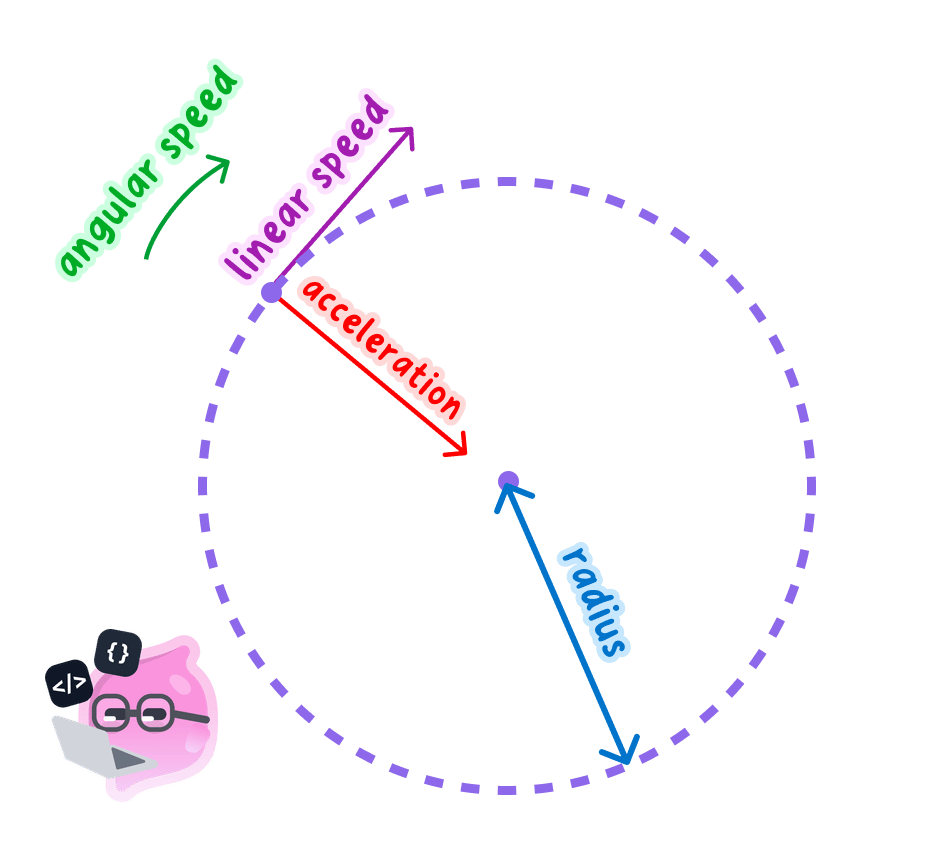
- A body moving in a circle travels along a tangent to the circle at every instant, so its direction of motion is different at every point of the path.
- Gravitational attraction supplies the centripetal force for a planet, a moon or a satellite, and it acts along the line joining the two bodies.
- That force therefore points towards the centre of the circle, while the velocity points along the tangent, so the two are always at right angles to each other.
Why the speed stays constant
- A force only changes the speed of a body when part of that force acts along the direction the body is already moving.
- In a circular orbit the gravitational pull is at right angles to the velocity, so it has no component along the direction of travel.
- Nothing speeds the body up and nothing slows it down, so the speed stays constant all the way round.
- What the force does instead is pull the body sideways out of the straight line it would otherwise follow, which continuously turns the direction of motion.
- Because the direction changes, the velocity changes even though the speed does not.
- A changing velocity is an acceleration, so a satellite in a steady circular orbit is accelerating towards the Earth at every moment while never getting any faster.
- Remove the gravitational force and the body would carry straight on along the tangent, which is what happens to a hammer thrower's hammer at the moment the wire is released.
Radius and orbital speed
Definition
Stable orbit
A stable orbit is one in which the orbital speed of a body matches its orbital radius, so the body keeps circling at the same distance instead of spiralling in or escaping.
- A stable orbit needs the gravitational pull at that distance to be exactly the centripetal force required to bend the path into a circle.
- Only one orbital speed satisfies that condition at any given radius, so the speed and the radius are locked together.
- Close to the central body the field is stronger, the inward pull is larger, and a greater speed is needed to hold the body on that tighter circle.
- Further out the field is weaker, so a smaller speed is enough to keep the body on that wider circle.
- If the orbital speed of a satellite increases and the orbit is to stay stable, the radius must decrease.
- If the orbital speed decreases and the orbit is to stay stable, the radius must increase.
- The same rule explains the Solar System, since Mercury is close in and races round at about 48 km/s48\ \text{km/s}48 km/s while Neptune is far out and crawls at about 5 km/s5\ \text{km/s}5 km/s.
- It also explains why a low satellite completes an orbit in about 909090 minutes while the far more distant Moon needs about 272727 days.
Example
Comparing two satellite orbits
- Satellite A orbits at a radius of 7.0×10⁶ m7.0 \times 10^{6}\ \text{m}7.0×10⁶ m and satellite B orbits the Earth at 4.2×10⁷ m4.2 \times 10^{7}\ \text{m}4.2×10⁷ m.
- Satellite A is much closer to the Earth, so the gravitational field strength at its orbit is much larger.
- A larger inward force is needed to hold it on its tighter circle, and that is only provided at a higher orbital speed.
- Satellite A therefore travels faster and completes each orbit in far less time than satellite B.
Example
Velocity change over half an orbit
- A satellite in a circular orbit travels at 7.5 km/s7.5\ \text{km/s}7.5 km/s due north as it crosses the equator.
- Half an orbit later it crosses the equator again, still at 7.5 km/s7.5\ \text{km/s}7.5 km/s but now travelling due south.
- The speed is unchanged because gravity never acted along the direction of motion.
- The velocity has reversed because the direction of motion has turned through 180∘180^{\circ}180∘, which is why the satellite counts as accelerating throughout.
Exam technique
Explaining constant speed in orbit
- Use the words speed and velocity precisely, because a question asking why one is constant while the other is not is testing exactly that distinction.
- Say that the gravitational force acts at right angles to the direction of motion, since that is the marking point that most answers miss.
- State that the force is directed towards the centre of the orbit, rather than writing only that gravity pulls the satellite down.
- For a stable orbit question, give the direction of both changes, so a faster orbit means a smaller radius and a slower orbit means a larger radius.
- Justify the change with the strength of the gravitational field at that distance instead of asserting the relationship on its own.
Common Mistake
- Do not say that a satellite in a circular orbit is not accelerating, because its direction is changing all the time.
- Do not treat speed and velocity as the same word in this topic, since the whole explanation depends on the difference between them.
- Do not draw the gravitational force along the direction of travel, because it points towards the centre of the orbit.
- Do not claim that a satellite further from the Earth must travel faster, because a wider orbit needs a smaller orbital speed.
Self review
- State the difference between speed and velocity.
- Explain why the gravitational force on a satellite changes its velocity but not its speed.
- State the direction of the resultant force on a body in a circular orbit.
- Explain how the radius of a stable orbit must change if the orbital speed increases.
- Explain why Mercury travels around the Sun faster than Neptune does.
