Question 22
HThe Figure shows apparatus used to investigate how the volume of a fixed mass of air changes with pressure.
A pump pushes oil into a glass tube. The oil compresses the air trapped at the top of the tube.
Figure
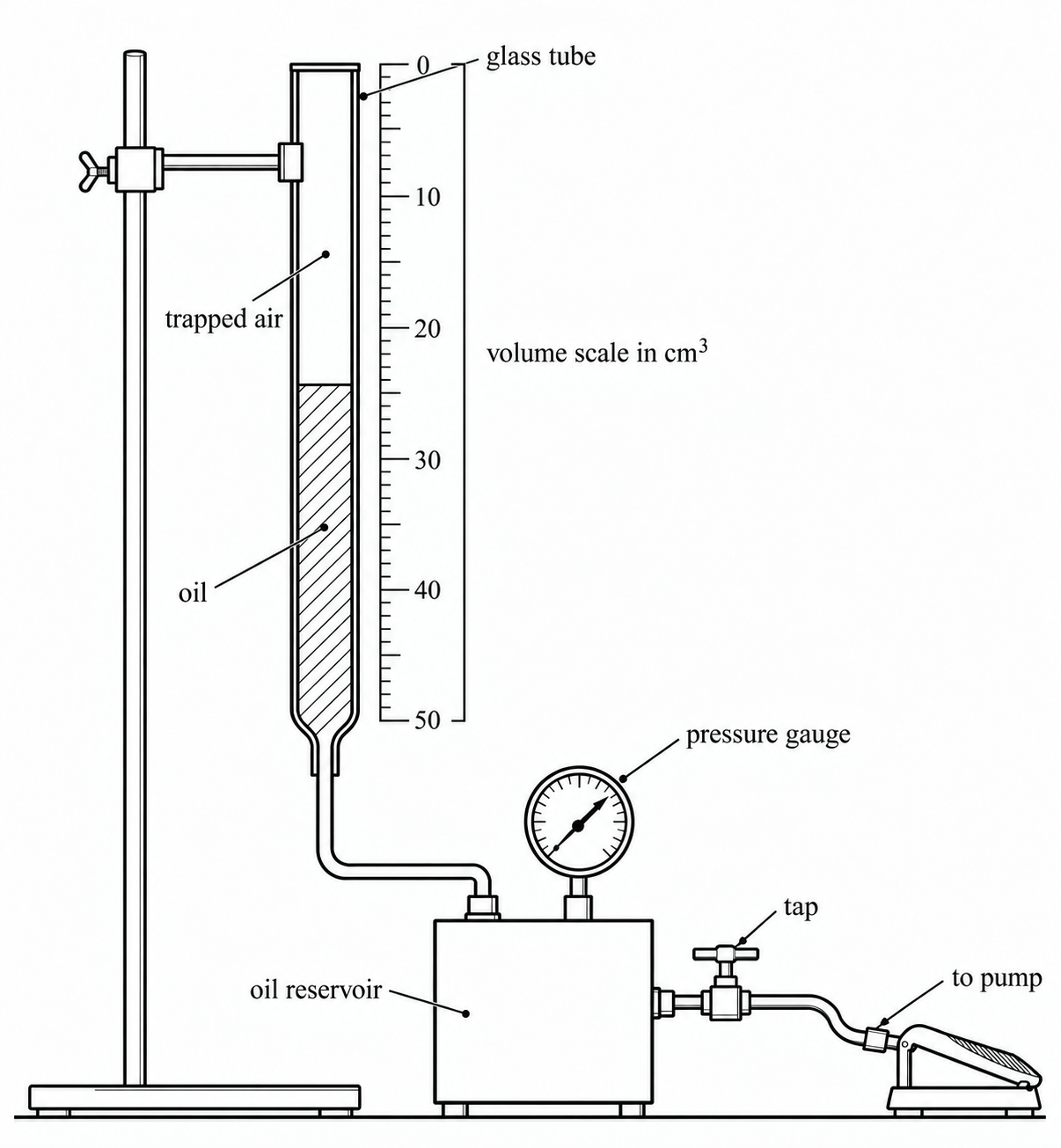
The Table shows the student's results.
Table
| Pressure in kPa\text{kPa}kPa | Volume of trapped air in cm3\text{cm}^{3}cm3 |
|---|---|
| 100 | 40.0 |
| 125 | 32.0 |
| 160 | 26.5 |
| 200 | 20.0 |
| 250 | 16.0 |
a.[2]
One of the results is anomalous.
Identify the anomalous result. Justify your answer with calculations.
b.[2]
Calculate the volume that the student should have recorded at a pressure of 160 kPa.
Use the equation
P1×V1=P2×V2P_1 \times V_1 = P_2 \times V_2P1×V1=P2×V2
c.[3]
The student took the anomalous reading immediately after using the pump.
Explain how this could cause the anomalous reading, and suggest how the student should change the method.
d.[1]
Explain why it is important that no air leaks out of the top of the tube.
14.3 Gas pressure and temperature Questions
108 exam-style questions on Edexcel GCSE Physics 14.3 Gas pressure and temperature, covering 14.3.1 Gas pressure and particle motion, 14.3.2 Temperature and pressure at constant volume, 14.3.3 Absolute zero and the kelvin scale, 14.3.4 Compressing and expanding gases, 14.3.5 Volume and pressure at constant temperature, and 14.3.6 Doing work on a gas. Each one has a worked solution and a mark scheme showing where the marks go.