Question 12
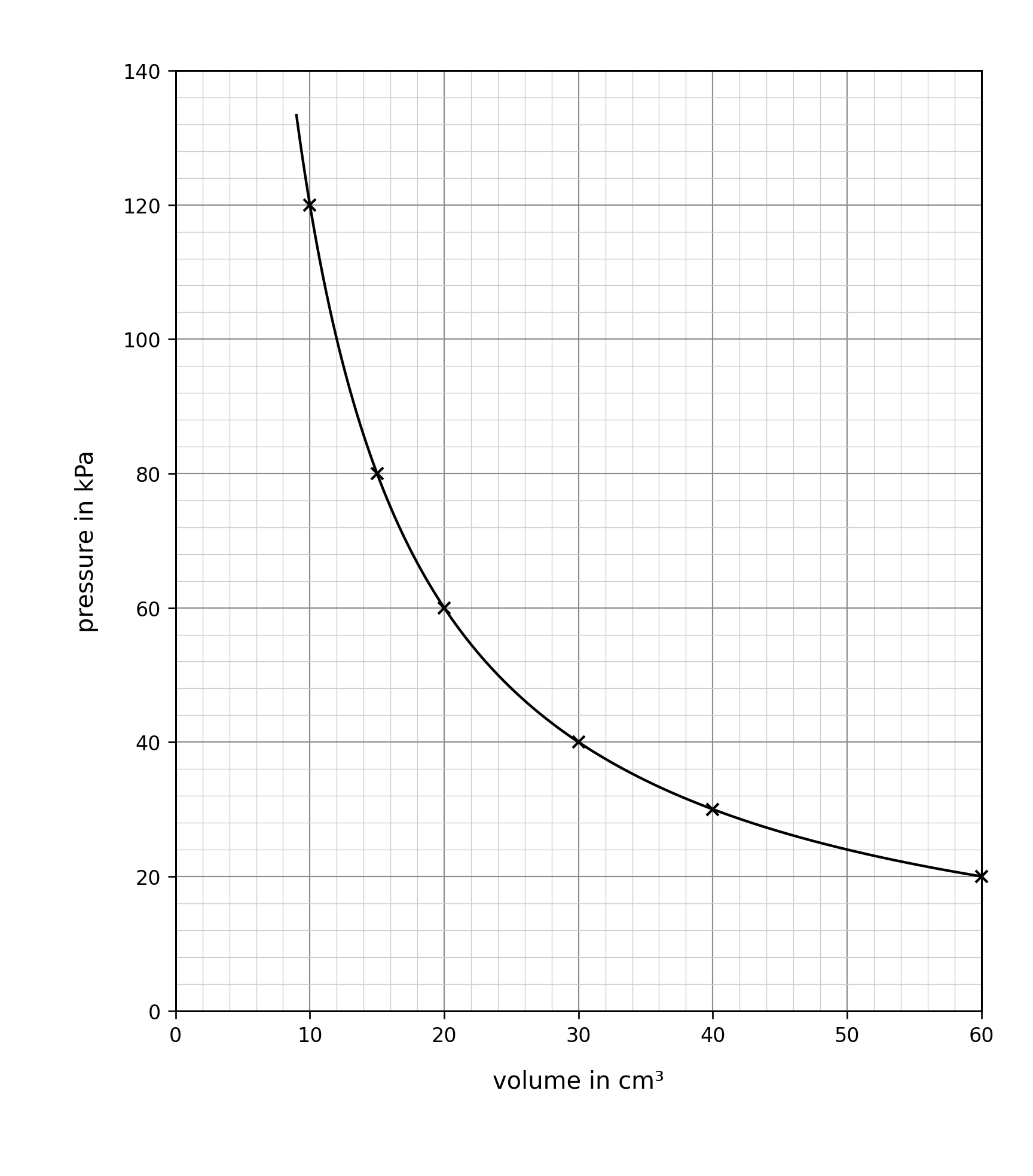
FThe Figure shows how the pressure of a fixed mass of gas changes when its volume changes. The temperature of the gas stays the same.
Figure
a.[1]
Use the Figure to give the pressure of the gas when the volume is 20 cm3.
b.[1]
Use the Figure to determine the volume of the gas when the pressure is 40 kPa.
c.[2]
Show that pressure×volume\text{pressure} \times \text{volume}pressure×volume has the same value at 20 cm3 and at 40 cm3.
d.[2]
Calculate the pressure of the gas when its volume is 80 cm3.
Use the equation
P1×V1=P2×V2P_1 \times V_1 = P_2 \times V_2P1×V1=P2×V2
e.[2]
A student says:
'When the volume of the gas doubles, the pressure of the gas also doubles.'
Explain whether the student is correct. Use the Figure in your answer.
14.3 Gas pressure and temperature Questions
108 exam-style questions on Edexcel GCSE Physics 14.3 Gas pressure and temperature, covering 14.3.1 Gas pressure and particle motion, 14.3.2 Temperature and pressure at constant volume, 14.3.3 Absolute zero and the kelvin scale, 14.3.4 Compressing and expanding gases, 14.3.5 Volume and pressure at constant temperature, and 14.3.6 Doing work on a gas. Each one has a worked solution and a mark scheme showing where the marks go.