Where gas pressure comes from
Definition
Gas pressure
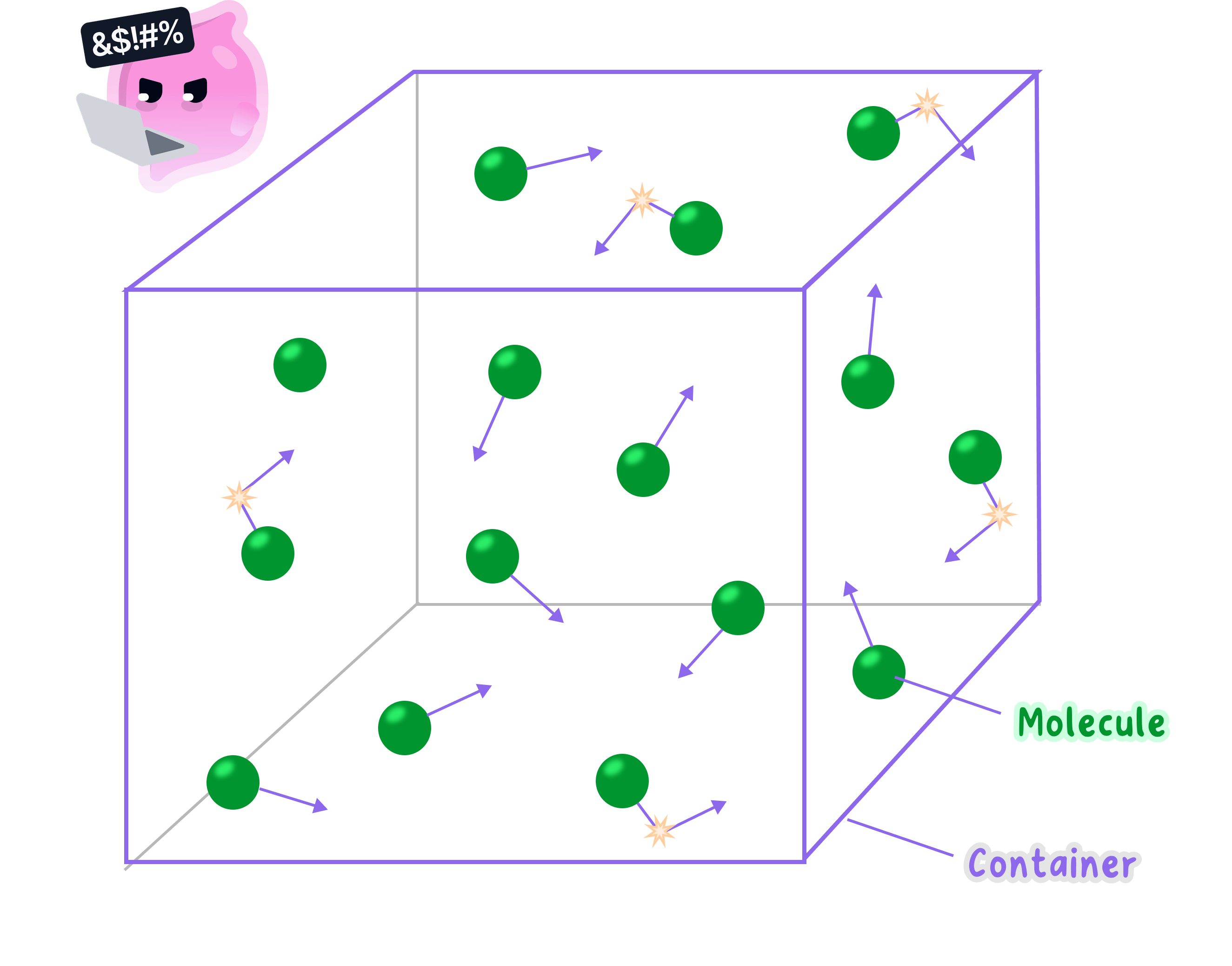
Gas pressure is the force per unit area that gas particles exert on a surface as a result of their collisions with it.
- The particles of a gas move rapidly and randomly in all directions, and they have a wide spread of speeds rather than all moving at one speed.
- Between collisions each particle travels in a straight line, because the forces between widely separated gas particles are very weak.
- When a particle reaches a wall it collides with it and rebounds, so the direction of its motion is reversed.
- Changing the direction of a moving particle requires a force from the wall, and the particle exerts an equal and opposite force back on the wall.
- One collision gives an extremely small force lasting an extremely short time, so a single particle produces no measurable effect.
- A gas contains an enormous number of particles, so an enormous number of collisions happen on every part of the wall every second.
- Those separate impacts add up to a steady total force on the wall rather than a series of noticeable jolts.
- The pressure of the gas is that total force spread over the area of the surface it acts on.
What the pressure depends on
- Two features of the collisions set the pressure: how often particles hit the wall, and how hard each one hits it.
- Faster particles hit the wall harder and rebound more forcefully, so each collision contributes more to the total force.
- Adding more particles to the same container increases the number of collisions each second, which is why a bicycle tyre becomes harder as it is pumped up.
- Removing particles has the opposite effect, so a gas at low pressure produces fewer collisions each second on the same area of wall.
- Because the motion is random, particles reach every part of the container, so the pressure acts on the whole inner surface and not only on the base.
- The pressure inside a small container of gas is effectively the same at every point in it, unlike the pressure in a liquid, which increases with depth.
- Atmospheric pressure at sea level is about 1.0×10⁵ Pa1.0\times10^{5}\ \text{Pa}1.0×10⁵ Pa, produced by air particles colliding with every exposed surface.
Pressure, force and area
- Pressure is defined by p=FAp=\dfrac{F}{A}p=AF, where ppp is the pressure, FFF is the force acting on the surface and AAA is the area of that surface.
- The units are pascals for pressure, newtons for force and square metres for area, and 1 Pa=1 N/m21\ \text{Pa}=1\ \text{N/m}^{2}1 Pa=1 N/m2.
- Rearranging gives F=p×AF=p\times AF=p×A, which is how the force on a piston, a window or a wall is worked out from the pressure.
- The same pressure produces a larger force on a larger area, so a wide door in a pressurised cabin experiences a very large total force.
- Convert areas into square metres before substituting, because 1 cm2=1×10⁻⁴ m21\ \text{cm}^{2}=1\times10^{-4}\ \text{m}^{2}1 cm2=1×10⁻⁴ m2.
Example
Force produced by a gas on a piston
- A gas at a pressure of 1.5×10⁵ Pa1.5\times10^{5}\ \text{Pa}1.5×10⁵ Pa acts on a piston of area 2.0×10⁻³ m22.0\times10^{-3}\ \text{m}^{2}2.0×10⁻³ m2.
- Rearranging p=FAp=\dfrac{F}{A}p=AF gives F=p×AF=p\times AF=p×A.
- Substituting gives F=1.5×105×2.0×10−3F=1.5\times10^{5}\times2.0\times10^{-3}F=1.5×105×2.0×10−3.
- The force on the piston is F=300 NF=300\ \text{N}F=300 N.
- That force is the combined effect of countless particle collisions with the piston every second.
Exam technique
Explaining gas pressure
- Build the answer as a chain: random motion, collisions with the wall, a force on the wall, then force divided by area.
- Use the word collisions explicitly, because an answer that only says the particles push on the wall misses the mechanism mark.
- Say that there are very many collisions each second, since the step from one tiny force to a steady pressure depends on that number.
- Mention both how often and how hard the particles hit when a question asks what the pressure depends on.
- Write p=FAp=\dfrac{F}{A}p=AF before substituting, and convert any area given in square centimetres into square metres.
Common Mistake
- Do not write that gas particles push on the walls all the time, because the force comes from separate collisions.
- Do not write that particles repel one another to create the pressure, because the forces between widely separated gas particles are negligible.
- Do not confuse force with pressure, because the same force spread over a larger area gives a smaller pressure.
- Do not say the gas pushes hardest on the bottom of the container, because the random motion sends particles to every wall equally.
Self review
- Describe how the particles of a gas move.
- Explain how the collisions of gas particles produce a force on a container wall.
- State the two features of the collisions that decide the pressure.
- State the equation that links pressure, force and area, with the unit of each quantity.
- Calculate the force produced by a pressure of 2.0×10⁵ Pa2.0\times10^{5}\ \text{Pa}2.0×10⁵ Pa on an area of 0.010 m20.010\ \text{m}^{2}0.010 m2.
- Explain why the pressure on a container wall is steady rather than jerky.
