9.1.1 Interactions and types of force
Forces come from interactions between objects
Force
A force is a push or a pull on an object that arises from an interaction with another object, measured in newtons.
- A force is a push or a pull that one object exerts on another, and it is measured in newtons, N\text{N}N.
- A force never appears on its own, because it is produced by an interaction, so every force has an object that exerts it and an object that experiences it.
- A force has both a size and a direction, so it is drawn as an arrow whose length shows the size and whose point shows the direction.
- Interactions fall into two groups: those that act by contact, where surfaces touch, and those that act at a distance, where the objects are separated by a gap.
- Naming the correct force is the first step in almost every forces question, because the mark is reserved for the precise name rather than for the word force on its own.
Non-contact forces act through fields
Non-contact force
A non-contact force is a force that acts between two objects that are not touching, through a gravitational, electrostatic or magnetic field.
Force field
A force field is a region in which an object experiences a non-contact force because of its mass, its charge or its magnetism.
- In a non-contact interaction the two objects are separated by a gap, and the force is carried across that gap by a field.
- Three non-contact interactions are needed at this level: gravitational, electrostatic and magnetic.
- A gravitational force acts between any two objects that have mass.
- A tennis ball falling from a window is inside the Earth's gravitational field, so the ball is pulled towards the centre of the Earth while the ball pulls the Earth upwards with a force of the same size.
- Gravitational forces are always attractive, and they become weaker as the two masses move further apart.
- An electrostatic force acts between objects that carry an electric charge.
- A polythene rod rubbed with a dry cloth gains electrons and becomes negatively charged, so it sits in its own electrostatic field and attracts small pieces of paper without touching them.
- Electrostatic forces can attract or repel, because like charges repel and unlike charges attract.
- A magnetic force acts between two magnets, or between a magnet and a magnetic material such as iron, steel, nickel or cobalt.
- A bar magnet held a few millimetres above a steel paperclip lifts it through the magnetic field in the gap, and the paperclip pulls the magnet downwards with a force of the same size.
- Magnetic forces can also attract or repel, because like poles repel and unlike poles attract.
- To describe any non-contact interaction, name the field, name the property that puts the object into that field, which is mass, charge or magnetism, and then give the direction of the force.
An object experiences a non-contact force because it sits inside another object's gravitational, electrostatic or magnetic field, so naming the field names the interaction.
Contact forces act where surfaces touch
Normal contact force
The normal contact force is the force that a surface exerts on an object touching it, acting at right angles to that surface.
Friction
Friction is a force that opposes the relative motion between two surfaces in contact.
- A contact force acts only while two surfaces are touching, and it disappears the instant they separate.
- The normal contact force is the push that a surface gives to an object resting on it, and the word normal means at 90∘90^\circ90∘ to that surface.
- A textbook lying on a desk is pulled down by its weight and pushed up by the normal contact force from the desk, so two arrows are drawn on the book pointing in opposite directions.
- On a slope, such as a ramp, the normal contact force is still perpendicular to the surface, so it is no longer vertical.
- Friction acts along the surfaces, in the direction that opposes sliding or the tendency to slide.
- Pushing a heavy box across a hall floor to the right produces a friction force on the box that acts to the left.
- Friction acts even when nothing is moving, so a box that will not budge has a friction force equal in size and opposite in direction to your push.
- Friction is useful when a tyre grips a wet road or a brake pad grips a disc, and unwanted when it heats a machine and wears its moving parts away.
- Pushes and pulls from a hand, a rope or a spring are also contact forces, because they stop the moment contact is lost.
- Do not write that a force can only exist when two objects touch, because gravitational, electrostatic and magnetic forces all act across a gap.
- Do not draw the normal contact force vertically when the surface is sloping, because it is always at right angles to the surface itself.
- Do not write that friction always acts backwards, because friction acts against sliding, and on the driving wheels of a car it acts forwards.
- Do not use the word gravity where a named force is wanted, because weight is the force and gravitational is the field.
Interactions produce pairs of forces
- Whenever two objects interact, each one exerts a force on the other, so forces are always produced in pairs.
- The two forces in a pair are equal in size, opposite in direction, of the same type, and they act on two different objects.
- When a swimmer pushes backwards on the wall of a pool, the wall pushes forwards on the swimmer with a force of the same size, and that forward force on the swimmer is what starts the swim.
- The two forces in a pair never cancel each other out, because they act on different objects, so only one of them is ever drawn on the object being studied.
- Balanced forces are a different idea, because those act on the same object and add to a resultant of zero.
- Each force in a pair is represented as a vector arrow drawn on the object it acts on, starting at that object and pointing along the direction of the force.
- Every arrow is labelled with the name of the force, and arrow lengths are kept in proportion so that a longer arrow means a larger force.
Forces between a magnet and a paperclip
- A bar magnet is held a short distance above a steel paperclip and the paperclip jumps up to it.
- The two objects are not touching, so the interaction is a non-contact interaction.
- The paperclip lies inside the magnetic field of the magnet, so it experiences a magnetic force directed towards the magnet.
- The paperclip becomes magnetised, produces its own magnetic field and exerts a magnetic force on the magnet.
- The force on the magnet is equal in size to the force on the paperclip and points towards the paperclip.
- On a diagram, one arrow is drawn on the paperclip pointing up towards the magnet, and an arrow of the same length is drawn on the magnet pointing down towards the paperclip.
Describing an interaction
- Decide first whether the objects are touching, because that single choice fixes whether the answer is about contact or about a field.
- For a non-contact force, name the field as gravitational, electrostatic or magnetic rather than writing that there is a force field.
- Use the full name of a contact force, so write normal contact force rather than surface force, and weight rather than gravity.
- Say which object each force acts on, because a separate mark is often reserved for the object rather than for the force.
- Draw force arrows starting on the object and keep their lengths in proportion whenever the question compares sizes.
- Name the three non-contact interactions and the field linked to each one.
- State what the word normal means in the term normal contact force.
- Explain why friction acts on a box that is being pushed but is not yet moving.
- State the four features shared by the two forces produced in any interaction.
- Explain the difference between a pair of forces from an interaction and balanced forces on one object.
9.1.2 Vector and scalar quantities
Scalar quantities have size only
Scalar quantity
A scalar quantity has magnitude but no specific direction, such as distance, speed, mass or energy.
- A scalar quantity is fully described by a magnitude, which means a number together with a unit.
- Nothing else is needed, so once you know a temperature is 18 ∘C18\ ^\circ\text{C}18 ∘C you know everything that quantity carries.
- Scalars used across the course include distance in m\text{m}m, speed in m/s\text{m/s}m/s, mass in kg\text{kg}kg, energy in J\text{J}J, time in s\text{s}s, temperature in ∘C^\circ\text{C}∘C, density in kg/m3\text{kg/m}^3kg/m3 and power in W\text{W}W.
- Scalars are combined by ordinary arithmetic, so walking 300 m300\ \text{m}300 m to the shop and 300 m300\ \text{m}300 m back gives a total distance of 600 m600\ \text{m}600 m.
Vector quantities have size and direction
Vector quantity
A vector quantity has both magnitude and a specific direction, such as displacement, velocity, acceleration or force.
- A vector quantity has a magnitude and a direction, and it is not fully described until both have been given.
- A force of 20 N20\ \text{N}20 N is an incomplete description, while a force of 20 N20\ \text{N}20 N to the right is the complete vector.
- Vectors used across the course include displacement in m\text{m}m, velocity in m/s\text{m/s}m/s, acceleration in m/s2\text{m/s}^2m/s2, force in N\text{N}N, weight in N\text{N}N and momentum in kg m/s\text{kg m/s}kg m/s.
- A vector is represented by an arrow, where the length is drawn to a scale to show the magnitude and the way the arrow points shows the direction.
- Changing only the direction changes the vector, so a car driving north at 15 m/s15\ \text{m/s}15 m/s and a car driving south at 15 m/s15\ \text{m/s}15 m/s have the same speed but different velocities.
- A direction can be given as a compass bearing, as left or right, as up or down, or as a positive or negative sign along a chosen line.
- A negative sign in front of a vector therefore carries physical meaning, because a velocity of −6 m/s-6\ \text{m/s}−6 m/s is a velocity of 6 m/s6\ \text{m/s}6 m/s in the opposite direction to the one chosen as positive.
Matched pairs of scalars and vectors
- Several quantities come in pairs, one scalar and one vector, sharing a unit but not a meaning.
- Distance is the total length of the path travelled, while displacement is the straight-line change in position together with its direction.
- A runner who completes one lap of a 400 m400\ \text{m}400 m track has travelled a distance of 400 m400\ \text{m}400 m but has a displacement of 0 m0\ \text{m}0 m, because the finish point is the start point.
- Speed is how fast an object is moving, while velocity is speed in a stated direction.
- A car driving round a roundabout at a steady 8 m/s8\ \text{m/s}8 m/s has a constant speed but a changing velocity, because its direction keeps changing.
- Mass is the quantity of matter in an object, measured in kg\text{kg}kg, and it does not change when the object is moved somewhere else.
- Weight is the gravitational force acting on that mass, measured in N\text{N}N, and it acts towards the centre of the planet or moon the object is near.
- A 60 kg60\ \text{kg}60 kg astronaut still has a mass of 60 kg60\ \text{kg}60 kg on the Moon, but weighs about one sixth as much there, because the Moon's gravitational field strength is smaller.
Distance and displacement on a walk
- A pupil walks 120 m120\ \text{m}120 m east from the school gate along a straight road, then turns and walks 50 m50\ \text{m}50 m back west along the same road.
- The distance travelled is the total length of the path, which is 120+50=170 m120 + 50 = 170\ \text{m}120+50=170 m.
- The displacement is the straight-line change in position, which is 120−50=70 m120 - 50 = 70\ \text{m}120−50=70 m.
- The distance is complete as it stands, because it is a scalar.
- The displacement is only complete once the direction is added, so the answer is 70 m70\ \text{m}70 m east.
- Do not write that a scalar has no size, because both scalars and vectors have a magnitude and only the direction separates them.
- Do not treat mass and weight as the same quantity, because mass is a scalar in kg\text{kg}kg and weight is a vector force in N\text{N}N.
- Do not say only that a vector has a direction, because the magnitude is half of the definition and half of the mark.
- Do not give a displacement or a velocity without a direction, since an answer with no direction is an incomplete vector.
Answering a difference question
- Give the property of both types of quantity in the same answer, because a difference mark needs the two halves side by side.
- Use the word magnitude rather than size where you can, since it is the wording the mark schemes use.
- Follow the definitions with one matched pair, such as speed and velocity or mass and weight, so the difference is shown in use.
- Listing examples on their own rarely scores, because the definition carries the mark and the example only illustrates it.
- State what a scalar quantity has and what a vector quantity has in addition.
- Give three scalar quantities and three vector quantities with their units.
- Explain why a runner who finishes one lap of a track has a displacement of zero.
- Explain why a car moving at a steady speed round a roundabout has a changing velocity.
- State which of mass and weight is measured in newtons and explain why.
9.1.3 Vector diagrams and free body diagrams
Adding forces with a scale vector diagram
Resultant force
Resultant force is the single force that has the same effect as all the forces acting on an object, after their sizes and directions have been taken into account.
- Because a force is a vector, two forces that do not act along the same line cannot be added as plain numbers.
- A scale vector diagram solves this by drawing each force as an arrow whose length is fixed by a stated scale, such as 1 cm=10 N1\ \text{cm} = 10\ \text{N}1 cm=10 N.
- The arrows are joined tip to tail, so the tail of the second arrow is placed at the tip of the first while each arrow keeps its own direction.
- The resultant is drawn from the tail of the first arrow to the tip of the last arrow, measured with a ruler and converted back into newtons using the scale.
- Its direction is measured with a protractor and quoted as an angle from a stated reference, such as 53∘53^\circ53∘ north of east.
- The full method runs as follows.
- Choose a scale that makes the longest arrow fill most of the space available, and write it on the diagram.
- Draw the first force arrow accurately, to scale and in the correct direction.
- Draw each remaining arrow starting at the tip of the arrow before it.
- Join the tail of the first arrow to the tip of the last arrow and label that line as the resultant.
- Measure its length in centimetres and multiply by the scale to get the force in newtons.
- Measure its angle and quote the answer as a magnitude with a unit and a direction.
- At this level the answer is expected from the scale drawing itself rather than from trigonometry, so the accuracy of the construction is what is being assessed.
Equilibrium and the closed vector diagram
Equilibrium
An object is in equilibrium when the resultant force acting on it is zero, so it stays at rest or keeps moving at a constant velocity.
- An object is in equilibrium when all the forces acting on it add to a resultant of zero.
- On a scale vector diagram that shows up as a closed shape, because the tip of the last arrow lands exactly on the tail of the first and there is no resultant arrow left to draw.
- Three forces in equilibrium therefore form a closed triangle when they are drawn tip to tail.
- Equilibrium does not mean that nothing is happening, because the object is either stationary or moving at a constant velocity, and both mean zero acceleration.
- A mass hanging still on a spring is in equilibrium, because the upward force from the stretched spring is equal in size and opposite in direction to the downward weight.
- Pull that mass further down and release it and the spring force is now larger than the weight, so there is an upward resultant force and the mass accelerates upwards.
- Push it above the equilibrium position and the weight is now larger than the spring force, so the resultant force acts downwards.
- The reasoning also runs backwards, so if a question states that an object is stationary or moving at a steady speed in a straight line, you may write down that the resultant force is zero and use it.
Resolving one force into two components
Resolving a force
Resolving a force means replacing one force with two component forces at right angles to each other that together have exactly the same effect.
- Resolving is the reverse of adding, because one force is replaced by two forces at right angles that together have exactly the same effect.
- The two replacement forces are the components, and they are usually chosen to be horizontal and vertical, or parallel and perpendicular to a slope.
- On a scale drawing, draw the original force to scale and then complete a rectangle that has this arrow as its diagonal.
- The two sides of that rectangle are the components, so measuring each side and converting with the same scale gives the size of each one.
- A sledge pulled by a rope held at an angle is the standard case, because the horizontal component drags the sledge forwards while the vertical component lifts part of its weight off the snow.
- Each component is always smaller than the original force, so a component that comes out larger than the force itself shows that the drawing is wrong.
Free body force diagrams
Free body force diagram
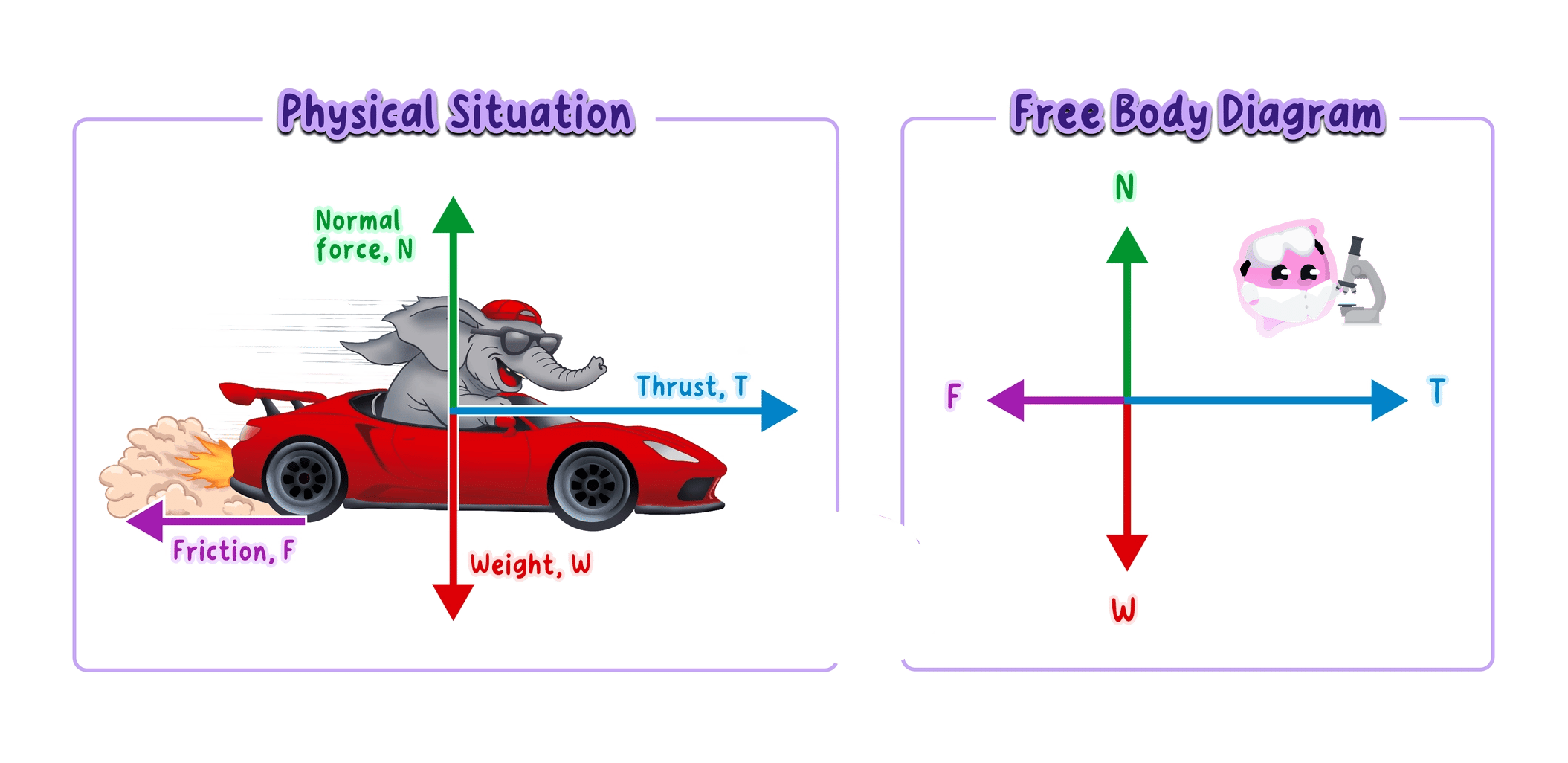
A free body force diagram is a diagram that shows only the forces acting on one chosen object, drawn as labelled arrows starting at that object.
- A free body force diagram strips a situation down to one object and shows every force acting on that object.
- The object is drawn as a simple box or a dot, and each force is drawn as an arrow starting on the object and pointing the way the force acts.
- Every arrow carries a label naming the force, and the lengths are drawn in proportion so the diagram shows at a glance whether the forces balance.
- Forces that the object exerts on other things are left out, because those forces act somewhere else.
- The forces most often needed are listed below.
- Weight, the gravitational force on the object, drawn vertically downwards from its centre of mass.
- Normal contact force, drawn at right angles to the surface the object rests on.
- Friction, drawn along the surface, opposing sliding.
- Tension, drawn along a rope, cable or spring, away from the object.
- Air resistance, or drag in a liquid, drawn opposite to the direction of motion through the fluid.
- Thrust, or the driving force, drawn in the direction in which an engine or motor pushes.
- Upthrust, drawn vertically upwards on an object floating or submerged in a fluid.
- A skydiver falling at a steady speed has just two arrows, weight downwards and air resistance upwards, and they are drawn the same length because the forces are balanced.
Forces on an isolated object or a system
- The motion of an object depends on the resultant force acting on it, not on any single force taken by itself.
- If the forces are unbalanced the resultant force is not zero, and the object accelerates in the direction of that resultant.
- If the forces are balanced the resultant force is zero, and this is the special case of equilibrium.
- A car on a level road has a forward driving force from the engine and backward resistive forces from friction and air resistance.
- While the driving force is larger than the total resistive force the car speeds up, and the difference between them is the resultant force.
- Air resistance grows as the car goes faster, so eventually the resistive forces match the driving force, the resultant becomes zero and the car settles at a steady top speed.
- A system of connected objects can be treated as one body, so a car towing a caravan can be drawn with a single weight, a single driving force and a single total resistive force.
- If the question asks for the force in the tow bar, the caravan has to be drawn on its own free body diagram, because the tension in the bar is then an external force acting on it.
Resultant of two forces at right angles
- A box on a smooth floor is pulled by a force of 30 N30\ \text{N}30 N due east and a force of 40 N40\ \text{N}40 N due north.
- A scale of 1 cm=10 N1\ \text{cm} = 10\ \text{N}1 cm=10 N makes the two arrows 3.0 cm3.0\ \text{cm}3.0 cm and 4.0 cm4.0\ \text{cm}4.0 cm long.
- The 3.0 cm3.0\ \text{cm}3.0 cm arrow is drawn pointing east, and the 4.0 cm4.0\ \text{cm}4.0 cm arrow is drawn pointing north from its tip.
- The resultant is drawn from the tail of the first arrow to the tip of the second and measures 5.0 cm5.0\ \text{cm}5.0 cm.
- Converting with the scale gives 5.0 cm×10 N/cm=50 N5.0\ \text{cm} \times 10\ \text{N/cm} = 50\ \text{N}5.0 cm×10 N/cm=50 N.
- Measuring the angle between the resultant and the eastward arrow gives 53∘53^\circ53∘, so the resultant is 50 N50\ \text{N}50 N at 53∘53^\circ53∘ north of east.
Resolving a rope force on a sledge
- A sledge is pulled by a rope with a force of 80 N80\ \text{N}80 N acting at 30∘30^\circ30∘ above the horizontal.
- Using a scale of 1 cm=20 N1\ \text{cm} = 20\ \text{N}1 cm=20 N, the rope force is drawn 4.0 cm4.0\ \text{cm}4.0 cm long at 30∘30^\circ30∘ to the horizontal.
- A rectangle is completed with this arrow as its diagonal, giving a horizontal side of 3.5 cm3.5\ \text{cm}3.5 cm and a vertical side of 2.0 cm2.0\ \text{cm}2.0 cm.
- The horizontal component is 3.5 cm×20 N/cm=70 N3.5\ \text{cm} \times 20\ \text{N/cm} = 70\ \text{N}3.5 cm×20 N/cm=70 N.
- The vertical component is 2.0 cm×20 N/cm=40 N2.0\ \text{cm} \times 20\ \text{N/cm} = 40\ \text{N}2.0 cm×20 N/cm=40 N.
- The horizontal component of 70 N70\ \text{N}70 N drags the sledge forwards, while the vertical component of 40 N40\ \text{N}40 N reduces the normal contact force from the snow.
- Do not write that an object moving at a constant speed in a straight line has a forward resultant force, because a constant velocity means the resultant force is zero.
- Do not confuse no resultant force with no forces, since a book resting on a desk has two forces acting on it and a resultant of zero.
- Do not draw on a free body diagram any force that the object exerts on something else, because only forces acting on the chosen object belong there.
- Do not add force sizes as plain numbers when the forces act at an angle to each other, because only forces along the same line can be added arithmetically.
Marks in a scale drawing question
- Write the scale on the paper, because the examiner needs it to check the length of every arrow you have drawn.
- Use a sharp pencil, a ruler and a protractor, since one millimetre of error on a 1 cm=10 N1\ \text{cm} = 10\ \text{N}1 cm=10 N diagram is already a 10 N10\ \text{N}10 N error.
- Quote the resultant as a magnitude and a direction, and state the reference the angle has been measured from.
- Label every arrow on a free body diagram with the name of the force, because an unlabelled arrow earns nothing.
- Where the question says the object is at rest or moving at a constant velocity, open the answer by stating that the resultant force is zero.
- Describe how two forces acting at an angle are added using a scale vector diagram.
- State what the shape of a vector diagram looks like when the forces are in equilibrium.
- Explain what resolving a force into components means and name the two directions usually chosen.
- State the rule about which forces may appear on a free body force diagram.
- Explain why a car reaches a steady top speed even though the engine keeps providing a driving force.
