Balance of gravity and pressure
Nuclear fusion
Nuclear fusion is the joining of small nuclei to create a larger nucleus, with a loss of mass that is accompanied by a release of energy.
Main sequence star
A main sequence star is a star in the long, stable stage of its life in which the outward pressure from hydrogen fusion balances the inward pull of gravity.
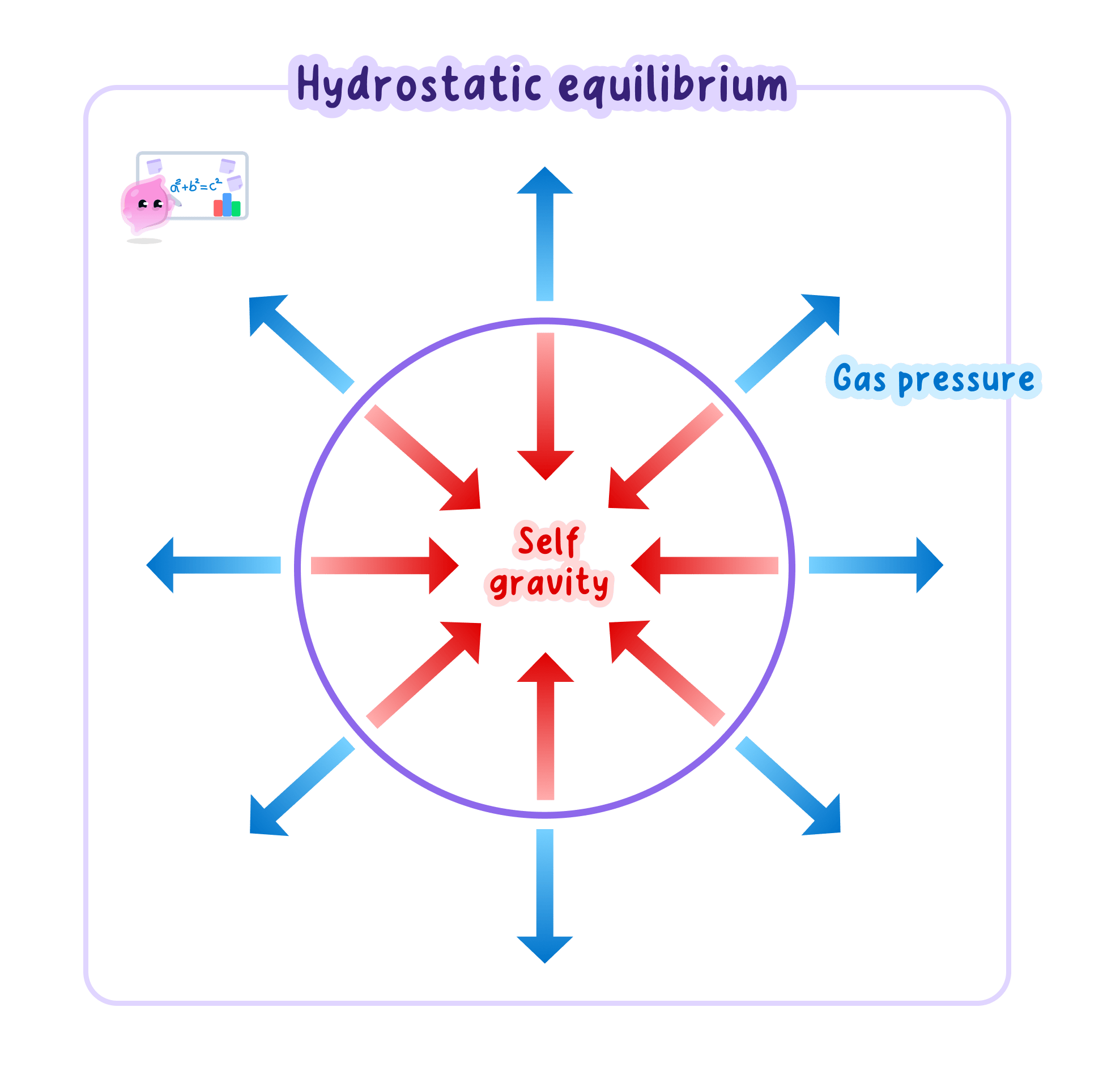
- Two opposing effects decide what a star does at every stage of its life, gravity pulling all of its material inwards and thermal expansion pushing it outwards.
- The outward push comes from the hot gas in the core, because nuclear fusion keeps the core at millions of degrees and hot gas exerts a very large pressure.
- When the two effects are balanced the star neither collapses nor swells, so its size stays steady for a very long time.
- When fusion slows the core cools, the outward push weakens, gravity wins and part of the star contracts.
- When fusion speeds up the core gets hotter, the outward push strengthens and the star expands.
- Every stage in the life of a star is one of these situations, so the whole life cycle can be read as the balance being made, held, lost and remade.
From nebula to main sequence
Nebula
A nebula is a cloud of dust and gas in space from which stars form.
Protostar
A protostar is the hot, dense ball of gas formed as a nebula collapses under gravity, before nuclear fusion begins in its core.
- A star begins as a nebula, a cold cloud of dust and hydrogen gas spread thinly through space.
- Gravity pulls the material of the cloud together, and the denser parts pull in more material still, so the collapse speeds up as it goes.
- As the material falls inwards its gravitational store is transferred to the thermal store of the gas, so the centre of the cloud gets steadily hotter.
- The hot dense ball at this stage is a protostar, which glows from that heating alone because no fusion has started yet.
- Once the core passes about 101010 million K\text{K}K the hydrogen nuclei move fast enough to fuse together into helium, and a star is born.
- Fusion releases energy, the core pressure rises, and the collapse stops when that outward push exactly balances gravity.
- The star is now a main sequence star, and it stays that way for as long as there is hydrogen in the core to fuse.
- This is by far the longest stage, lasting about 101010 billion years for a star the size of the Sun, which is currently about halfway through it.
The red giant stage
Red giant
A red giant is the much larger, cooler star that a star of similar mass to the Sun becomes once hydrogen fusion in its core stops.
- Eventually the hydrogen in the core is used up, fusion there slows and the outward push is no longer enough to hold gravity off.
- The core contracts under gravity, and that contraction raises its temperature high enough for helium nuclei to fuse into larger nuclei.
- The extra energy released heats the outer layers, and those layers expand enormously.
- Spreading the same energy over a far larger surface leaves that surface cooler, so the star glows red rather than yellow or white.
- The result is a red giant, a star with a small hot core and a huge cool outer envelope.
- When the Sun reaches this stage its surface will swell out past the orbit of the Earth, and the stage will last only a few hundred million years.
The white dwarf stage
White dwarf
A white dwarf is the small, hot, very dense core left behind when a red giant sheds its outer layers.
- Fusion in the core eventually stops for good, because the core is not massive enough to reach the temperature that heavier nuclei need.
- With no energy released there is nothing to hold the outer layers, and they drift gently away into space.
- Gravity pulls what is left of the core into a body roughly the size of the Earth, and this hot dense remnant is a white dwarf.
- A white dwarf shines only from the energy stored during its earlier life, so it slowly cools and fades over billions of years.
- The full order for a star of similar mass to the Sun is therefore nebula, main sequence star, red giant and white dwarf.
Following the balance through a life
- In the nebula there is no fusion and no outward push, so gravity acts alone and the cloud collapses.
- On the main sequence the push from the hot core exactly matches gravity, so the size holds steady for billions of years.
- When core hydrogen runs out the push drops below gravity, so the core is squeezed smaller and heats up.
- Helium fusion then raises the push above gravity in the outer layers, so those layers expand and the star becomes a red giant.
- Once fusion ends the push disappears for good, gravity wins completely and the core is crushed into a white dwarf.
How much a red giant swells
- A star like the Sun expands to roughly 100100100 times its main sequence radius when it becomes a red giant.
- Volume depends on the cube of the radius, so the volume increases by a factor of 1003=1×106100^{3} = 1 \times 10^{6}1003=1×10⁶.
- Almost none of the mass is lost during the expansion, and ρ=mV\rho = \dfrac{m}{V}ρ=Vm shows that the mean density falls by that same factor of a million.
- A red giant is therefore an extremely thin, spread out star despite being so large.
Describing a life cycle for marks
- Name each stage in the right order, since a describe question usually gives one mark for each correctly placed stage.
- Say what triggers each change as well as naming it, for example that core hydrogen running out is what ends the main sequence stage.
- Use the words gravity and outward pressure explicitly in any question about why a star changes size.
- State which force is winning at that moment, because saying the forces are unbalanced is not enough for the mark.
- Link a colour change to a surface temperature change, since red means a cooler surface than yellow or white.
- Do not write that a star runs out of fuel and instantly dies, because the core contracts and begins fusing helium first.
- Do not confuse the small hot core with the huge cool envelope of a red giant, since it is the outer layers that expand and cool.
- Do not say a white dwarf is still fusing, because it shines only from energy stored earlier.
- Do not describe nuclear fission in a star, since stars release energy by fusing small nuclei together.
- List the four stages in the life of a star of similar mass to the Sun, in order.
- Explain what keeps a main sequence star at a constant size.
- Describe how a nebula becomes hot enough for fusion to start.
- Explain why the surface of a red giant is cooler than the surface of a main sequence star.
- Describe what a white dwarf is and explain why it fades over time.
