Energy stores and transfers
Definition
Energy store
An energy store is a way in which energy is held in a system, such as a kinetic, gravitational, elastic, chemical, magnetic, electrostatic, nuclear or thermal store.
- Energy is transferred between stores. The four transfer pathways are mechanically, electrically, by heating and by radiation.
- A transfer diagram must identify the initial store, the pathway and the final store. It should also identify the object or system whose store changes.
- Energy is often dissipated during a transfer. Dissipated energy spreads into thermal stores of the surroundings and becomes less useful because it is harder to transfer for a chosen purpose.
Energy transfer diagrams
Definition
Sankey diagram
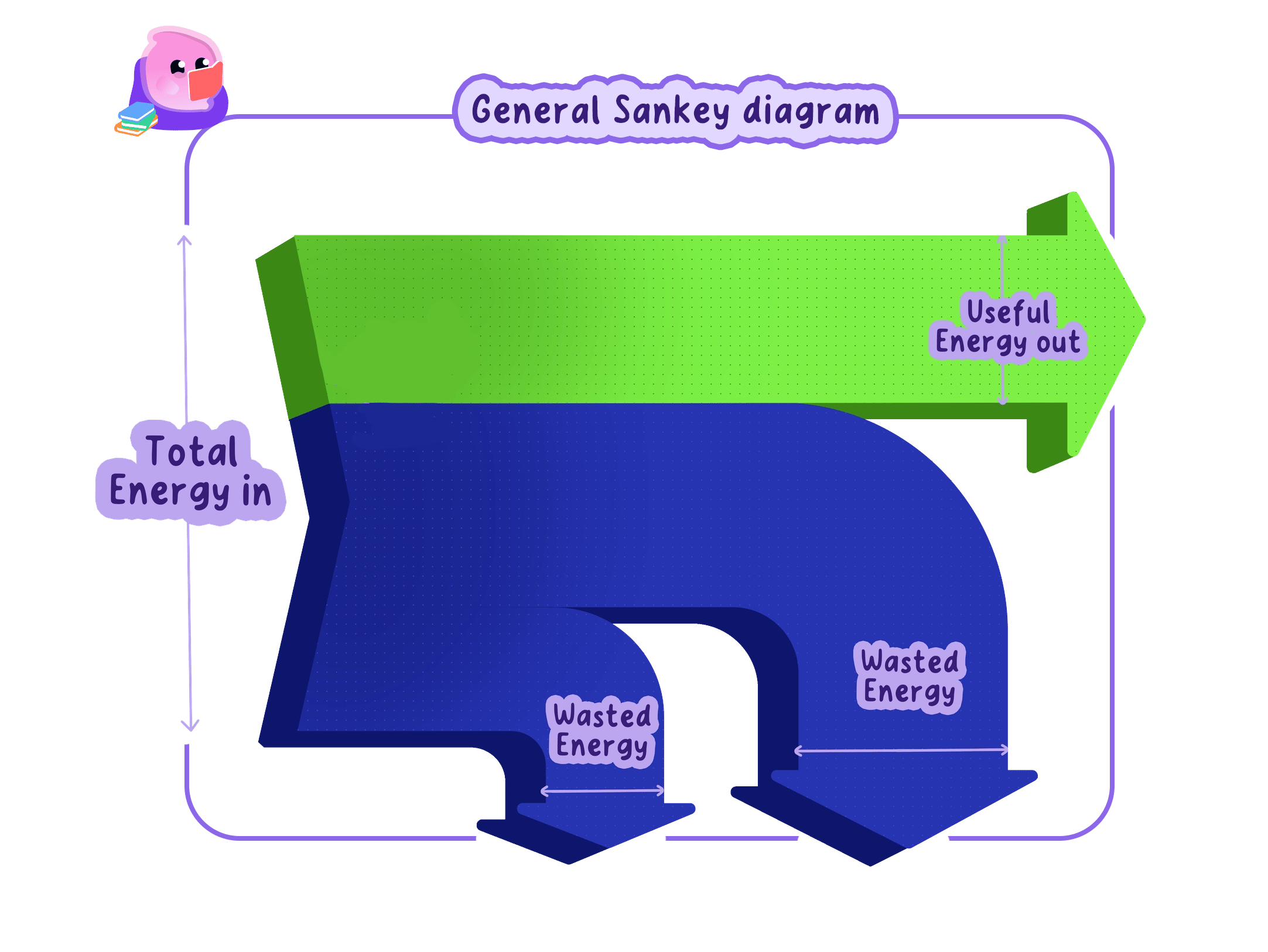
A Sankey diagram is an energy transfer diagram in which the width of each arrow is proportional to the amount of energy it represents.
- The input arrow represents the total energy supplied.
- Useful and dissipated output arrows split from the input. Their total width must equal the input width because energy is conserved.
- Calculate a missing transfer by subtraction. Einput=Euseful+EdissipatedE_{\mathrm{input}}=E_{\mathrm{useful}}+E_{\mathrm{dissipated}}Einput=Euseful+Edissipated.
- Labels must name energy stores or transfer pathways precisely. Avoid vague labels such as energy lost.
Conservation of energy
Definition
Conservation of energy
Conservation of energy means that energy cannot be created or destroyed, only transferred between stores.
Definition
Closed system
A closed system is a system across whose boundary no energy is transferred, so its total energy stays constant.
- The total energy of a closed system remains constant. Internal transfers can change individual stores, but there is no net change in the total.
- Energy does not disappear when a device is inefficient. The non-useful part is transferred to thermal stores of the device and surroundings.
Analysing system changes
- Object projected upwards: energy transfers mechanically from the kinetic store to the gravitational store, with some dissipated by air resistance.
- Object moving up a slope: the gravitational store increases, while friction transfers some energy to thermal stores.
- Moving object hitting an obstacle: energy leaves the kinetic store and is transferred into thermal and elastic stores, while sound waves carry energy away and work is done deforming the objects.
- Object accelerated by a constant force: work done by the force transfers energy into the kinetic store, while resistive forces may dissipate some energy.
- Vehicle slowing down: energy leaves the kinetic store and is transferred mainly to thermal stores of the brakes, tyres, road and surroundings.
- Water heated to boiling in a kettle: energy is transferred electrically from the supply to thermal stores of the heating element and water, with some transferred to the kettle and surroundings.
Example
Energy changes for a rising ball
- Situation: a 0.20 kg0.20\ \text{kg}0.20 kg ball is thrown upwards at 12 m s−112\ \text{m s}^{-1}12 m s−1 where g=10 N kg−1g=10\ \text{N kg}^{-1}g=10 N kg−1.
- Initial kinetic energy: Ek=12×0.20×122=14.4 JE_{\mathrm{k}}=\dfrac{1}{2}\times0.20\times12^{2}=14.4\ \text{J}Ek=21×0.20×122=14.4 J.
- Ignoring air resistance: conservation gives mgΔh=14.4 Jmg\Delta h=14.4\ \text{J}mgΔh=14.4 J.
- Maximum height gained: Δh=14.40.20×10=7.2 m\Delta h=\dfrac{14.4}{0.20\times10}=7.2\ \text{m}Δh=0.20×1014.4=7.2 m.
- With air resistance: some energy is dissipated to thermal stores, so the ball reaches a height below 7.2 m7.2\ \text{m}7.2 m.
Exam technique
Writing energy explanations
- Name the store and the object. Write the kinetic store of the car, not simply kinetic energy.
- Name the transfer pathway. State mechanically, electrically, by heating or by radiation.
- Account for dissipated energy. State which thermal stores increase rather than saying energy is lost.
- For a closed system, state that the total energy remains constant.
Common Mistake
- Do not write that energy is used up or destroyed.
- Do not call heat an energy store. Heating is a transfer pathway, while a thermal store belongs to an object or system.
- Do not label every unwanted output as heat. Name the thermal store that gains energy and the transfer pathway where required.
Self review
- What are the four energy transfer pathways?
- What does the width of a Sankey arrow represent?
- What does conservation of energy mean?
- Why is the total energy of a closed system constant?
- Describe the energy changes when a vehicle slows down.
